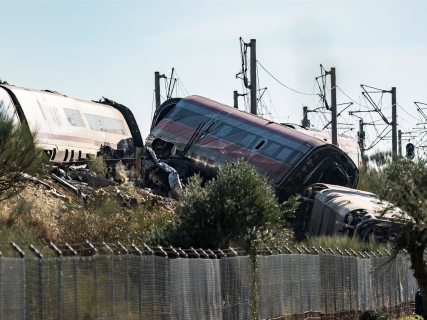

The black box of the Iryo train that had an accident in Urda (Toledo) records that its driver tried to contact the Atocha control center on three or four occasions without obtaining an initial response, according to information published this Sunday by El Mundo. The records make it possible to reconstruct part of the minutes prior to the collision with a Renfe AVE train, which caused 69 fatalities.
The information released places the first attempts at communication after the convoy suffered a total loss of transmission of the LZB signaling system. The incident occurred at 8:30:53, according to the chronology collected by the newspaper.
The LZB system failure and the first attempts at communication
After detecting the problem, the train driver reduced speed to 80 kilometers per hour and began running with the secondary ASFA/BSL system. During that interval, she would have tried to inform the Atocha Regulation and Control Center (CRC) of the incident on several occasions, without receiving a response.
The train ended up stopping at 8:38 in front of signal E242, at the entrance to the Urda station. It was then that the driver managed to establish communication with the control center.
According to the sequence published, at 8:41 Atocha informed the Iryo Operations Control Center of the fall of the LZB central that affected the convoy. Subsequently, the driver received instructions to try to restore operation of the safety system.
Two restart attempts before the impact
The disclosed records also state that the driver attempted to restart the equipment on two occasions, without managing to get the system to pass the functional tests.
At 8:43, Adif notified the Iryo operations center by email of the breakdown of the Urda central. According to the information published, at that time signal E242 was cleared, although the train continued to be stopped.
At 8:50, the driver reported that the convoy still had not passed the LZB system tests. The operations center then requested assistance from the Maintenance department.
Three minutes later, at 8:53:12, the Renfe AVE collided with the rear part of the Iryo, which remained immobilized. According to the data collected by El Mundo, the force of the impact displaced the convoy to reach 47 kilometers per hour in just three seconds. The train took another nine seconds to stop completely.
What is known and what remains to be clarified
The information about attempts at communication provides new details for the reconstruction of the accident, but it does not allow, by itself, the causes of the collision to be established or possible responsibilities to be determined.
The sequence of alerts, the instructions transmitted from the control center, and the management of the incident must be analyzed together with the rest of the technical records and the conclusions of the investigation. The existence of attempts at communication without an initial response, as the journalistic information records, does not equate to a conclusion about the functioning of the control system or the actions of those responsible.