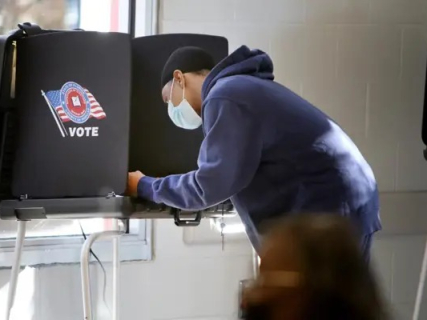
Are they underestimating the Republican vote in the polls? The question mark that could alter election night in the United States

The lower participation of certain Republican voters in polls has complicated election estimates since 2016. Pew Research Center warns that the problem exists, although it does not show that it will be repeated with the same intensity in these elections.

Add DEMÓCRATA to Google

Ask FREN

Published

Last updated

3 minutes

Most read

Elecciones 29N · Encuestas

La media de las encuestas

Media a 3 de noviembre de 2026 · 17 institutos

  • PP30,4 %
  • PSOE27,4 %
  • Vox19,2 %
  • Frente Amplio6,5 %
  • ERC2,4 %
  • Podemos2,4 %
010203040ene 2024jul 2024ene 2025jul 2025ene 2026jul 2026

Media del último estudio de cada instituto en 30 días y su evolución semanal desde el 23J. Partidos con al menos un 2 %.

Todas las encuestas

Elecciones generales del 29 de noviembre · Demócrata

WhatsApp Image 2026 11 03 at 23.36.05

Polling stations are once again facing one of the great uncertainties of American politics this Tuesday: are they correctly managing to measure electoral support for the Republican Party or is there a portion of its voters that is not sufficiently reflected in the surveys?

The question takes on special importance in midterm elections, where small differences within a small group of districts can determine which party controls the House of Representatives and the Senate.

The problem is not new. Since Donald Trump’s first presidential victory, in 2016, American polling firms have had difficulties in capturing certain segments of the Republican electorate.

However, methodological studies also warn that not all polling errors respond to the same causes, nor can they be automatically extrapolated from one election to another.

Why some Republican voters participate less in polls

A report published by Pew Research Center on September 16 of last year explains that there is growing evidence that Republicans have shown a slightly lower tendency than Democrats to participate in certain polls, especially during presidential elections.

This difference can lead to what specialists call partisan nonresponse bias.

The phenomenon appears when the people who agree to answer a survey have political preferences different from those who refuse to participate and the statistical adjustments fail to fully compensate for that difference.

In that case, the sample may reflect a distribution of votes that does not match that of the electorate as a whole.

Pew links this problem to some of the difficulties that polls experienced in estimating support for Trump and other Republican candidates in 2016, 2020 and 2024.

The problem does not affect all elections in the same way

Researchers also introduce an important distinction: measurement errors associated with the Republican electorate were less severe in the 2018 and 2022 midterm elections than in some presidential elections.

This means that there is no rule according to which polls must necessarily underestimate Republicans in any given election.

Moreover, territorial differences are fundamental. The participation of rural, urban, and suburban voters can change from one election to another, as can the composition of the electorate that ultimately goes to the polls.

The hypothesis that many rural Republicans refuse to respond because they are angry with pollsters seems plausible as a partial explanation for some behaviors, but it cannot be taken as proven for the 2026 elections without specific studies that identify that motivation.

Polls are finding it increasingly difficult to get responses

Pew Research Center warns that one of the main problems of U.S. polling is the decline in participation rates.

In the center’s own telephone surveys, the proportion of people who responded fell from 36% in 1997 to single-digit percentages in the most recent years of the series studied.

The 2022 telephone poll by The New York Times and Siena, cited by Pew, achieved a response rate of 0.4%.

This does not mean that a poll with few responses is necessarily incorrect. Its accuracy also depends on how the sample is selected, the information available about the participants, and the statistical adjustments applied.

However, the more difficult it becomes to contact voters, the greater the risk that those who agree to participate do not adequately reflect the overall population.

How pollsters try to correct the problem

To reduce these errors, numerous institutes incorporate weights based on political characteristics, such as party identification or recall of voting in previous elections.

These techniques seek to correct imbalances between the survey participants and the estimated composition of the electorate.

However, they do not completely eliminate uncertainty either. If the actual participation of certain groups changes or if people who do not respond have different behaviors from those who do, deviations can persist.

Therefore, national estimates should be interpreted together with territorial data, especially in elections where each district of the House of Representatives and each state with Senate seats votes independently.

The response will come with the scrutiny

The first hours of the count will make it possible to compare the previous estimates with the actual results, although it will be necessary to wait until enough votes have been counted before drawing conclusions.

A difference between polls and results would also not automatically prove the existence of a hidden Republican vote. It could be due to changes in turnout, estimation errors, last-minute shifts, or peculiarities of the electoral system.

The big question tonight is not only which party gets more votes, but to what extent the polls have managed to correctly identify those who ultimately went to the polls.

More key points, information and questions with FREN

AI-GENERATED CONTENT

What steps does a survey follow to be considered statistically representative in the United States?

For a survey to be considered statistically representative in the United States, it is not enough to “ask many people”: it must follow a series of technical steps that ensure the results can be confidently extrapolated to the target population (for example, adults residing in the U.S.). The principles are general, but the U.S. ecosystem has some particularities (weight of telephony, ethnic diversity, political polarization, etc.) that condition the design.

1. Precisely define the target population

The first step is to clearly specify whom you want to represent. It is not the same as:

  • “Adults residing in the United States aged 18 or older.”
  • “U.S. citizens of voting age.”
  • “Likely voters in the presidential elections.”

This definition conditions everything: the sampling frame, the mode of contact, stratification quotas, and subsequent weighting. For example, electoral surveys usually restrict to registered citizens and sometimes to those who meet certain “likely voter” criteria.

2. Build an appropriate sampling frame

The sampling frame is the list or system from which people are selected. In the United States, the following are mainly used:

  • Telephone lists (landlines and mobiles) with random digit dialing (RDD) or based on commercial records.
  • Probabilistic online panels, where households are randomly selected (by mail or phone) and then invited to participate online.
  • Registered voter lists for specifically electoral studies.

To be representative, the frame coverage must be very high: if it systematically excludes certain groups (for example, households without internet connection or young people who only use mobile phones), a coverage bias is introduced.

3. Random selection and sample design

The heart of representativeness is that all people in the population have a known and non-zero probability of being selected. To achieve this, the following are used:

  • Simple random sampling: individuals are chosen at random within the frame (technically easy but inefficient if diversity is to be ensured).
  • Stratified sampling: the population is divided into strata (for example, region, race/ethnicity, educational level) and a random sample is drawn in each, often over-representing small groups to analyze them.
  • Cluster sampling: large units (counties, postal code areas) are selected first and then households or individuals within them, useful in face-to-face or mixed surveys.

In the U.S., it is common to combine stratification (to ensure racial/ethnic minorities or rural areas) with random selection within each stratum.

4. Sample size and margin of error

A key requirement is that the sample has a sufficient size so that the sampling error is reasonable. To estimate national proportions, many public surveys work with around 1,000 interviews, which gives an approximate margin of error of ±3 percentage points for proportions near 50%, provided the design is close to simple random sampling.

However, complex designs (stratification, clusters, overrepresentations) increase the design effect, so the margin of error is adjusted and both data are usually published: effective sample size and estimated margin.

5. Minimize and measure nonresponse

Another crucial step is managing nonresponse (people who do not answer or hang up). Very low response rates can bias results if respondents are systematically different. To mitigate this, institutes:

  • Make multiple contact attempts at different times and days.
  • Use incentives in online or mail surveys.
  • Apply adjustment and weighting techniques afterward.

6. Weighting and adjustment to the real population

Once data are collected, the sample composition is compared with known population parameters (for example, from the census or the American Community Survey) on variables such as:

  • Age and sex.
  • Race/ethnicity (whites, African Americans, Hispanics, Asians, etc.).
  • Educational level.
  • Region and area type (urban, suburban, rural).

If any group is overrepresented or underrepresented, weights are assigned so that the weighted distribution matches the population reality. In electoral surveys, weights are also often adjusted based on declared voting behavior in previous elections or voter registration.

7. Quality control and transparency

Finally, for a survey to be accepted as representative, methodological transparency is required: description of the universe, mode of collection (phone, online, mixed), sampling frame, design, response rates, weighting variables, and margin of error. Professional organizations in the U.S. (such as AAPOR) recommend detailed disclosure standards so other researchers can evaluate the quality and real representativeness of the study.

What are the competencies and functions of the President of the United States in electoral matters?

The President of the United States plays a very relevant role in political life and, by extension, in the electoral context, but his formal competencies in strictly electoral matters are quite limited due to the U.S. constitutional design, which distributes power among the states, Congress, and the independent electoral administration itself.

First, the U.S. Constitution does not grant the president direct organization of elections. The main authority over holding elections (both federal and state/local) lies with the states. States set rules on voter registration, voting methods (in-person, mail, early), district design, and polling place administration. The president cannot, by himself, change these rules or suspend federal elections.

However, the president does influence the electoral framework in several ways:

  • Signing and vetoing federal electoral laws: Congress has the power to regulate certain aspects of federal elections (for example, rules on campaign finance, protection of voting rights, minimum standards for voter registration). Any law passed by Congress must be signed by the president to take effect, or it can be vetoed, forcing Congress to gather a supermajority to override the veto. This gives the president indirect influence over electoral legislation.
  • Appointment of federal judges and Supreme Court justices: The president nominates federal judges and Supreme Court justices, with Senate confirmation. Although these judges are independent, their decisions can be decisive in electoral disputes, interpretation of voting rights laws, campaign finance, or districting (gerrymandering). Thus, in the medium and long term, the presidency influences the “referee” of the electoral system.
  • Leadership of the Department of Justice: The president appoints the Attorney General and senior officials of the Department of Justice (DOJ). Through its Civil Rights Division, the DOJ can investigate discrimination in voting access, file lawsuits against states or counties for practices violating federal voting rights laws (such as the Voting Rights Act), and oversee some procedures. Although the DOJ must act with legal criteria and some autonomy, the president’s political orientation influences the priority given to such cases.

Regarding the concrete management of elections, the president does not administer censuses, does not decide the date of presidential elections (set by federal law: the first Tuesday after the first Monday in November of presidential even-numbered years), nor controls vote counting. Nor does he certify state results: that function belongs to each state’s authorities. The counting of electoral votes (the Electoral College) and its formal certification is done in Congress, in a joint session of the House of Representatives and the Senate, presided over by the vice president in his capacity as president of the Senate.

Where he does have a specific role is in the appointment of the Election Assistance Commission (EAC), an independent federal agency that provides technical support to states: issuing recommendations, distributing funds to improve electoral technology, and collecting data. Commissioners are appointed by the president with Senate confirmation. However, the EAC does not administer elections nor issue binding general rules; its power is more of assistance and technical standardization.

Another important aspect is the president’s role as candidate and party leader. Institutionally, the president can greatly influence the electoral climate through:

  • Public discourse and legitimacy of the process: His statements about election fairness or fraud affect citizen confidence in the system. Although he has no direct authority to annul or validate results, his position can pressure state legislators, governors, and electoral authorities.
  • Use of federal resources: The White House and federal agencies are subject to strict rules (such as the Hatch Act) that limit the use of public resources for partisan purposes. The president must respect these limits, although in practice the line between institutional activity and campaign activity can be blurred.
  • National emergencies: In emergencies (for example, natural disasters or security crises), the president can declare states of emergency or mobilize federal resources that indirectly affect the conduct of elections (ensuring security, facilitating logistics). But even in these cases, the decision to postpone or modify federal elections would mainly rest with Congress and the states, not on a unilateral presidential decree.

In summary, the President of the United States is not the electoral authority nor the organizer of elections. His formal competencies focus on:

  • Intervening in electoral legislation through signing or vetoing.
  • Shaping the judiciary that resolves electoral disputes.
  • Leading a Department of Justice capable of enforcing voting rights laws.
  • Appointing officials of federal agencies providing technical electoral support.

His most decisive power in electoral matters is therefore indirect and structural: he influences the rules of the game and those who interpret them, but does not control the day-to-day electoral machinery, which remains in the hands of the states and independent authorities.

What differences are there between the electoral competencies of the President of the United States and those of the Prime Minister of Spain? How do the federal courts and the U.S. Supreme Court intervene in presidential electoral disputes? What exact role does the Electoral College have in the presidential election and how does it relate to the popular vote?

What legal requirements exist in the United States for the publication and regulation of electoral surveys?

In the United States, the regulation of electoral surveys is quite lax compared to many European countries. The logic of freedom of expression protected by the First Amendment predominates, so there is no specific federal law that regulates in detail how surveys must be published nor are “poll blackouts” imposed before elections. However, there is a framework of rules that indirectly affect their financing, dissemination, and presentation to the public.

1. Absence of a specific federal law on surveys

At the federal level, there is no:

  • General limits on the publication of surveys in the days prior to elections.
  • General legal obligation to publish technical details or methodology (sample size, margin of error, etc.).
  • Mandatory registration of polling companies to publish surveys.

These matters are strongly covered by the First Amendment, which protects both the media and private pollsters from content restrictions, except in very specific cases (fraud, defamation, misleading advertising, etc.).

2. Requirements linked to political financing (FEC)

Where there is regulation is in how surveys are paid for and used within campaigns:

  • The Federal Election Commission (FEC) requires that expenses on surveys contracted by campaigns or political action committees (PACs and Super PACs) be accounted for and declared as “campaign expenditures”.
  • If survey results are used in campaign ads (spots, mailings, online ads), those ads must comply with “disclaimer” rules: indicating who finances them and whether they are authorized by a candidate or committee.
  • When internal surveys are shared with third parties as in-kind support, they may be considered in-kind contributions and must be declared as coordinated contributions or expenses.

These obligations do not regulate the technical content of the survey but do regulate transparency about who pays for it and how it integrates into the electoral strategy.

3. State and local rules

The United States is highly decentralized, and some states have passed rules that partially affect surveys:

  • “Electioneering communications” laws: in certain states, if a communication citing surveys clearly identifies candidates and is disseminated near an election, it may be subject to registration obligations, financing limits, or notices similar to campaign ads.
  • Regulation of “push polls”: some states (for example, New Hampshire or Maine) have rules against surveys that, under the guise of polling, actually seek to influence through biased questions. They usually require identifying the sponsor or prohibit deceptive practices.
  • Telephony and consumer protection: under state and federal laws (including the Telephone Consumer Protection Act, TCPA), the use of robocalls or automated calls for surveys without prior consent is restricted, especially to mobiles.

These rules vary greatly from state to state: they do not configure a homogeneous national standard on how a survey must be published, but they do condition the way responses are collected and results are used in political communications.

4. Professional self-regulation and best practice standards

In the absence of strong regulation, sector self-regulation plays a central role:

  • Organizations such as AAPOR (American Association for Public Opinion Research) and other professional associations have developed codes of conduct recommending disclosure of technical details, sampling method, field dates, response rate, and weighting method.
  • Many major media outlets (New York Times, Washington Post, TV networks) only publish surveys that meet certain minimum methodological standards of transparency and rigor.
  • These codes are not legally binding but function as a reputational mechanism: those who do not comply may lose public credibility and access to major media.

5. Online surveys, personal data, and privacy

There is no general federal data protection law like the European GDPR, but there are partial frameworks affecting surveys:

  • The Federal Trade Commission (FTC) can act against data collection practices that are “unfair or deceptive”, for example, if anonymity is promised but identifiable data are reused.
  • Some surveys are conducted using online panels or data from digital platforms, subject to those platforms’ terms of use and sectoral laws (minors, health, financial information, etc.).
  • Several states (California, Colorado, Virginia, among others) have passed privacy laws granting rights of information, access, or deletion of personal data, which may apply to certain identifiable types of surveys.

6. Overall balance

In summary, the U.S. framework is characterized by:

  • High protection of freedom of expression and therefore few direct restrictions on publishing surveys.
  • Regulation focused on campaign financing and transparency, rather than polling methodology.
  • A patchwork of state rules on calls, “push polls,” and electoral communications.
  • A strong role for self-regulation and professional standards to ensure quality and transparency.

For a detailed analysis of a specific case (type of survey, state, dissemination medium), it is necessary to review both applicable federal regulations and the specific state legislation where the survey is conducted or targeted.

Play

Test your knowledge with FREN!

How much do you know about this topic? Answer the following 3 questions.

What is one of the main problems facing American surveys according to Pew Research Center?

Question 1 of 3

In what type of elections was the measurement error associated with the Republican electorate lower, according to the news?

Question 2 of 3

What technique do polling institutes apply to reduce errors derived from the composition of survey participants?

Question 3 of 3