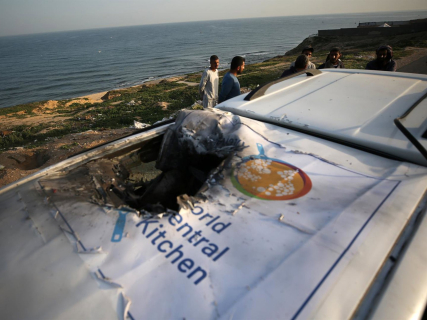

The Australian Foreign Minister, Penny Wong, has called for consultations with the Israeli ambassador to Australia, Hillel Newman, after Israeli authorities decided not to impose criminal responsibilities for the death of Australian aid worker Zomi Frankcom in an Israeli Army bombing of a vehicle in Deir al Balá, in which six other workers from the NGO World Central Kitchen (WCK) also died.
"I have met with Ambassador Hillel Newman, the ambassador of Israel to Australia, and I made it clear that Australia's position is that Israel's decision is far from the accountability we expect," Wong stated at a press conference following the meeting, which was reported by the state broadcaster ABC.
The head of Australian diplomacy has described the absence of charges against the military involved as "especially insulting and painful," and has questioned why, if the initial impacts were considered a "catastrophic error," more attacks were carried out against the convoy.
"We still have not received a satisfactory explanation of why the attack occurred in a humanitarian fire control zone, after the high command ordered the brigade commander not to attack the convoy," she added, considering the dismissal of two officers and the reprimand of three others after the death of seven people due to their actions as clearly insufficient accountability.
In this regard, she emphasized that "democracies seek and accept higher standards" and that "the Australian government will continue to pressure Israel to achieve justice for Zomi, her family, and her colleagues."
Although Wong has rejected expelling the Israeli ambassador, arguing that doing so "would hinder dialogue and defending Australia's interests," she admitted that the diplomatic relationship between the two countries is going through a "difficult moment."
"We have an Australian humanitarian worker who died not in the first attack, but in the context of three distinct attacks against a humanitarian convoy," the minister emphasized.
The Foreign Minister has indicated that the Australian government will consult with Frankcom's family on the next steps to take and has insisted that, "at a minimum, they deserve an apology" from the Israeli authorities.
Israel refuses to apologize for fear of "legal consequences"
This possibility has been dismissed by the Israeli ambassador, who, despite conveying his condolences to the relatives of the aid worker, has maintained that a formal apology could lead to "legal consequences."
"I would like to tell you, without beating around the bush, that we share your pain and deeply regret the circumstances that led to this death. Any innocent life is a tragedy," he stated in remarks to the media at the end of his meeting with Australian Foreign Minister Hillel Newman.
In his appearance, also reported by ABC, he defended the validity of the decision made by the Israeli authorities, arguing that the conclusions of a two-year investigation should not be called into question for "not fitting anyone's political agenda."
"It must be understood that not in all cases of death or fatalities is there criminal responsibility," he asserted.
The diplomat added that the attack on the humanitarian convoy "was a mistake in retrospect, but the court's conclusions indicate that there was no criminal intent and, therefore, there was no criminal responsibility."
The internal investigation of the Israel Defense Forces (IDF) acknowledges that a series of serious failures led the soldiers to mistakenly think that a fighter from the Islamic Resistance Movement (Hamas) was traveling with the convoy. However, it maintains that WCK did not communicate to the Army the presence of armed security personnel in the caravan and that it deviated from the previously agreed and coordinated route with the military commanders.
On this basis, the report concluded that the decisions made by the commanders did not raise reasonable suspicions of criminal conduct.