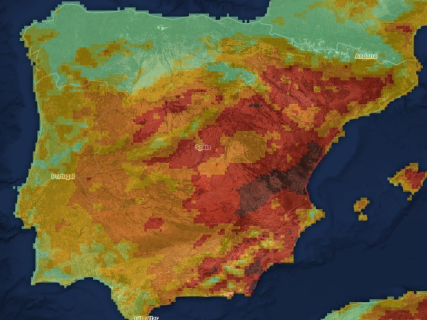
Map of fires in Spain today, August 20: Las Hurdes maintains the main emergency while Salamanca contains the advance of the fire

The fire in Pinofranqueado remains the most concerning focus of the day, while the slight entry of the flames in Salamanca is under control and other recent fires are evolving favorably.

5 minutes

mapa incendios 20 agosto

mapa incendios 20 agosto

Add DEMÓCRATA to Google

Ask FREN

Published

Last updated

5 minutes

Most read

The wildfire map of this Thursday places in Las Hurdes, in the province of Cáceres, the main active focus of the day. The fire declared in Pinofranqueado has several hamlets evacuated and a large extinction device, although the situation has improved at the border with Castilla y León.

The fire slightly entered the province of Salamanca, but the Junta de Castilla y León has confirmed that this situation is controlled and that there is no active flame in its territory. The map also includes other recent focuses that maintain surveillance work, such as Aldea del Fresno, in Madrid, and the reproduction detected in the perimeter of the fire in La Vall d’Uixó, in Castellón.

Official map of active fires from Copernicus

The European Forest Fire Information System, EFFIS, offers a public viewer to locate fires, heat points, and burned areas in Spain and the rest of Europe.

The map allows observing the perimeters detected by satellite, but the appearance of a heat point does not necessarily mean that there is an active wildfire. To know the official status of each emergency, the autonomous services of 112 and extinction must also be consulted.

Las Hurdes concentrates the main emergency of the map

The fire in Pinofranqueado, in the Cáceres region of Las Hurdes, continues to be the most important focus in Spain this August 20. The fire has activated level 2 of the INFOCAEX Plan and has forced the evacuation of several hamlets while a large device works to contain its evolution.

The complicated orography conditions the extinction work in the sectors that remain active. In the area, means from the Junta de Extremadura, state resources, and personnel from the Military Emergency Unit are still deployed, with the priority placed on protecting the population and consolidating the areas where the fire has been contained.

Salamanca keeps the arrival of the fire controlled

The fire has limitedly crossed into the province of Salamanca, but the latest report from the Junta de Castilla y León confirmed that there is no flame in Castilian and Leonese territory. The means of the INFOCAL operation remain at the provincial border to prevent any new advance.

Moreover, the north wind pushes the fire towards already burned areas, a circumstance that complicates its spread towards Salamanca. The province remains under surveillance, but it should not be considered a new active front with flames within the emergency.

Aldea del Fresno evolves favorably in Madrid

The forest fire declared in Aldea del Fresno, in the Sierra Oeste of Madrid, has left behind the most complicated situation after initially forcing preventive measures to be adopted in the area.

The improvement allowed for the lifting of confinements and the reduction of restrictions for the population. Teams are now maintaining surveillance and finishing work on the perimeter to prevent possible reproductions and complete the stabilization of the fire.

La Vall d’Uixó monitors a reproduction within the perimeter

Firefighters had to intervene again in Castellón after detecting a reproduction of the fire in La Vall d’Uixó in an area of vegetation that had not burned within the perimeter of the original fire.

The rapid action allowed for the containment of the new focus, although the episode requires maintaining vigilance. A controlled fire can register reproductions as long as it has not been declared extinguished, especially when temperature and dryness conditions remain favorable for spread.

Ponteareas reduces the emergency after the fire stabilizes

The fire in the parish of Nogueira, in Ponteareas, shows a favorable evolution after the difficulties recorded during the first hours due to the wind and the appearance of secondary foci.

The fire has stabilized and teams continue to work on the affected surface to consolidate the perimeter. With this evolution, the Galician fire loses weight among the main foci of the day, while Las Hurdes concentrates most of the attention on the national map.

To know the specific situation of a municipality, these sources should be used:

  • EFFIS-Copernicus: satellite location, perimeters, and heat points.
  • Civil Protection: emergencies and state deployment.
  • DGT: closed or affected roads.
  • AEMET: daily fire risk level.
  • Autonomous services of 112: official status of each fire, evacuations, and confinements.

Search engine: check the fire risk today in your municipality

Enter the name of your municipality in the search engine to know the level of forest fire risk forecasted today according to AEMET. The search engine is updated daily and shows the situation in more than 8,000 Spanish municipalities through the Forest Fire Danger Index (IPIF).

↔ Slide the table sideways to check all the days.

Slide the table sideways to check all the days.

The system classifies the risk into six levels:

  1. Very low.
  2. Low.
  3. Moderate.
  4. High.
  5. Very high.
  6. Extreme.

Each municipality appears classified according to the predominant level expected for that day.

How the fire risk map works

The search engine uses the information published daily by the State Meteorological Agency through its *Forest Fire Danger Index (IPIF).

This system combines different meteorological variables that directly influence the possibility of a forest fire starting and spreading, among them:

  • Temperature.
  • Relative humidity.
  • Wind speed and direction.
  • Accumulated precipitation.
  • State of vegetation.

With all that data, AEMET prepares a forecast map that allows estimating the level of danger existing at each point of the national territory.

What each risk level means

The index used by AEMET divides the fire risk into six categories:

  • Very low* and low indicate that the weather conditions are not favorable for the start of a large fire.
  • The moderate level advises taking extreme caution, especially in activities that may generate sparks or flames.
  • When the risk becomes high, very high, or extreme, the chances of a fire starting and spreading rapidly increase considerably, especially if episodes of intense wind or very high temperatures coincide.

More key points, information and questions with FREN

AI-GENERATED CONTENT

What steps must the Junta de Extremadura follow to request the declaration of a catastrophic zone after a forest fire?

The declaration of a "zone severely affected by a civil protection emergency" (formerly catastrophic zone) is made by the Government of Spain, but the Junta de Extremadura must initiate and justify the request. After a forest fire, its key task is to demonstrate the extent of the damage, coordinate the affected municipalities, and formally articulate the request to the State. From there, the central Government evaluates the file and, if appropriate, approves the declaration by agreement of the Council of Ministers.

1. General legal basis

The figure of "zone severely affected by a civil protection emergency" is framed within the state civil protection regulations. This regulation:

  • Allows the Government of Spain to declare the affected area when a catastrophe (such as a large forest fire) clearly exceeds the ordinary response capacity of the Autonomous Community and municipalities.
  • Facilitates the implementation of exceptional aid and measures for individuals, companies, public administrations, and affected economic sectors.

2. Steps corresponding to the Junta de Extremadura

a) Activation and management of the emergency
  • Activate the regional civil protection plan against forest fires when the magnitude requires it (for example, moving to emergency phases above the ordinary operational level).
  • Coordinate the resources of its own (INFOEX or other regional devices), municipal, and state (UME, State resources) if requested.
  • Collect data on damages and actions from the beginning, as they will later form part of the file.
b) Information gathering and damage assessment

Once the fire is stabilized or extinguished, the Junta must structure the information:

  • Civil protection and environmental technical reports, describing:
    • Burned area and type of forest mass.
    • Residual risks (erosion, flood risk, impact on fauna, etc.).
    • Actions taken during the emergency and resources mobilized.
  • Municipal reports from the affected municipalities:
    • Damage to homes, municipal infrastructure, livestock or agricultural operations, local businesses.
    • Social impact (evacuations, water use restrictions, loss of supplies, etc.).
  • Aggregate economic assessment:
    • Estimation of public material damages (roads, water intakes, facilities, public forests).
    • Estimation of private damages (homes, companies, agricultural and forestry operations).
    • Calculation of intervention and initial recovery costs.
c) Formal initiation of the file in the Junta
  • Normally, the initiative corresponds to the department responsible for civil protection or environment, which prepares a justificatory report.
  • This report is submitted to the Government Council of the Junta de Extremadura, which adopts a formal agreement to request the declaration from the Government of Spain.
  • The Government Council agreement must:
    • Define the affected geographic area (municipal terms, regions, or specific zones).
    • Include or annex the technical and economic reports and assessments.
    • Justify that the magnitude of the damage exceeds the ordinary autonomous and local response capacity.
d) Submission of the request to the State
  • The Junta sends the agreement and the complete file to the competent state ministry (usually the one responsible for civil protection or interior, depending on the current organization).
  • It may also maintain political and technical contacts with that ministry to complete data and align specific measures (aid to the agricultural sector, hydrological-forestry restoration, etc.).

3. Steps corresponding to the State

  • The receiving ministry analyzes the documentation, may request clarifications or extensions, and coordinates with other affected ministries (Finance, Agriculture, Transport, etc.).
  • If it considers the severity and general interest proven, it submits a proposal for agreement to the Council of Ministers declaring the severely affected zone.
  • The Council of Ministers, if applicable, adopts the agreement, which is published in the Official State Gazette and specifies:
    • Territorial scope of the declaration.
    • Types of aid and applicable measures.

4. Legal effects of the declaration

Once the zone is declared severely affected:

  • Lines of aid and subsidies are opened for:
    • Individuals (main residence, belongings, personal damages).
    • Local corporations (repair of infrastructure and public services).
    • Companies and affected agricultural or forestry operations.
  • Tax and labor benefits may be approved (deferrals, partial exemptions, measures on social contributions).
  • Extraordinary environmental restoration and infrastructure actions are foreseen, financed or co-financed by the General State Administration.
  • The Junta and municipalities take on managing and channeling aid requests according to the bases established by the State.

In summary, the Junta de Extremadura must: manage the emergency, thoroughly document and assess the damages, approve a formal request agreement in its Government Council, and submit a solid file to the competent ministry. From there, the decision and activation of the special aid regime depend on the Government of Spain.

Can you detail what specific types of economic aid are usually activated when a zone is declared severely affected after a fire? What role do the Extremaduran municipalities have in preparing the request for a severely affected zone and in the subsequent management of aid? Could you help me draft a Government Council agreement of the Junta de Extremadura to request this declaration after a specific fire?

What powers does the president of the Junta de Castilla y León have in managing emergencies caused by forest fires?

The president of the Junta de Castilla y León is not the "operational chief" of forest fires, but he is the highest political and government authority in the Community and, therefore, the apex of the regional civil protection system when a fire becomes a major emergency. His powers are understood based on the Statute of Autonomy, the regional citizen protection law, and the state Law 17/2015 of the National Civil Protection System.

1. General framework: Statute of Autonomy

Organic Law 14/2007, reforming the Statute of Autonomy of Castilla y León, defines the president as:

  • Supreme representative of the Community and ordinary representative of the State within it.
  • President of the Junta, who directs and coordinates the action of the regional Government and sets the agenda and deliberations of the Government Council.
  • Holder of the power to sign the decrees and agreements of the Junta and order their publication in the Official Gazette of Castilla y León.

This means that, although the technical management of fires is assigned to ministries and specialized services, the president:

  • Sets the general political line in civil protection and emergencies.
  • Coordinates the involved ministers (environment, interior, agriculture, etc.) in crisis situations.
  • Endorses and signs the agreements and regulatory provisions that shape the forest fire fighting system.

2. Civil protection and forest fire plans

The Law 4/2007, on Citizen Protection of Castilla y León, configures the regional citizen protection system and assigns the Community Administration the responsibility for civil protection services within its scope. Although the consulted excerpts do not detail article by article the president's role, it is clear that:

  • The Junta de Castilla y León is responsible for planning and executing policies of prevention, risk control, and emergency response.
  • The emergency response plans (including the Civil Protection Plan for Emergencies due to Forest Fires in Castilla y León – INFOCAL, approved by Decree 274/1999 and cited in Decree-law 2/2023) are integrated into this system.

At the state level, the Law 17/2015, of July 9, on the National Civil Protection System establishes that:

  • Forest fires are addressed through special civil protection plans (regional and, if applicable, state) specific to this risk.
  • The regional and special territorial plans are approved by the competent Administration of the Autonomous Community.
  • The emergency coordination bodies of the Autonomous Communities are essential parts of the system and can act as operational coordination centers.

3. Specific powers of the president in forest fires

Based on these laws, the powers of the president of the Junta de Castilla y León in managing emergencies caused by forest fires can be summarized as follows:

  • Political direction of the emergency: sets the general orientation of the response, decides the prioritization of resources at a high level, and politically coordinates all involved ministries through the Government Council.
  • Approval and support of regulatory and planning instruments: as president of the Junta, he promotes, approves, and signs the decrees and agreements that:
    • Regulate the prevention and extinction operation of forest fires.
    • Modify the Forest Law of Castilla y León or develop INFOCAL (for example, Decree-law 2/2023, on urgent measures on prevention and extinction of forest fires, which adapts the regional system to state requirements).
  • High-level inter-administrative coordination: as the ordinary representative of the State in the Community, the president is the main political interlocutor:
    • With the General State Administration (particularly the Ministry of the Interior and the Government Delegation) to request additional support from state resources, including the Military Emergency Unit.
    • With other neighboring autonomous communities when the fire has a supra-territorial dimension.
  • Action in emergencies of national interest: if a fire is declared a national interest emergency, Law 17/2015 provides that direction passes to the Minister of the Interior. In this scenario:
    • The president maintains political direction over regional resources and their integration into the state device.
    • Acts as the main interlocutor and political responsible of the Community before the State and the citizens of Castilla y León.
  • Promotion of post-fire recovery: although sectoral management falls to the competent ministries (environment, agriculture, housing, etc.), the president:
    • Coordinates and directs the overall package of environmental, economic, and social restoration measures.
    • Can promote government agreements and regional regulations to articulate aid and actions in affected areas.

In short, the president of the Junta exercises a political and strategic leadership and coordination function of the response to forest fires as civil protection emergencies, while the technical and operational management is articulated through INFOCAL, specialized services, and the Community's emergency coordination bodies, integrated into the National Civil Protection System.

What laws regulate the management and prevention of forest fires in Spain?

The management and prevention of forest fires in Spain is supported by a basic block of state regulations that set the "common ground" for the entire country and leave a wide margin for development to the autonomous communities, which are mainly responsible for the daily management of the forest and extinction devices.

Law 43/2003, on Forests, and its evolution

The central axis is Law 43/2003, of November 21, on Forests (text in the Official State Gazette), mainly amended by Law 10/2006 and Law 21/2015. It is basic state legislation on forests and environment, and regulates:

  • Forest planning: Spanish Forest Strategy, Spanish Forest Plan, and forest resource management plans.
  • Management and uses of forests, requiring management instruments.
  • Forest fire prevention: preventive planning, infrastructures, use limitations, and obligations of owners and users.
  • Sanctioning regime on matters covered by the law, including fire-related infractions.
  • Participation and information: citizen access to forest information and awareness campaigns.

The law is basic: it sets principles, minimum obligations, and common criteria (e.g., planning, coordination, basis of the sanctioning regime), while the autonomous communities develop:

  • Their own prevention and defense plans against forest fires.
  • Detailed regulation of fire uses, agricultural burns, safety strips, etc.
  • The specific organization of extinction services and classification of infractions and sanctions within the basic framework.

Royal Decree-law 15/2022, on urgent measures

Royal Decree-law 15/2022, of August 1, on urgent measures regarding forest fires (text in the Official State Gazette), strengthens this framework in a climate change context. It amends several articles of the Forest Law (e.g., arts. 9, 46, 48, and introduces arts. 48 bis and 50 bis) to:

  • Harden and specify the preventive obligations of administrations and landowners.
  • Reinforce inter-administrative coordination, including the action of the Forest Fire Fighting Committee (CLIF).
  • Connect fire management with new national strategic guidelines agreed with the autonomous communities.

Here too, the State sets a minimum standard, leaving operational details to the communities (risk calendars, resource allocation, device organization, etc.).

Civil protection and emergency planning

Law 17/2015, on the National Civil Protection System

Law 17/2015, of July 9, on the National Civil Protection System (text in the Official State Gazette) sets the general civil protection framework, within which forest fire emergencies are framed. It regulates:

  • The National Civil Protection System, its coordination bodies, and distribution of powers.
  • Emergency planning (basic, special, and territorial plans, including forest fire risk).
  • Mobilization of state resources (such as the UME) to support communities.
  • A specific sanctioning regime in civil protection matters.

It is also a basic law: communities approve their territorial and special civil protection plans, framed within this framework and coordinated through state bodies.

Basic directive and State Plan for forest fires

Specific planning for fire risk is detailed in:

  • Royal Decree 893/2013, of November 15, which approves the Basic Directive for Civil Protection Planning of Emergency due to Forest Fires (text in the Official State Gazette). Although this regulation has been partially repealed by Royal Decree 524/2023, its provision foresees that the Directive continues to apply until the new planning instrument is approved. It establishes minimum requirements for plans:
    • State, regional, and local plans against forest fires.
    • Foundations, structure, organization, and operational and response criteria.
    • Mechanisms of coordination between administrations and with other emergency services.
  • The Resolution of October 31, 2014, which publishes the State Civil Protection Plan for Emergencies due to Forest Fires (text in the Official State Gazette), develops the Directive at the state level and:
    • Defines the organization and procedures of state resources.
    • Regulates how support is provided to regional plans when required or when there is national interest.

Other complementary regulations

There are also specific state regulations, such as Order PCM/641/2021, of June 21 (text in the Official State Gazette), which sets compensation for accidents of people collaborating in extinction work, or various orders and royal decrees on training and professional qualifications in emergencies and civil protection.

On this common basis, each autonomous community approves its own forest law, its prevention and extinction plans, and its specific sanctioning regulations, always respecting these state minimums in forests, environment, and civil protection.

Play

Test your knowledge with FREN!

How much do you know about this topic? Answer the following 3 questions.

What is the main active fire focus in Spain according to the information from August 20?

Question 1 of 3

Which locality remains confined due to the Pinofranqueado fire?

Question 2 of 3

How many levels of fire risk does the AEMET index use?

Question 3 of 3

Hola, soy Fren. ¿Cómo te ayudo?