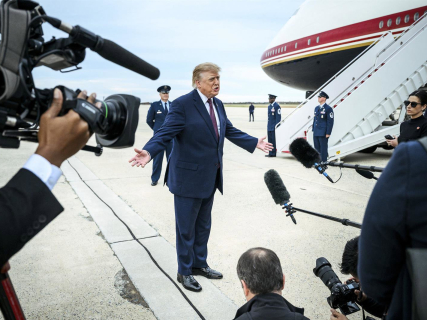

Donald Trump has not committed to unconditionally accepting the results of next Tuesday's November 3 legislative elections. The President of the United States assured last October 27 that he would respect the result of the midterms as long as he considered that they had been conducted honestly, statements that have reopened the debate over what would happen if the Republicans lost control of Congress and the leader publicly questioned the Democrats' victory.
"I will, if they are honest elections", Trump replied to the journalists who asked him if he would accept the results regardless of the winner. The statement, reported by The Washington Post and confirmed by the transcript of his appearance, came when millions of Americans had already begun to vote early or by mail. His stance recalls the one maintained after the 2020 presidential election, when he refused to recognize his defeat against Joe Biden and promoted accusations of electoral fraud that did not manage to alter the official result.
However, one thing is for Trump to question an election politically and quite another for him to be able to annul it through a presidential decision. The U.S. constitutional system distributes electoral powers among the states, the courts, and Congress, without granting the president the authority to accept or reject the results of legislative elections. The distinction takes on special importance in an election in which the 435 seats in the House of Representatives and 35 seats in the Senate will be renewed, and in which a few constituencies could determine which party controls Washington during the last two years of his term.
Can Trump refuse to accept a Democratic victory?
He can publicly reject the results, denounce alleged irregularities, or support legal actions, but his refusal has no automatic effect on the distribution of seats. The president does not have a constitutional mechanism to declare legislative elections invalid because he considers the result incorrect or harmful to his party.
In the United States, federal elections are organized and administered mainly by state and local authorities. It is these institutions that manage polling places, oversee the count, and certify the results, following the rules applicable to each state and the applicable federal legislation. The Federal Election Commission (FEC) also does not have the authority to validate or annul elections, since its activity is focused fundamentally on campaign financing.
This does not mean that the federal Government lacks any capacity for intervention. The Department of Justice can investigate possible violations of election laws and file lawsuits when it considers that there are breaches of federal regulations. However, a complaint from the Executive branch must be subject to judicial review and does not allow the result of the ballot box to be directly replaced by a decision of the White House.
The scenario, therefore, depends on whether there are specific challenges and how they are resolved, not on Trump personally accepting a Republican defeat. An accusation of fraud is also not enough by itself to invalidate an election: the alleged irregularities must be substantiated through the corresponding legal procedures.
Who certifies the results of the midterms in the United States
The primary responsibility for determining who has won an election rests with the election authorities of each state. Once the polls close, officials begin counting in-person, early, mail-in, and provisional votes. They then check the records, review possible discrepancies, and complete the verification procedures required by their respective laws.
This process is called canvass and serves to confirm that valid votes have been correctly included. When it ends, the competent authorities issue the official certification of the results, which forms the basis for the elected candidates to take their seats. Depending on the state, that responsibility may fall to the Secretary of State, an election board, or other legally designated bodies.
The United States Election Assistance Commission (EAC) explains that the results published during election night are not definitive, even though the media have already proclaimed a winner. Television projections do not replace official certifications, and differences between states’ calendars can cause some elections to take days or weeks to be resolved.
In addition, certifying the results constitutes a legal obligation for the officials in charge of the procedure, not a discretionary decision that they can block because of political disagreement. If an authority unjustifiably refuses to comply with that obligation, there are judicial mechanisms to require it to complete the process. Certification also does not prevent a result from being subsequently challenged through the channels provided for in the law.
What happens if a candidate denounces fraud or calls for a recount
When an election ends with a narrow difference between the candidates, state law may allow or require a new count of the votes. Some states automatically activate this review if the margin is below a certain percentage, while others allow the candidates to request the procedure within a specific period.
Challenges can also reach the courts when a candidacy questions the validity of certain ballots, denounces administrative errors or considers that an electoral provision has been violated. However, not all claims trigger a halt to a certification, nor does the filing of a lawsuit mean that the complainant’s arguments have been proven.
The difference between a close election and a formally challenged election is important. A result may take time to be known because votes remain to be counted and not because there is a suspicion of fraud. Likewise, a judicial review may confirm the original count, modify certain figures or adopt the measures provided for by law if a relevant irregularity is proven.
In this process, the president’s role remains limited. Although Trump can express his position or support the actions of his Administration, he does not personally decide which ballots are valid nor can he order state officials to proclaim a particular candidate the winner.
Alaska and California: the Trump Government’s lawsuits before the elections
The controversy over the acceptance of the results is not merely hypothetical. The Trump Administration has already promoted judicial proceedings related to the November elections, especially in Alaska and California, two states where disputes relevant to the balance of Congress are at stake.
In Alaska, the Department of Justice filed a lawsuit on October 23 aimed at preventing preventively the certification of the Senate elections under certain circumstances. The litigation is related to the presence of two candidates with practically identical names: Republican senator Dan S. Sullivan, who is seeking reelection, and another candidate, Dan J. Sullivan, whose candidacy also appears on the ballot.
The Government maintains that this coincidence could confuse voters and harm the Republican senator, who is competing with Democrat Mary Peltola. The lawsuit requests that, if the result is affected by that supposed confusion, its certification be prevented until the fate of certain votes is investigated. Trump publicly acknowledged that he supported the legal initiative, although several electoral law specialists have questioned its basis and a Republican senator from Alaska also criticized its filing.
In California, the Department of Justice has tried to temporarily prevent more than 20,000 mail-in votes corresponding to people whose U.S. citizenship the Administration questions from being counted. The Executive even went to an appeals court to request urgent intervention before the lawsuit was resolved at first instance.
These actions demonstrate that the Government can try to influence certain electoral proceedings through litigation, but they do not prove that the reported irregularities were committed nor guarantee that judges will accept its requests. The courts will have to examine the evidence and determine whether the requested measures have legal support.
The Congress has the final word on the contested seats
The main particularity of the American system appears when a dispute is not definitively resolved with the state certification. Article I, section 5, of the Constitution establishes that each chamber of Congress is in charge of judging the elections, the results, and the qualifications of its own members. This means that the House of Representatives and the Senate retain decisive authority to resolve controversies related to their seats.
In the House of Representatives, a defeated candidate may resort to the Federal Contested Elections Act (Federal Contested Elections Act) to challenge the election of their opponent. The rule allows a claim to be filed within 30 days after the official declaration of the result by the competent state authority, provided that the reasons for the challenge are set out specifically.
Once the procedure has begun, the House Administration Committee may examine documents, testimony, and ballots to assess the allegations. It then presents its conclusions to the full chamber, which has the power to decide which candidate should occupy the seat. The final decision rests with the House itself, which may confirm the election certified by the state or adopt a different resolution if it considers the legal grounds proven.
The situation is similar in the Senate, although its procedures are different. Challenges may be examined by the Committee on Rules and Administration, which investigates the claims and makes recommendations to the Upper House. The Senate may provisionally admit a candidate while their election is reviewed and, if it later considers that they were not entitled to the seat, rule on their exclusion in accordance with the applicable procedures and majorities.
Therefore, neither Trump nor the state governors have the last word when a congressional seat remains formally disputed. The Constitution reserves that authority to the representatives and senators themselves, without prejudice to the judicial decisions that may be adopted during the earlier stages.
Could a Republican majority block Democratic candidates?
The constitutional authority of each chamber has opened a debate about what would happen if control of Congress depended on several very tight results and any of the parties challenged the election of rival candidates. According to information published by Reuters on October 30, various experts have warned that challenges could take on a special political dimension when parliamentary majorities are at stake.
In this scenario, lawmakers could be forced to resolve disputes before all the seats were definitively occupied. The House of Representatives must organize itself at the start of each legislature and choose its speaker, known as the speaker, so the existence of several pending seats could complicate that procedure if the difference between Republicans and Democrats were very narrow.
However, the power of Congress to judge its own elections does not mean it can freely replace the results with partisan preferences. There are challenge procedures, evidence that must be examined, and legal precedents that regulate these disputes. State certification constitutes relevant evidence of the result, and whoever challenges it must justify their claim.
The House can also allow a candidate to occupy their seat provisionally while the investigation continues, although in certain circumstances the seat may remain vacant. The possibility of prolonged disputes exists, but it should not be confused with a power of the president to order Congress to reject the winners of the elections.
The precedents of Minnesota and New Hampshire: seats unresolved for months
American electoral history offers examples of disputes that lasted far beyond election night. One of the best-known cases occurred in Minnesota, during the 2008 Senate elections, when the Democrat Al Franken and the Republican Norm Coleman were separated by a minimal vote difference.
The showdown led to recounts and judicial proceedings that delayed the final declaration. Franken did not take his seat until July 2009, approximately six months after the term for which he had been elected began. During that period, Minnesota had incomplete representation in the Senate.
Another precedent occurred in New Hampshire after the 1974 elections, when the candidates John Durkin and Louis Wyman staged a dispute that reached the Upper Chamber. The state recounts offered contradictory results and the Senate did not manage to definitively resolve the conflict. Finally, the seat was declared vacant and new elections were held in September 1975, in which Durkin prevailed.
These cases illustrate that the disputed seats can remain pending resolution even after the start of a legislative term, although these are exceptional situations. The Historical Office of the House of Representatives counts 634 contested elections since 1789, a figure that reflects the existence of parliamentary mechanisms to resolve this type of controversy.
When the disputes would be resolved after the elections of November 3
The legislative elections will be held on Tuesday, November 3, 2026, but the results will not be official immediately. During the following days and weeks, the states will have to complete their counts, review the incidents and certify the winners, while the candidacies may file the claims provided for by the corresponding laws.
The new Congress will begin its constitutional term on January 3, 2027, although the date of its first session may be modified by law. If by then challenges over certain seats continue to be open, it will be the new Congress, and not the outgoing one, that will be in charge of resolving the controversies that reach that stage. This circumstance can have important consequences if the majorities are very tight.
The calendar also does not imply that the disputes will necessarily be resolved on the day of the parliamentary constitution. Some procedures may continue afterward, while the certified candidates provisionally occupy their seats or the affected seats remain unfilled. The duration will depend on the nature of the claim, the available evidence and the decisions of the competent authorities.
What would happen if Trump does not recognize a Republican defeat
If the Democrats manage to gain control of one or both chambers and Trump decides not to publicly recognize that result, his refusal would not by itself prevent the new legislators from taking office or the opposition from exercising the parliamentary majority that would correspond to it. The president would continue occupying the White House until the end of his term, scheduled for January 2029, but would have to face a new composition of Congress.
A Democratic majority could drive parliamentary investigations, chair committees, and limit the approval of certain proposals from the Administration. Trump would retain his constitutional powers, including the right of veto over laws and certain executive powers, but he could not use those powers to unilaterally cancel the results of the midterms.
The most delicate issue would arise if disputes occurred in constituencies decisive for determining the majorities. In that case, the state authorities, the courts and, ultimately, the House of Representatives or the Senate would have to resolve the conflicts through the established procedures. Trump's political position could influence public debate or the judicial strategies of his Administration, but it would not replace those institutional decisions.
In short, Trump can question the result of the November elections and promote legal claims, but he does not have the power to annul a Democratic victory on his own. The states certify the elections, the courts resolve the controversies submitted to their jurisdiction and each chamber of Congress decides in the final instance on the seats of its own members. That separation of functions will be one of the keys to understanding what happens if the results of November 3 are subject to political and judicial disputes.