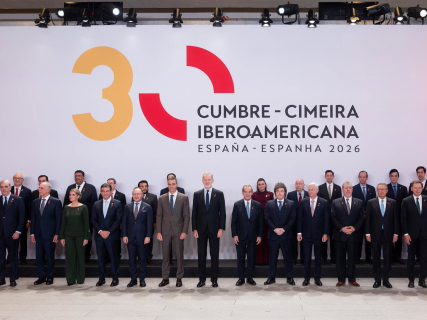

The Ibero-American leaders gathered in Madrid have expressed this Thursday their rejection of “coercion” and violations of the Charter of the United Nations in the region, through a final statement that has not had the support of Argentina, Colombia, Costa Rica, and Paraguay for this specific section.
The conclusions document of the XXX Ibero-American Summit, held in the Spanish capital, has moved forward despite the fact that several governments have distanced themselves from some points, in particular those relating to political interference in the region, the commitments reached, and the wording on gender equality.
“We reject coercion and the application of measures contrary to International Law and the Charter of the United Nations that hinder the ability of States to address their needs and development priorities,” the text agreed upon by the majority of leaders says, without the backing of Argentina, Colombia, Costa Rica, and Paraguay.
Argentina has also stepped away from the main commitments approved at the Ibero-American Summit, including the creation of the Ibero-American Alliance for Artificial Intelligence, the Ibero-American Charter for Academic Mobility, and the Ibero-American Charter for Care and Support.
For its part, Paraguay has also rejected the agreement on Artificial Intelligence and has joined the reservations about the language on gender equality, underscoring that it interprets it in accordance with its National Constitution.
In light of these discrepancies reflected in the final text, the Ibero-American secretary general, Andrés Allamand, has defended that the Madrid meeting is the “reaffirmation” summit and has downplayed the fact that some States have detached themselves from certain sections.
“It is absolutely normal; it causes no inconvenience,” he said, emphasizing that there is “consensus” around “the fundamental core of the declaration,” although certain countries have wanted to express a “particular point of view” on specific issues.
"The statement is very clear in the sense of rejecting every type of coercive measures that are not in accordance with International Law. Some countries would perhaps like to add some element, and they have every right to do so. Others might be interested in adding a comment to the opposite effect. They have every right to do so; that is the rule", he explained, also claiming the summit as an impetus to multilateralism in a context of "convulsion" of the international order.
Along the same lines, the President of the Government, Pedro Sánchez, has stressed that the document reflects "the diversity of opinions" in the Ibero-American space and has highlighted the fact that it has been possible to close a common text.
"It is nothing new. There has always been an effort to try to find that common denominator and in this case it has been achieved and I think it is the optimal result", he argued, thanking Allamand for his work in bringing to fruition a text of commitment.
As for the level of representation, after fewer than a handful of Ibero-American heads of State and Government have traveled to Madrid, below what was initially expected, Sánchez has preferred to highlight the "effort" of those who have indeed moved to Spain to represent their countries.
"Putting the focus on those absences, in some way reduces the importance and the effort that the leaders make", he said. By contrast, he expressed his recognition for the leaders who have come to the Spanish capital to take part in the meeting, including the Argentine president, Javier Milei, despite his ongoing disagreements.
"There are really very few multilateral spaces and those that exist are not very taken into account today, in the world in which we are", he added, asserting the presence of those who have chosen to attend the summit.
Agreements reached at the Ibero-American Summit
Within the framework of the Madrid meeting, the heads of State and of Government have endorsed several commitments in the area of regional cooperation, such as a strategy to promote exchange in education, culture, knowledge and innovation.
The goal is to promote equality, cohesion and social development, move toward environmental sustainability and strengthen democracy, institutions and the rule of law, as well as to favor productive transformation for sustainable development, as detailed in the statement.
The 22 countries have also given the go-ahead for the creation of the Ibero-American Network for Disaster Risk Reduction and Civil Protection, with which it is intended to improve the capabilities for prevention, mitigation, anticipation, and response to catastrophes. This framework includes the rollout of a Multi-Hazard Early Warning System and a Regional Cooperation Mechanism for Emergency Response.
Likewise, the States, without Argentina’s support, have agreed to promote the Ibero-American Alliance on Artificial Intelligence, which is voluntary in nature and conceived as a cooperation tool for gradual and complementary implementation in this field.
The summit has also approved the Ibero-American Charter on Academic Mobility, aimed at facilitating access to higher education institutions, establishing mechanisms for continuous training, and promoting the temporary exchange of university studies.
The text also seeks to encourage the transfer of case files, double degrees, and postgraduate studies among higher education centers of the Ibero-American countries “based on the principles of reciprocity, progressiveness, flexibility, transparency, and respect for the diversity of the region’s national education systems”.
Another of the concrete outcomes of the meeting has been the adoption of the Ibero-American Charter on Care and Support, which is recognized as “a guiding instrument of free and voluntary adherence, for the construction and strengthening of comprehensive, inclusive, and sustainable systems and policies of care and support”.