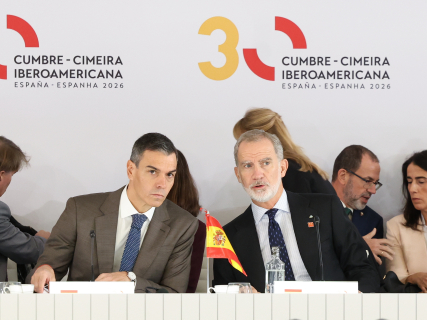

The XXX Ibero-American Summit concluded this Thursday in Madrid with a call for cooperation from King Felipe VI and the President of the Government, Pedro Sánchez, who have defended the need to maintain dialogue among the 22 countries despite their political differences. The King has asserted the role of the Ibero-American community in a scenario dominated internationally by rivalries, while the President of the Government has hailed the "great success" of a meeting that has made it possible to approve agreements on artificial intelligence, disaster prevention and academic mobility.
"We are the counterpoint to a geopolitical time marked by fronts, blocs, rivalry and competition," Felipe VI said during the closing of the summit, held at the Gallery of the Royal Collections. The monarch assured that "the spirit of the summits leaves Madrid strengthened" and defended that multilateral cooperation remains necessary to respond to shared problems.
For his part, Sánchez highlighted the agreements reached during the two days of work. "These are agreements that reflect what we are, a community of affections and shared values," he said. The president reiterated that, "above ideological differences," the Ibero-American countries share the will to build a better world.
The meeting included delegations from the 22 countries, although only ten were led by their top leaders. Among the most notable absences are the Brazilian president, Luiz Inácio Lula da Silva, and the Mexican president, Claudia Sheinbaum.
The King defends multilateralism and Sánchez calls for unity against unilateralism
Felipe VI opened the plenary session with a defense of the political diversity of the Ibero-American community, which he compared to a musical composition interpreted by different instruments. The King asked the leaders to "stick to the score" so that the meeting sounded "harmoniously".
"Our first responsibility is to the Ibero-American citizens," the monarch said, who called for strengthening shared institutions and a greater presence of the Ibero-American voice in international affairs.
In his address, Sánchez has warned that the world is going through a period of increasing division and has called for maintaining the commitment to dialogue, cooperation, and peace in the face of those who advocate for "retreat and unilateralism".
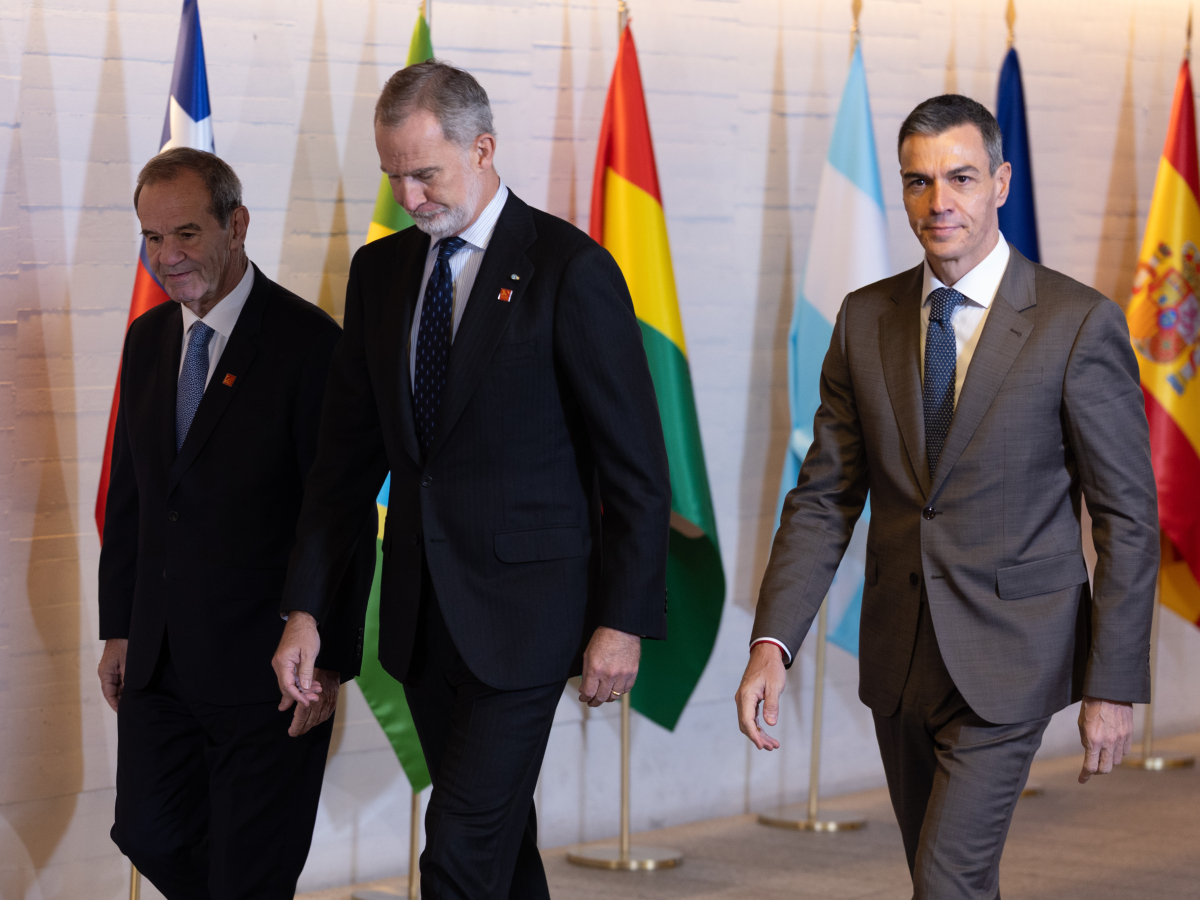
The head of the Executive branch has also called for Ibero-American countries to have more weight in international decisions and to develop shared responses in areas such as the ecological transition.
At the closing ceremony, Felipe VI handed over to the President of Honduras, Nasry Asfura, the term as Secretary Pro Tempore. The Central American country will assume this responsibility until the next summit, scheduled for 2028.
Milei equates socialism with fascism to Sánchez
One of the most prominent speeches of the day was that of Argentine President, Javier Milei, who has equated socialism with fascism during his address to the Ibero-American leaders.
The leader has turned to a quote from the Spanish writer and diplomat Salvador de Madariaga: "Socialism is fascist in politics and fascism is socialist in economics".
Milei added, in his view, that both doctrines share rejection of the free market and criticized progressive policies that, as he has stated, continue to gain ground in Europe.
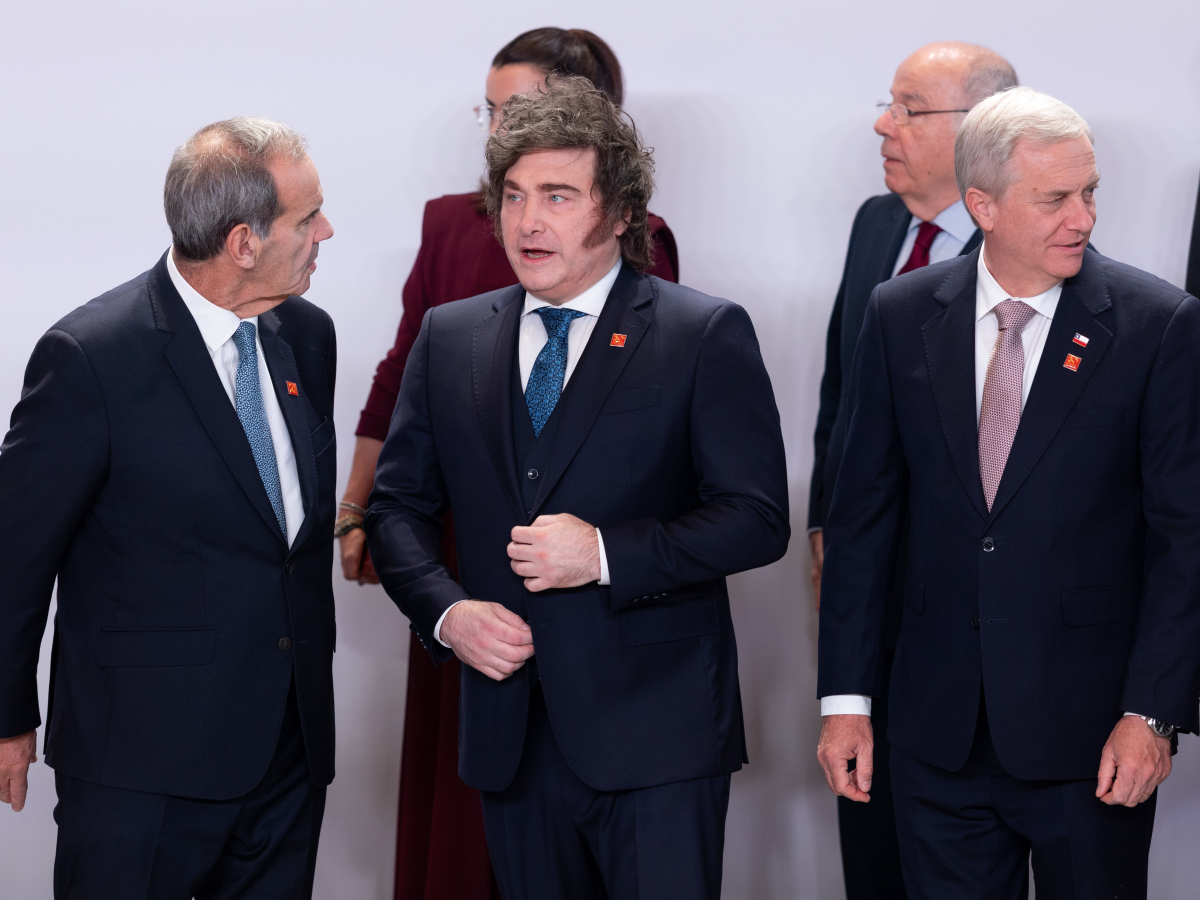
The Argentine president has not directly mentioned Pedro Sánchez nor repeated the insults he directed at him during his previous visit to Spain, on 21 October, when he called him an "unpresentable dictator, corrupt and authoritarian".
The relationship between the two leaders has once again been reflected in his greeting this Thursday, limited to a brief handshake. Milei also did not take part on Wednesday in the opening ceremony held at the Teatro Real nor in the official dinner offered by the kings at the Royal Palace. Instead, he held a meeting with the President of Vox, Santiago Abascal.
Before addressing his political positions, Milei has expressed his condolences for the 69 fatalities of the rail accident in Urda (Toledo) and has extended his solidarity to the families of the victims and the injured.
Kast speaks about Venezuela and Sánchez holds a bilateral meeting with the Chilean president
The president of Chile, José Antonio Kast, has devoted a large part of his address to security and the fight against transnational organized crime. The head of state highlighted the cooperation initiatives promoted together with Argentina, Bolivia, Ecuador, and Peru.
He has also referred to the evolution of diplomatic relations with Venezuela. "We are resuming our relations and in recent months doors have been opened that were closed for a long time," he said.
Kast defended dialogue among Ibero-American countries and called for overcoming historical differences in order to move forward on shared projects.
On the sidelines of the summit, Sánchez has held a bilateral meeting with Kast at the request of the Chilean delegation, according to Moncloa sources. The Spanish president also celebrated a meeting with the president of the European Council, António Costa.
Guatemala defends democracy and Costa Rica calls for cooperation against drug trafficking
The president of Guatemala, Bernardo Arévalo, has warned that "democracy is not exhausted at the ballot box" and has called on governments to listen to the demands of young people.
Arévalo has defended respect for human rights and multilateralism, in addition to asserting dialogue as a tool for reaching agreements between countries with different political positions.
For her part, the president of Costa Rica, Laura Fernández, has focused her address on drug trafficking and organized crime.
"No country in Ibero-America or on the planet can combat this threat alone," Fernández warned, who has defended greater police cooperation and the exchange of information between governments.
The head of government also explained some of the measures promoted by her administration, including the tougher penalties under criminal laws and the construction of penitentiary centers to prevent criminal leaders from continuing to operate from prison.
The President of Bolivia, Rodrigo Paz, has proposed greater mining cooperation among Ibero-American countries. The head of government has stated that the concentration of natural resources in Bolivia, Chile and Peru offers opportunities to develop joint projects.
The Madrid agreements: artificial intelligence, education and disaster prevention
The summit concluded with the approval of a final declaration and several cooperation agreements among the participating countries.
Among the main initiatives is the Ibero-American Alliance for Artificial Intelligence, intended to strengthen collaboration in the development and use of this technology.
The President of the Dominican Republic, Luis Abinader, has offered his country as the venue for a center linked to this alliance and has committed to facilitating technical and institutional resources for its operation.
The governments have also approved a Ibero-American Network for Disaster Risk Reduction and Civil Protection, in addition to a Charter for Academic Mobility and a Charter for Care and Support.
The Portuguese Prime Minister, Luís Montenegro, has announced that Portugal will double its contribution to the Ibero-American General Secretariat and has presented his country’s candidacy to assume the community’s temporary presidency during the period 2029-2030.
The Spanish Minister of Foreign Affairs, José Manuel Albares, has highlighted that the 22 countries have reached an agreement on the final declaration, something that did not occur at the previous summit held in Cuenca (Ecuador) in 2024.
Nevertheless, Argentina, Colombia, Costa Rica and Paraguay have dissociated themselves from a section of the declaration relating to the rejection of coercive measures contrary to International Law. Argentina has also expressed reservations about several cooperation initiatives.
The war in Ukraine and the blockade of Cuba reach the summit
The international situation has also had space in the interventions by the leaders. Sánchez defended support for Ukraine in the face of the Russian invasion, coinciding with the visit to Madrid by the Ukrainian President, Volodímir Zelenski.
"In this story there is an aggressor, Russia, and an aggrieved party, Ukraine", Sánchez said, who has warned that Vladímir Putin intends to weaken the foundations of the European project and alter its security architecture.
Zelenski has denounced that Russia is incorporating young Ukrainians into its army who were moved to Russian territory when they were children after the start of the invasion.
Featured story
Zelensky warns Ibero-American leaders of the risk of allowing Putin to retain Ukrainian territories
3 minutes
On the other hand, the foreign ministers of Brazil, Cuba, Mexico, Uruguay and Nicaragua have condemned the U.S. economic blockade against Cuba.
The Brazilian chancellor, Mauro Vieira, has rejected Washington’s measures to restrict the supply of energy to the island and has stated that his country "does not fit in anyone’s backyard".
The Cuban minister, Bruno Rodríguez, has denounced the consequences of the tightening of U.S. sanctions and has thanked the countries that, at the United Nations, supported the resolutions against the embargo.
A summit with ten top leaders and the absences of Brazil and Mexico
The Madrid meeting brought together ten heads of State and Government, two vice presidents and ministerial delegations from the rest of the countries.
The absence of Lula da Silva and Claudia Sheinbaum was one of the main surprises of the meeting. Albares has explained that the Brazilian president has just been re-elected and must deal with domestic matters, while the Mexican leader makes few international trips.
The minister has assured that both governments maintain their support for Ibero-American cooperation and has recalled his meetings with the foreign affairs officials of Brazil and Mexico.
Participation at the highest level has surpassed that of Cuenca in 2024, where four leaders attended, although it has fallen below the 17 who participated in Santo Domingo in 2023.
The XXX Ibero-American Summit has been held for two days in Madrid, with the opening ceremony on Wednesday at the Teatro Real, the official dinner at the Palacio Real and the plenary session on Thursday at the Gallery of the Royal Collections.
The meeting has ended with the transfer of the temporary presidency to Honduras and with cooperation agreements that the countries will have to develop over the next few years.