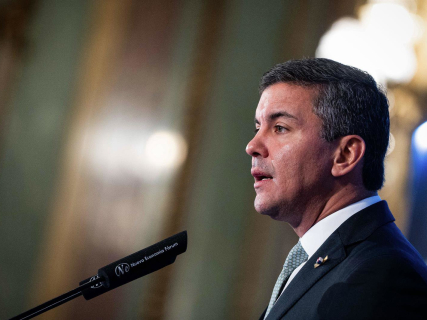

The President of Paraguay, Santiago Peña, has announced this Thursday his resignation from office following the intervention of Banco Ueno, whose serious lack of liquidity has left for hours millions of clients, including numerous pensioners, unable to access their funds.
In the face of moves in Congress to put him on trial through impeachment for his handling of the financial crisis, Peña has chosen to leave power "thinking about the stability of the country, about social peace, and about the need to preserve democratic institutions".
In his address to the nation, the head of state has apologized to the citizens for the consequences of the banking collapse. "I want to apologize to the people if at any moment I have fallen short. It was never my intention to betray the trust," he said in a video shared on social media.
The problem was triggered on Tuesday morning, when the intervention by the supervisors led to the blocking of deposits of millions of Paraguayans — among them those of retirees —, which caused demonstrations throughout the country, where approximately one in three people had savings in the intervened entity.
The political situation became even more tense this Thursday, when the Chamber of Deputies began to debate the formal opening of a process to remove the president from office. The decisive moment came when the former president and leader of the ruling Partido Colorado, with a parliamentary majority, expressed his support for the initiative.
Peña has emphasized that, before leaving office, his priority will be "the peace of mind of the Paraguayan people who entrusted their savings" in the national banking system, noting that "behind each deposit there are years of effort, sacrifice and family projects".
"My greatest desire is that the return of those resources is guaranteed, that the Deposit Guarantee Fund fulfills its purpose and that it is protected," he stated, before justifying his departure by emphasizing that Peña is leaving because "no office is more important than the stability of the Republic," and "no person is above Paraguay".
"I thank you for the trust for every moment lived and for having given me the honor of serving this great nation," he concluded in his farewell.
Links with the United States and international agenda
Externally, the Trump Administration had forged a particularly close relationship with the government of Peña, aligned with positions favorable to the business sector.
In March of this year, the Paraguayan head of state signed with the United States the agreement of the Statute of Forces, or SOFA by its English acronym, which allows and regulates the temporary presence of civilian and military personnel of the Pentagon, as well as of American companies, in Paraguayan territory for activities related to visits by ships, training programs, and joint military maneuvers.
Last month, the Under Secretary of State, Christopher Landau, held a meeting with Peña in Asunción and highlighted that Paraguay occupies a key place in the regional strategy of U.S. diplomacy, at a time when Trump is trying to strengthen his influence in Latin America.
After that meeting, Peña traveled to Washington, where he met with the Secretary of the Treasury, Scott Bessent, to discuss matters related to critical minerals and economic cooperation projects.