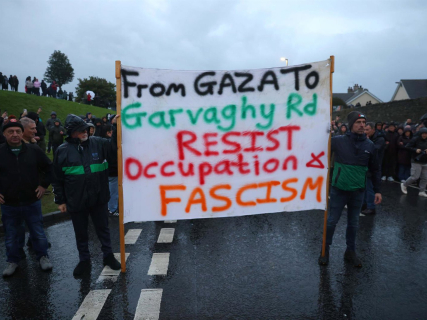

The First Minister of Northern Ireland, the Irish nationalist Michelle O'Neill, has joined the protest that is currently blocking the passage of the unionist Orange Order through Garvaghy Road in Portadown, after this route received official permission for the first time in 28 years.
The controversial parade, initially scheduled for 8:00 AM (9:00 AM in mainland Spain), remains suspended and members of the Orange Order are still waiting, well into the afternoon, for the area to be cleared so they can begin the march, according to British and Irish media reports.
The Chief of Police of Northern Ireland, Jon Boutcher, has called for calm and emphasized the work of the officers who "are managing an exceptionally complicated situation." "The police operation has helped ensure that there has been no violence or disorder so far," he noted.
O'Neill has called for the involvement of the Secretary of State for Northern Ireland of the British Government, Chris Bryant. "Does anyone think this is a good idea? No sensible person would make this decision," she stated.
"Why does the Parade Commission, after 28 years of blocking the march on this street, think it is okay to bring this mess back to the community?" she added before the media, accompanied by the president of her party, Sinn Féin, and leader of the opposition in Ireland, Mary Lou McDonald.
CALLS FOR CALM
For his part, the British Prime Minister, Andy Burnham, has requested "calm from all parties." "I know it is a tense situation. We ask for calm from all parties," he stated in remarks to the BBC. "There have been advances in Northern Ireland and we do not want to go backwards, so clearly today is a complicated situation, but it is very important that we work to ensure there is calm," he emphasized.
Bryant, the Secretary of State for Northern Ireland of the British Government, has traveled to Belfast and stressed that he is taking the situation "very, very seriously." "It is important that everyone obeys the law. I ask people to cooperate with the Police," he demanded.
The leader of the Democratic Unionist Party (DUP), the main unionist force, Gavin Robinson, has criticized O'Neill's presence at the protest against the Orangemen's parade. "The duty of a First Minister is to respect legal decisions, not to encourage opposition to them," he warned.
Bryant has avoided commenting on whether O'Neill could be violating the law with his actions. "My job is not to decide whether someone has violated the law or not. That corresponds to others. All I can say is that everyone should cooperate with the Police. Everyone," he reiterated, while reminding that those in public office "have the particular duty to try to calm and to have a moderate discourse."
The Irish Government has also reacted to express that it is "very concerned about the situation." "Our main concern is to prevent a return to the divisions of the past. Let us remember the important progress made over so many years for reconciliation under the Good Friday Agreement," Dublin has pointed out, according to the Irish public broadcaster, RTÉ.
In this line, the highest Catholic and Anglican representatives have issued a joint statement in which they demand "the urgent creation of a constructive, inclusive, and reconciling initiative." Catholic Archbishop Eamon Martin and Protestant Archbishop John McDowell have agreed that "the first commandment (...) is to love God and love your neighbor." This initiative must "seek a way to overcome the current crisis." "There is too much at stake," they have warned.
CONTROVERSIAL MARCH IN PORTADOWN
The Orange Order, the main Protestant organization in the territory, claims Garvaghy Street as a historical route for its parades in Portadown, something that the predominantly Catholic population of the area interprets as a provocation.
The Supreme Court of Northern Ireland has decided to admit the appeal against the ban that has weighed on the march for decades, imposed after the signing of the Good Friday Agreements, which ended 30 years of political violence in the region.
The Orangemen's marches became one of the main focal points of political tension in the 1990s, which led to the creation of the Parades Commission to oversee and regulate these events.
Precisely, the commission has resolved this Friday that the parade may take place, although limited to 35 participants and without a marching band.
The conflict in Northern Ireland between unionists in favor of maintaining the link with the United Kingdom and nationalists who demand the reunification of Ireland lasted almost three decades, until the signing in 1998 of the Good Friday Agreements, which left more than 3,500 dead.
Despite the fact that tensions between both communities persist, these agreements established a political framework to address the issue through a system of self-government under British sovereignty and with London's commitment to call a referendum on self-determination when it considers that there is a favorable majority.