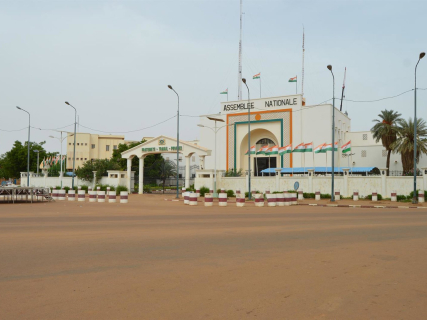

The Alliance of Sahel States (AES) has declared the mutiny that began early Saturday morning in Niamey, the capital of Niger, as "frustrated," which has been described by Nigerien authorities as an "attempted coup," awaiting the reappearance of the leader of the military junta, Abdourahmane Tchiani, on the scene.
Despite the initial confusion, daily life has gradually resumed its course, with more people on the streets as the morning progressed into the early afternoon of this Sunday. Meanwhile, security sources have indicated to the RFI network that a dozen rebellious soldiers have been detained, with no information available so far regarding possible victims.
Niger is part, along with Burkina Faso and Mali, of the AES, a bloc of African countries governed by military juntas that have emerged from coups and have strengthened ties with Russia in recent years.
In a statement released late Saturday, the AES strongly condemned the uprising of a group of rebellious soldiers at Air Base 101 and in the Plateau neighborhood, an area where various state institutions are concentrated and which is located near the Presidential Palace.
"Thanks to the bravery and professionalism of the loyal republican forces, this latest attempt was contained and frustrated," proclaimed the CES in a joint statement in which it declares "fully committed and mobilized alongside Niger, whose determination to continue the fight for sovereignty and peace it shares."
The alliance finally calls on the populations of the three countries to "remain particularly vigilant against disinformation campaigns, manipulation of public opinion, and attempts to sow division that may accompany destabilization efforts."
Regarding the origin of the mutiny, RFI sources point out that the involved soldiers would belong to special forces units unexpectedly transferred to Niamey from regions such as Tillabéri or Dosso, key scenarios in the fight against the Islamic State and Al Qaeda's affiliate in the Sahel, the Support Group for Islam and Muslims (JNIM), and that they may be dissatisfied with the evolution of operations.
The director of the Tombuctú Institute, Bakary Sambe, has pointed out to the French broadcaster that the episode is particularly serious because, "for the first time since the coup d'état of 2023, the threat did not come from abroad, nor from jihadists, but from the armed forces themselves," which, in his opinion, "evidences the division of the Nigerien Army," a scenario that would have led the Government to resort to Russian mercenaries from the Africa Corps to ensure internal control.
"Russian support is no longer a hypothesis. It was the Nigerien command of Base 101 who requested the presence of the Africa Corps," the analyst assured RFI, "to recover the facilities."