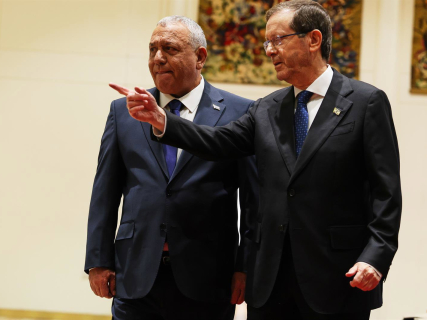

The opposition bloc to Israel’s acting prime minister, Benjamin Netanyahu, has closed this Tuesday an agreement to run for former minister Matan Kahana, from the Yashar party of Gadi Eisenkot, as the next president of the Knesset, the Israeli Parliament.
Kahana’s designation comes after several days of talks between Yashar, which leads the opposition bloc with 21 seats, and B'Yachad, of Naftali Bennett and Yair Lapid; The Democrats, of Yair Golan; and Yisrael Beitenu, of Avigdor Lieberman. The pact reflects Eisenkot’s political weight, which secures one of the first posts that the new opposition front can take away from Likud, Netanyahu’s formation.
Some opposition forces had initially suggested that former Prime Minister Yair Lapid, leader of the second force of the bloc, assume the Presidency of the Knesset within the coalition that Eisenkot must articulate and that, to succeed, will require the backing of Arab parties or of disloyal deputies from Jewish lists.
With this nomination, the aim is to send a message of strength before the inaugural session of the Knesset through the rapid replacement of the current president, Amir Ohana, close to Netanyahu. This move forms part of the distribution of responsibilities within the opposition alliance that aims to unseat the current Executive. Israeli media point out that Lieberman could occupy the presidency of the influential parliamentary commission on Foreign Affairs and Defense.
The president of the Knesset is elected in an open vote during a special plenary session, by simple majority, so the support of the Arab formations will be decisive for the candidacy to move forward.
On this very Tuesday, Ahmad Tibi, one of the leaders of Joint List, the main Arab coalition, has announced that they will back Kahana for the post.
"The first crucial step that signals a change is the replacement of the president of the Knesset. The Yashar party has informed us that it will be Matan Kahana. I congratulate him and we will vote in his favor because we want to be part of the change," he said in statements to the Kan network.
Hours later, Ohana has confirmed that the vote to choose his successor will take place next Tuesday, November 17, after the request of 67 deputies, which he has described as "unusual," after having promised to advance the session if at least 61 parliamentarians requested it.
In a statement released by the newspaper 'Times of Israel', he has said that "I will act as I promised: I will respect the will of the majority of the deputies," stressing that he will do so despite his "firm opposition" to the agenda of the bloc led by Eisenkot.
Along these lines, Ohana has denounced that the initiative to advance the vote on his replacement at the head of the Israeli Parliament "is intended to push forward legislation that would grant an immense power to the attorney general, which would further exacerbate the imbalance between elected leaders and the bureaucratic hierarchy".
Kahana was Minister of Religious Services between 2021 and 2022 and previously served as a military officer and a pilot in the Israeli Air Force. In recent years, he has passed through several right-wing formations until joining the party led by Eisenkot, who was Chief of the General Staff of Israel between 2015 and 2019.
The constitution of the new Parliament activates the deadlines for the formation of a Government: the designated candidate will have 28 days to form an Executive, a period that the president of the country can extend by an additional 14 days.