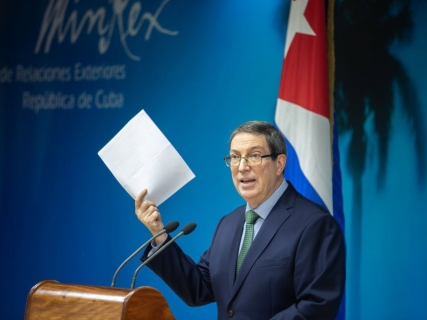

The Cuban Minister of Foreign Affairs, Bruno Rodríguez, has addressed the plenary of the Ibero-American Summit held in Madrid to denounce the “collective punishment” that, as he pointed out, the United States is applying against the island, further emphasizing that not all the governments in the region support Havana in the current situation.
Rodríguez has argued that the Ibero-American Community must operate “without interference, exclusions, or external pressure” and has warned that the international scenario is “marked by unilateralism, the imperialist and unworkable attempt to impose peace by force,” and by violations of International Law and Human Rights.
As he has stressed, in the last ten months “the Cuban people have suffered the unprecedented strengthening of the U.S. economic blockade.” Along these lines, he has accused Washington of imposing “an energy siege equivalent to a naval blockade” and of applying “secondary sanctions to individuals or entities that establish commercial relations with Cuba.”
“The United States has taken its obsessive war of choking economic punishment against Cuba to inhuman limits of collective punishment,” the head of Cuban diplomacy insisted, who thanked the support of Ibero-American countries that last week voted in favor of the UN General Assembly resolution that condemns the U.S. embargo on the island.
The foreign minister has drawn attention to the change in stance of several governments in the region, noting that traditionally the Ibero-American bloc used to align itself with Havana, while now, due to the closer ties of some leaders to the Administration of Donald Trump, several States choose to abstain or even vote against the text.
“Cuba is not a threat”
In a message shared on social media, Cuban President Miguel Díaz-Canel has backed the intervention of his foreign minister, reiterating the accusation of “the unprecedented strengthening of the blockade,” as well as “the imposition of the energy siege and the application of secondary sanctions to individuals or entities that establish commercial relations with Cuba.”
Díaz-Canel has also reiterated Cuba’s commitment to Ibero-American cooperation, “under conditions of equality, sovereignty, mutual respect, and in line with national priorities,” and he concluded with the statement “Cuba is not a threat, the blockade is.”
The resolution against the embargo was approved with 130 votes in favor, 17 against—among them Argentina, Colombia, Costa Rica, Ecuador and Paraguay—and 25 abstentions, among which are Chile, the Dominican Republic, Honduras and Peru.