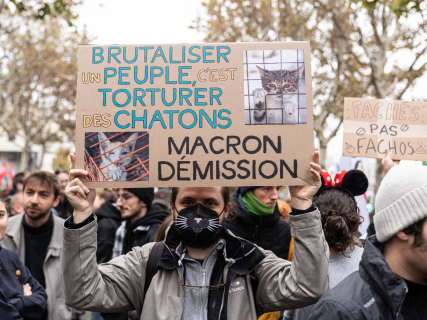

The so-called Third Act of the social protests in France once again filled the streets this Saturday. According to the official count, more than 320,000 people have participated in the mobilizations, while the calling organizations—students, unions and 'yellow vests'—raise the figure to 500,000 demonstrators throughout the country. The day has unfolded for the most part peacefully, although disturbances and clashes with the security forces have been recorded that ended with 565 arrests.
The Youth Inter-Union has put the number of attendees at close to half a million, a turnout lower than the 800,000 who, according to the organizers, took to the streets the previous Saturday. Last October 24, the authorities had reported 410,000 people in the marches.
"Despite the metro stations closed, a week of campaigning by the official media intended to sow panic and a change in the place of the rally, the crowd has been just as numerous this week. And just as disciplined," the leader of La Francia Insumisa, Jean-Luc Mélenchon, has claimed, when assessing the capacity for mobilization.
The left-wing presidential candidate has also criticized the deduction of participants from the count, considering that it "encourages (President Emmanuel) Macron to prolong the standoff". "The higher it is, the harder the fall will be. He will have to give in or leave," he has stressed.
The students, origin of the current wave of protests in France, have also directly pointed to the Executive. The general secretary of the National Union Force Ouvrière-High Schools and Colleges (SNFOLC), François Pozzo di Borgo, has emphasized that, despite the announced commitments, the Government has not "responded to all the demands".
"At the moment, what the government proposes are mainly adjustments," but that "in essence," it has "not responded to the demands," such as the repeal of the Parcoursup access system or the latest legal reform for baccalaureate and secondary education, he explained in statements to the BFMTV channel.
The rising cost of living is the other major axis of the protests. "We deprive ourselves of everything," lamented one protester, Emilie, a housewife and mother of five children. "I have two children in high school, in different schools, and their conditions are similar (...). There are no teachers, nor material for practical work, nor doors in the bathrooms, a roof that is collapsing on a student (...) it is unacceptable," she added before denouncing police violence.
565 detained and presence of radical groups
The Ministry of the Interior has reported that, as of 9:00 p.m., 565 arrests had been made throughout the territory linked to the protests, about 200 fewer than the previous week, but almost 200 more than two weeks ago. Of these, 61 took place in Paris. In the capital, 15,000 identity checks were carried out out of a total of 40,000 nationwide.
The department also warned of the presence of "radical elements" "in several cities" and specifically cites Bordeaux, Toulouse, Rennes, Lille, Nantes, Marseille or Lyon. "At the end of the demonstration they enter the urban centers with the purpose of causing damage and looting," Interior has indicated, which assures that "the systematic interventions of the police have prevented it," although "the clashes are still continuing."
Checks at railway stations, roads and toll booths have also made it possible to intercept people carrying improvised weapons, according to the same source. The large deployment will remain active throughout the night, with special reinforcement in Paris, where it is being applied with particular rigor.
In any case, and in particular until noon, the situation has been "generally calm, without notable incidents". "The security measures remain adapted to the situation, especially at the end of the day, in anticipation of Halloween night," the Ministry indicated. "The position of the Minister of the Interior (Laurent Nuñez) remains unchanged: the police will act with the utmost firmness against those responsible for the violence and damage," it warned.
Charges and clashes in Paris
In the capital, riot police charged against groups of protesters and objects were thrown after the end of the march that ran to the Porte de Charenton.
The agents have resorted to the use of tear gas against dozens of hooded and black-clad individuals who, armed with hammers, have torn up cobblestones to throw them at the police. According to the authorities, at least one incendiary device has also been thrown.
The Prefecture has explained that a group of several hundred people positioned at the back of the demonstration has attacked the agents with objects, including a Molotov cocktail. As a consequence of these incidents, five police officers have been injured in Paris, three of them due to the impact of Molotov cocktails, according to the tally of the local authorities.
In addition to Paris, marches and episodes of tension have been recorded in other cities such as Nice, Toulouse, Marseille and Rennes. In Marseille, around 10,000 people have taken to the streets, while in Grenoble 7,300 demonstrators have been counted, including some 200 members of the so-called 'black block'.
In Bordeaux, the police have counted 11,000 attendees, according to official data, and in Lyon the Prefecture has estimated participation at 19,000 people.
For this day, the French authorities had reinforced the security deployment throughout the country, with close to 70,000 police officers and other personnel mobilized with the aim of preventing disturbances, looting and acts of vandalism.