
This Saturday, the Irish conservative party Fine Gael has released its action plan to move toward the reunification of the island with Northern Ireland, currently under British sovereignty, exactly one year before the party assumes Government leadership under the coalition pact signed with the centrist Fianna Fáil.
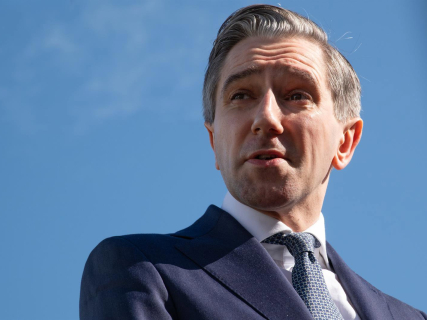
The party leader, Simon Harris, presented at the annual convention held in the city of Cork the long-awaited proposal on the future constitutional framework for the island of Ireland.
During his speech, Harris defended the launch of a new Department for Relations with Northern Ireland and the creation of an "independent, interparty and advisory forum, backed by the Executive," conceived as a key component of preparations for a possible reunification. This body would be regulated by law, would have an initial term of five years, and could be extended for another two.
According to Fine Gael’s document, the forum would have an independent chair appointed by the Irish Government, as well as its own secretariat and financial resources. Its mission would be to produce reports, studies and technical proposals on the process of territorial unity.
"The Forum would commission research, examine constitutional and institutional options, identify areas of agreement and disagreement, and provide recommendations to help lay the groundwork for a Unified Island," the roadmap states.
Participation in this forum would be open to representatives of all political forces with representation anywhere on the island, including unionist parties that maintain their loyalty to the British Crown and that "advocate exclusively by peaceful means."
At the same time, Fine Gael intends to analyze the "protection of British identity" in Northern Ireland, as well as "the rights and identities of all communities, including flags, emblems and anthems," in addition to studying the "future" of the institutions in Belfast and the "possible reform of local and regional government across the island, in accordance with the European principle of subsidiarity."
Fianna Fáil sets out three scenarios for the future of the island
Fianna Fáil’s approach goes one step further and considers the examination of three possible models that reflect the different sensitivities present on the island: a unified Ireland without autonomous governments; a unified Ireland with an autonomous republic in the North; and a third, continuity scenario, without constitutional changes, which would maintain the framework established by the 1998 Good Friday Agreement.
The Good Friday Agreement, which put an end to the Northern Ireland conflict, states that the minister for Northern Ireland of the British Government may call a referendum on reunification when he considers it likely that a favorable majority will emerge—a hypothesis, according to the latest polls, that could be closer than ever.
Fine Gael and Fianna Fáil have been governing in coalition since the 2020 elections and have been alternating in the post of prime minister. Both formations, located in the center-right, chose to join forces in the face of the growth of the nationalist and left-wing party Sinn Féin.