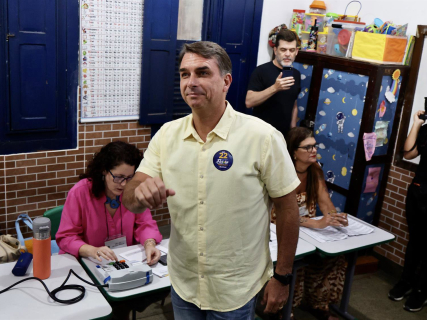

The far-right presidential candidate of Brazil, Flávio Bolsonaro, has communicated that he will not accept the result of the second round held this Sunday, in which the current head of state, Luiz Inácio Lula da Silva, has been reelected, and has announced that his party will request the annulment of the elections due to the controversial extension of the voting hours.
In a public appearance after Lula's victory was confirmed with 51.79% of the votes against the 48.21% obtained by him, the leader of the Liberal Party (PL) has labeled what happened during the electoral day as "unacceptable." His reproaches focus on the ruling of the Supreme Federal Court judge, Cristiano Zanin, who decided to extend the voting time nationwide by two hours due to the problems detected in public transportation.
Bolsonaro has blamed Zanin —whom he has described as "Lula's former lawyer"— for altering "the rules of the game in the middle of the game" and for "trampling on specialized electoral justice" by issuing the order at 5:01 PM (local time), when the closing of the polling stations was scheduled. "This has never happened in the history of Brazil, there was a total break of equality among Brazilians from various cities and states," the candidate has stated.
According to the conservative leader, the interveners from his party were "removed from the safe room" (the center where the data is processed) at the moment the judicial decision was executed. "It is impossible to recognize the election data in the context of how these things happened. We are going to undertake legal actions and request the annulment of these elections," Bolsonaro has emphasized, calling on his supporters to "not give up."
The extension of the voting hours was decreed by the Supreme Court after complaints about the lack of transportation for voters, mainly at the request of Lula da Silva's campaign team. However, Bolsonaro's own candidacy had also previously requested an extension, although limited to five states (Sao Paulo, Santa Catarina, Paraná, Minas Gerais, and Rio Grande do Sul). Zanin's decision forced the initial counting to be halted and was adopted despite the explicit rejection of the Electoral Public Ministry.