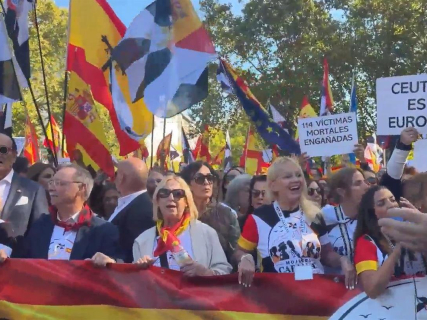

From conversations at the school gates to a demonstration in front of the Congress of Deputies. This is how Mujeres Caballas, the citizen movement born in Ceuta, has evolved in just a few months, which this Sunday, October 25, has brought its demands to Madrid. The platform, initially driven by 19 women from different professions and political sensitivities, has managed to mobilize thousands of people to demand urgent measures from the Government of Pedro Sánchez in response to the consequences of the migratory crisis recorded in the autonomous city on the past 30th and 31st of July. Its main objective, according to its members, is to restore normalcy, reinforce security, and achieve concrete commitments from the institutions.
Among the main promoters of the movement are Maxi Lacasa, local police and one of its spokespersons; Kumari Nanwani and Carmen Luna, who have led the organization of a protest called under the slogan "Ceuta stands in Madrid". They are joined by professionals from healthcare, education, law, and other fields who decided to organize in response to what they consider an insufficient response from the administrations. The demonstration has also seen the presence of the president of Ceuta, Juan Jesús Vivas (PP), although the organizers insist that their initiative does not respond to partisan interests and is open to any citizen, regardless of their ideology.
How Mujeres Caballas was born: from a group of mothers to a citizen movement
The origin of Mujeres Caballas lies in the weeks following the massive entry of migrants from Morocco during the days 30 and 31 of July 2026, an episode that profoundly altered the situation of the autonomous city and triggered a political, humanitarian, and security crisis.
As their representatives have explained to media such as El Faro de Ceuta, El Pueblo de Ceuta, and Europa Press, the initiative began to take shape from conversations among women who shared their concerns about the changes they perceived in daily life. Many of them were mothers who met at the school gates, while others were directly related to healthcare, educational, or security services.
What initially were informal conversations ended up becoming an organized platform. Kumari Nanwani has explained that the founding core was made up of 19 women, who decided to join efforts to bring their claims to the institutions.
The collective defines itself as peaceful, plural, independent, and non-partisan. Its members claim to represent different sensitivities and traditions of the city, historically characterized by the coexistence of Christian, Muslim, Jewish, and Hindu communities.
In fact, the chosen name also constitutes a declaration of identity. "Caballa" is the popular name used to refer to the inhabitants of Ceuta, a nickname linked to the fishing tradition of the city and recognized by the Royal Spanish Academy.
Maxi Lacasa, Kumari Nanwani, and Carmen Luna: the visible faces of the platform
Although Mujeres Caballas brings together women from different sectors, three names have gained special prominence during the preparation of the Madrid march: Maxi Lacasa, Kumari Nanwani, and Carmen Luna.
Maxi Lacasa, a local police officer in Ceuta, has become one of the main spokespersons for the collective. In her public interventions, she has denounced the deterioration of security that, according to her, many families perceive and has demanded a more forceful response from the institutions.
In an interview granted to Artículo14, Lacasa explained that the members of the movement had decided to take their demands to Madrid after participating in various local mobilizations without obtaining the responses they expected. The spokesperson described the situation that some women live as a form of "self-confinement", stating that many families have modified their routines for fear of experiencing incidents.
For her part, Kumari Nanwani has actively participated in the organization and dissemination of the call. According to El Pueblo de Ceuta, one of her main concerns was that the situation in the city stopped being an exclusively local issue and reached the institutions where political decisions are made.
Carmen Luna has also been one of the visible promoters of the initiative. The three participated in meetings with local media in the days leading up to the protest to explain the route of the march, facilitate transportation, and publicize the main demands.
Among the members of the collective is also Elisabeth Muñoz, nurse and union representative of the Ceuta health sector, who has denounced the healthcare pressure that, in her opinion, public services have been under since the end of July.
What Mujeres Caballas demand from the Government of Pedro Sánchez
The platform has conveyed to Madrid a set of demands mainly related to citizen security, border control, immigration policy, and the functioning of public services.
One of their main demands is to reinforce the border perimeter of Ceuta with more police personnel, material resources, and technological tools. The organizers believe that the authorities must take measures to prevent a massive entry like that of last summer from happening again.
They also demand the application of the return procedures provided for in Spanish and European regulations for people who do not have the right to remain in the country, as well as a reform of the Immigration Law that takes into account the territorial particularities of Ceuta and Melilla.
These demands must be interpreted within the framework of current law, which requires assessing the individual circumstances of the affected persons and respecting the guarantees of international protection.
Another highlighted issue is the situation of healthcare and assistance services. Some members of the platform, professionally linked to the healthcare field, argue that the arrival of thousands of people has increased pressure on emergencies, medical centers, and resources allocated to care for minors.
The conveners also request greater protection for migrant women, considering that there are situations of special vulnerability that require specific responses from the administrations.
In terms of security, the spokespersons have reported an increase in disturbances and sexual assaults. However, the figures they have disseminated about these crimes have not been able to be verified with official police statistics, so they should be understood as assertions of the collective and not as independently verified data.
A demonstration from Atocha to the Congress with thousands of attendees
The first major national mobilization of Mujeres Caballas was held this Sunday, October 25 in Madrid. The march began at 11:30 a.m. at the roundabout of Emperor Charles V, next to Atocha, and traveled along the Paseo del Prado, Neptuno, and the Carrera de San Jerónimo until reaching the Plaza de las Cortes, in front of the Congress of Deputies.
According to information published by Europa Press, thousands of people supported the call, which included families from Ceuta and citizens displaced from different parts of Spain.
The organization had prepared a dozen buses from Algeciras, in addition to facilitating the arrival of participants from provinces such as Málaga, Sevilla, Granada, Alicante, and Toledo.
The mobilization also had the collaboration of Ceuta entrepreneurs, who contributed to financing part of the travel expenses to facilitate citizens' attendance.
The organizers had requested attendees to wear white or black t-shirts, the colors of the Ceuta flag, with the aim of reinforcing the identity of the call.
The support of Juan Jesús Vivas and the demand for a non-partisan movement
The demonstration was backed by the president of the Autonomous City, Juan Jesús Vivas, who traveled to Madrid accompanied by members of his Executive.
The popular leader denounced that Ceuta continues to face a situation he considers unsustainable and defended the legitimacy of the citizens' demands.
Vivas also called for the return of people who remain in the city without residence authorization and questioned the management of the central Government.
Despite this institutional support, Mujeres Caballas insists that it is not an organization linked to the PP or any other political party. In statements to Libertad Digital, Maxi Lacasa emphasized that the movement did not arise as an ideological association, but as an initiative of women concerned about the situation of their families.
The platform has reiterated that its call is open to citizens of all sensitivities and that its intention is to convey the demands of Ceuta to the set of Spanish institutions.
A 30-day ultimatum and the intention to continue mobilizing
The protest in Madrid does not intend to be, according to its promoters, the end of the activity of Mujeres Caballas. The organizers have announced that they will demand a period of 30 days for the Government to specify actions related to security, border control, and the recovery of public services.
The choice of Madrid responds to a deliberate strategy: to place the demands of the autonomous city before the Congress of Deputies and to demand greater involvement from the central Executive.
Furthermore, the leaders of the group have explained that they intend to maintain a citizen network capable of organizing new initiatives when they consider that the circumstances require it.
With the demonstration this Sunday, Mujeres Caballas has managed to bring a mobilization arising from conversations among a small group of Ceuta women to the center of the Spanish capital.
What began as an initiative of 19 women has transformed into a platform with the capacity for national mobilization, which demands answers to the crisis in Ceuta and intends to maintain institutional pressure as long as its members consider that the city has not recovered normality.