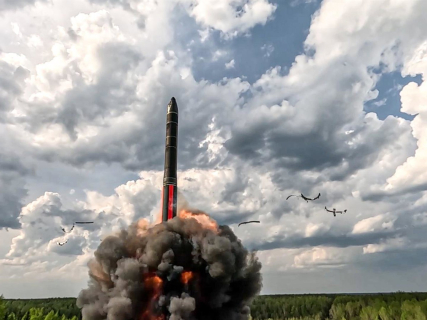

The United Nations General Assembly Presidents' Council (UNCPGA, for its acronym in English) warned this Sunday that "unilateralism is displacing multilateralism as an accepted form of state conduct" and how this drift causes "the absence of legally binding or verifiable nuclear arms control agreements."
"The Council is particularly concerned about the increasing violations of the United Nations Charter and the fact that unilateralism is replacing multilateralism as an accepted mode of state conduct," states the statement released by the body.
The Council considers as "evidence" of this drift "the absence of legally binding or verifiable nuclear arms control agreements among the major nuclear powers of the world, as well as the persistence of a massive nuclear arms race," in a context marked by the proliferation of bilateral agreements, such as the one signed between the United States and Saudi Arabia outside the International Atomic Energy Agency (IAEA), and by the continuous warnings from countries like North Korea about their nuclear status and capabilities.
Furthermore, the body holds that the "risk of nuclear war" is "aggravated by the rapid development of technologies assisted by artificial intelligence, the increasingly open discourse about the possible use of tactical nuclear weapons, the erosion of established nuclear deterrence doctrines, and the efforts of other states to acquire nuclear weaponry capabilities," reasons for which it calls for the holding of an international conference sponsored by the UN.
Escalation and global effects of the wars in Iran and Ukraine
In another section, the Council has expressed its "great concern" about the wars in Europe between Russia and Ukraine and in the Middle East "between the United States, Israel, and Iran," without referring to the Israeli bombings in Gaza and Lebanon, the Iranian reprisals against Washington's regional allies, or the conflict facing the Houthi rebels in Yemen with the internationally recognized authorities and the coalition led by Saudi Arabia.
Instead, the body warns that both conflicts "are expanding both horizontally and vertically, showing a growing trend to converge into a single interconnected theater of conflict," and urges the UN Secretary-General, António Guterres, to "urgently exercise his good offices," even raising the issue to the Security Council.
The Council also alerts to the "catastrophic consequences in the economic, financial, social, development, and humanitarian fields on a global scale, including widespread risks of massive famines, an increase in poverty, and setbacks in development efforts in the Global South," effects that it directly links to the wars in Ukraine and Iran.
In these war scenarios, the Council of Presidents of the Assembly denounces, "the civilian population of the belligerent countries has been the main victim of increasingly violent attacks with drones, ballistic missiles, and other means." "The Council strongly condemns these bombings against civilians, which constitute war crimes, and demands that they cease immediately," the note emphasizes.
In this context, the body encourages the new President of the General Assembly, the Bangladeshi Jalilur Rahman, to consult with member states "the feasibility of urgently convening the General Assembly (...) to address all aspects of the crises in the Middle East and Europe," as well as to "convene an urgent meeting with the heads of the main UN bodies" in order to analyze how to "mobilize the UN system to address all dimensions and global repercussions of the wars."
In the same statement, the Council of Presidents also requests Rahman to urgently convene "a special informative session for Member States dedicated to the governance of General Artificial Intelligence (GAI)" with a view to creating a global observatory, a certification system for safe and reliable GAI, a UN convention on GAI, and a specific international body for its oversight.