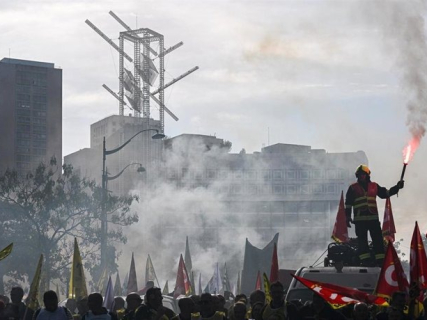
France imposes curfews in Paris and other cities after the disturbances and does not rule out a state of emergency.

The restrictions will begin tonight and will affect certain areas of the capital between 11:00 PM and 6:00 AM. The Government is preparing new measures in response to another demonstration called for Saturday.

WhatsApp Image 2026 10 19 at 19.36.54

WhatsApp Image 2026 10 19 at 19.36.54

Add DEMÓCRATA to Google

Ask FREN

Published

Last updated

4 minutes

Most read

Elecciones 29N · Encuestas

La media de las encuestas

Media a 19 de octubre de 2026 · 16 institutos

  • PP31,7 %
  • PSOE26,8 %
  • Vox18,7 %
  • Sumar6,3 %
  • Podemos3,1 %
  • ERC2,2 %
010203040ene 2024jul 2024ene 2025jul 2025ene 2026jul 2026

Media del último estudio de cada instituto en 30 días y su evolución semanal desde el 23J. Partidos con al menos un 2 %.

Todas las encuestas

Elecciones generales del 29 de noviembre · Demócrata

The French Government has announced the imposition of partial curfews in Paris and other major cities to contain the disturbances that have occurred over the weekend and that have left around 2,400 detainees, hundreds of agents injured, and thousands of businesses looted. The restrictions will begin to be implemented this Monday night, while the Executive prepares a new security device for the demonstration called for next Saturday.

The Prime Minister, Sébastien Lecornu, communicated the decision after a crisis cabinet meeting, in which the failures of the police deployment during the protests were examined. "I have asked the prefects to decree some curfews tonight to protect goods and services," he announced, without ruling out additional measures if the episodes of violence continue.

In Paris, the restrictions will affect the surroundings of the Place de la République and certain streets in the center, where circulation will be prohibited between 11:00 PM and 6:00 AM. Unlike other cities, where the limitations may apply only to unaccompanied minors, the measure announced for these areas of the capital will affect the entire population.

Restrictions in Paris, Lille, Nice, and Marseille

The French authorities have announced measures in major cities such as Paris, Lille, and Nice, although their scope will vary depending on the decisions made by each prefecture. In Marseille, one of the locations most affected by the altercations, the Prefecture of Bouches-du-Rhône has prohibited gatherings and demonstrations in the municipality between 12:00 PM and 8:00 PM this Monday.

The Executive is also considering limiting circulation in other particularly crowded points of the capital, including Les Halles, where several metro and train lines converge. Lecornu explained that certain spaces are particularly sensitive due to their symbolism or because they concentrate important transport connections.

The Prime Minister has also not ruled out resorting to states of emergency if the evolution of the disturbances requires it, although he believes that, for the moment, curfews constitute a more appropriate response. "All the tools at our disposal may be used," he warned.

About 2,400 detainees and thousands of businesses looted

The decision comes after a weekend of massive mobilizations that resulted in serious clashes, fires, and looting in various French cities. According to the balance reported by the authorities, about 2,400 people have been arrested and nearly a thousand members of the security forces have been injured.

The disturbances have also caused significant material damage. More than 3,000 commercial establishments have suffered looting and several public buildings have been affected by fires, including the City Hall of Limoges. In Paris, the clashes continued during the night of Sunday, with attacks on shops and large stores near the City Hall.

The magnitude of the protests exceeded the forecasts of the Ministry of the Interior. The authorities had estimated participation of about 200,000 people in the mobilizations on Saturday, but attendance was much higher. The deployed device, consisting of about 60,000 personnel, proved insufficient to prevent the incidents recorded in various locations.

Macron rejects the resignation of the Minister of the Interior

The crisis has also had consequences within the Executive. The Minister of the Interior, Laurent Nuñez, has acknowledged that he submitted his resignation to President Emmanuel Macron after the disturbances, although the head of state has rejected his departure from the Government.

In an interview granted to France Inter, Nuñez admitted that the police deployment was insufficient in some aspects given a participation that far exceeded initial estimates. The minister also acknowledged that the security forces lost control of the situation in certain cities.

Macron had called on Sunday night, during a televised intervention, for a review of the forecasting and intelligence errors that contributed to the spread of the disturbances. The French president described the violence as "unprecedented" and announced investigations to determine responsibilities for the attacks on establishments and public institutions.

"Those who have destroyed must pay for it; those who have tried to overthrow the Republic will have to answer for their actions," warned the head of state, who urged the Government to act with firmness and transparency.

The crisis exacerbates the political confrontation ahead of the presidential elections

The response to the riots has opened a new confrontation between the main French political forces, with a few months to go before the presidential elections. Both the Government and Marine Le Pen, leader of National Rally (RN), have directed their criticisms against La France Insoumise (LFI), led by Jean-Luc Mélenchon, which they politically blame for contributing to the climate of tension.

Le Pen has accused Mélenchon's party of legitimizing violence and allowing social demands to be overshadowed by the disturbances. Lecornu, for his part, has stated that sectors of the far left intend to prolong the riots until the presidential elections.

These accusations come despite the fact that the episodes of violence cannot be generally attributed to those who participated peacefully in the demonstrations. The protests brought together numerous groups with social demands, while the looting and destruction were carried out by groups that acted during and after the mobilizations.

With a new call from the yellow vests planned for Saturday, the French Executive is trying to regain control of the streets without resorting, for now, to a general declaration of a state of emergency. The restrictions announced this Monday constitute the first territorial response to a crisis that has acquired both a police and political dimension.

More key points, information and questions with FREN

AI-GENERATED CONTENT

What are the legal requirements for the French Government to declare a state of emergency?

To declare the ordinary French state of emergency —état d’urgence— there must be an imminent danger arising from serious disturbances of public order or a situation of a public calamity nature. The declaration is formalized by a decree of the President of the Republic adopted in the Council of Ministers; to maintain it for more than twelve days, a law from Parliament is necessary.

1. What circumstances allow its declaration

The main regulation is Law 55-385, of April 3, 1955, with its subsequent amendments. Its article 1 establishes two alternative conditions: only one needs to be met, it is not necessary to meet both:

  • Imminent danger to public order: it must result from attacks or serious impacts against that order. A political disagreement or mere existence of protests is not enough; the justification must rest on the seriousness of the facts and the imminence of the danger.
  • Public calamity: there must be events that, due to their nature and seriousness, present that character. This assumption allows responding to exceptional situations other than disturbances of public order.

The law does not contain a closed list of events that require its declaration. The Executive initially assesses whether the facts reach the legal threshold, but that assessment is subject to judicial review: it is not an unlimited power.

2. Who declares it and over what territory

The initial declaration does not require prior parliamentary authorization. The decision must be made in the Council of Ministers and embodied in a presidential decree, according to the procedure also recorded by the French Senate. Therefore, a public declaration by the president, an order from the Minister of the Interior, or a decision by a prefect is not enough.

The decree must determine the affected territorial districts. It may cover the entire metropolitan territory or only a part, as well as the overseas territories contemplated by law, including New Caledonia. The territorial delimitation is relevant because exceptional powers must be exercised within the authorized scope.

3. How long does it last and how is it extended

The Executive's declaration allows maintaining the regime for twelve days. If it is intended to prolong it, parliamentary intervention becomes mandatory: a law must authorize the extension and set its duration. The Government cannot replace that authorization with successive extension decrees.

The Senate's legislative documentation on the 2015 extension and the corresponding bill also include the possibility of ending the regime early by decree in the Council of Ministers, informing Parliament.

4. What controls and limits remain in force

Declaring the state of emergency does not globally suspend rights nor automatically authorize any restriction. Each measure requires a specific legal authorization and must respect the requirements of necessity, adequacy, and proportionality.

  • Parliamentary control: the National Assembly and the Senate must receive information without delay about government measures and may request additional information to supervise them.
  • Judicial control: administrative courts and the Council of State can review the legality of the declaration and its implementing measures.
  • Material limits: restrictions on movement, closures, bans on gatherings, or individualized measures can only be imposed under legally provided conditions, not by mere invocation of the emergency.
5. Do not confuse it with other exceptional powers

This legal regime is different from the state of siege of article 36 of the Constitution and the presidential exceptional powers of article 16. Consequently, to declare the 1955 state of emergency it is not necessary to prove the conditions specific to those other mechanisms: the conditions of the 1955 Law must be specifically justified.

What are the powers and functions of the Prime Minister of France according to the country's Constitution?

I cannot answer your question in detail because I specialize exclusively in the politics and institutions of Spain (Spanish regulations, Congress and Senate, regional governments, Spanish parties, elections in Spain, etc.). The issue you raise refers to the constitutional system of France, which is outside my scope and the information bases I manage.

My design is oriented to work with very specific tools and databases about the Spanish political system: session diaries of the Congress and Senate, records of parliamentary initiatives, regulations published in the BOE and regional bulletins, information about governments and public administrations in Spain, as well as monitoring of Spanish political and legislative news. All this allows me to offer very precise and verifiable answers when the query is within that perimeter.

On the other hand, I do not have specialized, structured, or updated access to the constitutional regulations and institutional details of other countries, such as France. This means I cannot explain with guaranteed accuracy the powers of the French Prime Minister according to their Constitution, nor interpretative nuances, reforms, or comparative jurisprudence. I could attempt a generic explanation based on unverified knowledge, but that would go against the rules I must follow: I must not offer as certain legal or institutional information about other countries that I cannot verify with my canonical sources.

To properly resolve your doubt about the powers and functions of the Prime Minister of France, I recommend consulting specialized sources in French constitutional law or the Constitution of the Fifth French Republic (Constitution du 4 octobre 1958) itself, available online on official French portals. There you will find:

  • The articles regulating the Government and the Prime Minister.
  • The list of powers regarding the President of the Republic and Parliament.
  • The functions in terms of directing government action, political responsibility before the National Assembly, and regulatory power, among others.

If you are interested in making a comparison with the Spanish system (for example, between the French Prime Minister and the figure of the President of the Government in Spain), there I can be helpful: I can explain in detail what the Spanish Constitution and laws assign to our President of the Government, how political responsibility before the Congress of Deputies is articulated, what powers the Council of Ministers has, or how functions are distributed between the Government and the Head of State (the King) in Spain.

I can also help you with:

  • Explaining the functioning of Spanish institutions (Government, General Courts, Constitutional Court, etc.).
  • Analyzing the content and effects of Spanish laws and royal decree-laws.
  • Following the processing of legislative initiatives in the Congress and Senate.
  • Describing the role of autonomous communities and their distribution of powers with the State.
  • Contextualizing political and legislative news in Spain.

If you want, you can reformulate your question towards a comparative perspective centered on Spain, for example:

  • "What powers does the President of the Government in Spain have according to the Constitution?"
  • "How is the President of the Government in Spain elected and controlled?"
  • "What basic differences are there between the Spanish President of the Government and a Prime Minister of any parliamentary system?"

With one of those orientations, I will be able to offer you a precise, structured answer based on official Spanish sources.

What results did the National Rally (RN) and La France Insoumise (LFI) obtain in the latest French presidential elections?

The latest French presidential elections were in 2022. Marine Le Pen, candidate of the National Rally (RN), obtained 23.15% in the first round and 41.45% in the second, in which she was defeated by Emmanuel Macron. Jean-Luc Mélenchon, candidate of La France Insoumise (LFI), achieved 21.95% in the first round, finished third, and did not advance to the second round.

National Rally: second place and access to the final

The RN result corresponds to Marine Le Pen's presidential candidacy. In the first round, her 23.15% of the votes placed her in second position, behind Emmanuel Macron, who obtained 27.84%. That ranking allowed her to contest the second round against Macron.

In that final vote, Le Pen reached 41.45%, while Macron obtained 58.55% and won the elections. Therefore, RN reached the presidential final but did not obtain the Presidency of the Republic. The difference between both candidates in that second round was 17.10 percentage points.

It is important to distinguish the two results: the 23.15% expresses support for Le Pen when competing with all candidacies; the 41.45% corresponds to the final choice between her and Macron. They are not percentages of the same vote nor should they be used interchangeably to describe RN's result. The figures are recorded in the Le Figaro information.

La France Insoumise: third position, close to Le Pen

Jean-Luc Mélenchon obtained 21.95% of the votes in the first round. He was behind Macron and Le Pen, so his candidacy did not participate in the second round. Consequently, LFI does not have its own second-round percentage that can be compared with Le Pen's 41.45%.

The gap between Mélenchon and Le Pen was 1.20 percentage points. Although their support in the first round was close, the difference had a decisive consequence: Le Pen continued in the presidential competition and Mélenchon was eliminated.

In terms of votes, Mélenchon was just over 420,000 short of reaching the second round, as recalled by Demócrata reviewing his candidacy. That figure helps to gauge the closeness between both results, without changing the final ranking of the first round.

How to correctly compare both results

The direct comparison between RN and LFI should be made with the data from the first round, because it was the only one in which both candidacies competed. The summary is as follows:

  • RN — Marine Le Pen: 23.15%, second position and qualification for the second round.
  • LFI — Jean-Luc Mélenchon: 21.95%, third position and elimination in the first round.
  • Difference between both: 1.20 percentage points in favor of Le Pen.

In summary, RN obtained more votes than LFI in the first round and reached the second, but lost to Macron. LFI was close to reaching that second round, although it finished third. These are presidential candidacy results: they should not be confused with parliamentary seats or results of legislative or European elections.

Play

Test your knowledge with FREN!

How much do you know about this topic? Answer the following 3 questions.

Approximately how many people have been arrested following the riots in France over the weekend?

Question 1 of 3

What measure has the French government announced to contain the riots in Paris and other cities?

Question 2 of 3

What decision did President Macron make regarding the resignation of Interior Minister Laurent Nuñez?

Question 3 of 3