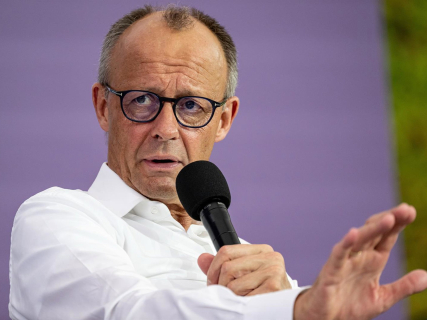
Germany accuses Russia of the bomb drone attack in Leipzig and raises the alert for hybrid warfare.

Berlin attributes to Moscow the thwarted attack of August 4 against the Leipzig/Halle airport. The accusation coincides with another possible sabotage against a key electrical substation in Brandenburg.

4 minutes

fotonoticia 20260819144505 1920

fotonoticia 20260819144505 1920

Add DEMÓCRATA to Google

Ask FREN

Published

Last updated

4 minutes

Most read

Germany has pointed to Russia as responsible for the failed attack with drones loaded with explosives against the Leipzig/Halle airport on August 4. The Government of Friedrich Merz thus elevates the episode to the category of hybrid threat and announces a response against Moscow, while the authorities investigate another possible sabotage against a strategic electrical infrastructure in Brandenburg.

The German Minister of the Interior, Alexander Dobrindt, and the Foreign Minister, Johann Wadephul, appeared this Tuesday in Berlin to communicate the conclusions reached by the Executive after several weeks of investigation.

"The German government concludes that Russia is responsible for the attack on August 4 at Leipzig airport," Dobrindt stated, according to the information released after the appearance. The German public television ARD has also confirmed that the federal government officially attributes the incident to Russia.

The decision represents a change from the position that Berlin maintained just 24 hours earlier. This Monday, the government spokesperson, Stefan Kornelius, refused to advance an attribution while investigations remained open and assured that any pointing would occur when the evidence was sufficiently solid.

At least three drones and explosives

The incident occurred during the night of August 4. At least three drones were involved in an operation directed against the Leipzig/Halle airport, where Ukrainian aircraft were located.

One of the devices loaded with explosives reached the vicinity of a Ukrainian plane. Another is said to have impacted against an aircraft without causing serious damage, while a third drone with explosive material was located days later within the airport perimeter.

The investigation determined that one of the devices did not explode due to a failure in the detonation mechanism, preventing a larger incident. Associated Press confirms that Berlin considers the episode a manifestation of Russian hybrid operations.

The German government had already classified the finding of a drone loaded with explosives as a "very serious security incident" and a "new quality of threat." The National Security Council met on August 7 under the presidency of Chancellor Friedrich Merz to analyze the case.

"Russia has Germany as a target"

The attribution comes amid German concern over the so-called hybrid war, which encompasses everything from sabotage and espionage to disinformation campaigns, cyberattacks, or actions against critical infrastructure.

"Russia has Germany as a target, just like the whole of Europe," Wadephul warned during the appearance.

Dobrindt has insisted that Germany "is not at war," but is indeed repeatedly exposed to disinformation, sabotage, attacks against critical infrastructure, and actions against Ukrainian interests.

This description coincides with the official assessment that the German Government itself made before attributing the Leipzig attack. Berlin maintains that Germany and Europe are subjected to an increasing combination of espionage, sabotage, disinformation, and cyberattacks from abroad.

Explosives near a thermal power plant in Brandenburg

The accusation against Russia has coincided with another incident affecting a critical German infrastructure, although for now the authorities have not linked both cases.

The police are investigating a possible attack against the electrical substation of Turnow-Preilack, in Brandenburg, a facility connected to Jänschwalde, one of the main thermal power plants in the region.

Investigators located an unexploded incendiary device and other homemade projectiles on the premises. Part of the infrastructure was temporarily out of service, although the general supply could be restored and there was no significant interruption of the grid.

The operator 50Hertz reported that the devices used were similar to homemade pyrotechnic projectiles and that other unused ones were found.

The company LEAG, responsible for the Jänschwalde plant, communicated a temporary shutdown of one of its units. The authorities in Brandenburg are investigating the episode as a possible deliberate attack against an energy infrastructure.

Berlin prepares its response

The Leipzig case has accelerated the response of Merz's Executive against drones and hybrid attacks. Germany is already working on strengthening the capacity of its security forces to detect, intercept, and neutralize unmanned devices.

The Government has also raised the general threat level from "abstract" to "high", after receiving an increasing volume of information from its own intelligence services and allied countries. Berlin specifies, however, that there is currently no specific threat against the population.

The response will also have a diplomatic dimension. According to Associated Press, Wadephul has announced measures against Russian interests in Germany, including the closure of the Russian consulate in Bonn on September 18 and the end of the agreement that allows the Russian House cultural center to operate in Berlin.

The German political offensive comes after Merz warned at the end of August that those responsible for the Leipzig episode would have to answer for their actions. The issue of drones was also part of the Executive's discussions during its retreat at the end of August, where the Government analyzed new defense capabilities against this type of threat.

More key points, information and questions with FREN

AI-GENERATED CONTENT

What is the parliamentary status of the new German measures to strengthen defense capabilities against drones and hybrid threats?

Based on the information available from the sources consulted, the “new German measures to strengthen defense capabilities against drones and hybrid threats” are, in their legislative aspect, at a preliminary or initial stage of parliamentary processing: the federal government has approved a reform project that expands the powers of the Federal Police against drones, but the text itself is still pending approval by Parliament. No specific status of reading or voting in the Bundestag nor specific treatment in the Bundesrat has been identified in the reviewed sources.

1. What specific measures have been identified

The piece most clearly linked to a parliamentary procedure is the legislative update described in the article from Demócrata “Germany will strengthen police capabilities to manage the drone threat” . According to this information:

  • The government of Friedrich Merz has approved a legislative document that explicitly expands the powers of the Federal Police to intercept and control drones.
  • The Police will be able to use their own drones, for example for monitoring demonstrations, and protect essential infrastructures and transport systems against drone threats.
  • The text also incorporates additional powers (interception of communications, detention of foreigners in the process of expulsion, random checks in sensitive areas, etc.).
  • The article itself emphasizes that “the text still requires parliamentary approval”, that is, it is an executive project that must pass through the Bundestag.

In parallel, other measures that strengthen capabilities against drones and hybrid threats, such as the launch of a Joint Drone Defense Center (GDAZ) in Berlin or a new anti-drone technology center associated with the German Aerospace Center, appear in the press as organizational and administrative deployment decisions, not as laws subject to detailed processing in the Bundestag and Bundesrat.

2. Parliamentary status: what is known

From the analyzed sources, the following conclusions about the parliamentary status can be drawn:

  • The key legislative measures are, for now, a regulatory update project approved by the Council of Ministers (Bundesregierung), mainly linked to expanding the powers of the Federal Police.
  • The government itself and the media indicate that the text still needs to be approved by Parliament, which implies that, at the time reflected by the news:
    • Either the project has not yet started its first reading in the Bundestag.
    • Or it is at a very early stage (first readings or referral to committee) about which the journalistic pieces do not provide details.
  • No Drucksache number (BT-Drs. xx/xxxx) nor a specific session of the Bundestag or Bundesrat where the text has been voted on is mentioned.
  • Consequently, there is no evidence in the sources used that the reform has already been approved by either the Bundestag or the Bundesrat, nor that the file has been definitively closed.

That is, in procedural terms, what is documented is a situation of pre-legislative and/or initial processing: the government has set the content and promoted it, but the parliamentary phase itself (readings, amendments, final vote) is not yet detailed.

3. Difference between legislative and operational measures

It is advisable to distinguish two levels:

  • Legislative level: the project to expand the powers of the Federal Police against drones, which does require Bundestag approval (and, depending on the type of law, may involve Bundesrat participation). Here the status is: government text approved, pending completion of parliamentary processing.
  • Operational and organizational level: the creation of anti-drone defense centers, industrial alliances (for example, agreements between Rheinmetall and Deutsche Telekom) or military and police deployment measures against hybrid threats. These actions, although politically relevant, do not always go through a specific legislative procedure and therefore do not necessarily generate a classic “parliamentary status”.

4. How to verify the exact status in the Bundestag and Bundesrat

To know precisely in which phase the specific file is today (type of law, readings held, votes, possible Bundesrat interventions), it is essential to locate the official title in German or the Drucksache number. With that data, you can directly consult:

Without that exact reference, press sources indicate that the “new measures” are, in their legal component, in the phase of government promotion and initial parliamentary processing, not yet completed.

What are the competencies of the German Interior Minister according to the law and to which political party does Alexander Dobrindt belong?

I cannot answer your question in detail because I specialize exclusively in the politics and institutions of Spain. This includes the Cortes Generales, the regional parliaments, the Government of Spain, the regional governments, the regulations, and public activity related to the Spanish sphere. The legal competencies of the German Interior Minister, as well as the political affiliation of specific leaders in Germany, are outside my scope of work and the databases I have access to.

Specifically, I do not have systematic or updated access to:

  • The constitutional and ordinary legislation of Germany that defines the competencies of its federal ministers.
  • The internal organizational rules of the German federal government or organic regulations of its ministries.
  • Official registers or specific databases about the profile and political career of German leaders.

For that reason, I could not offer you a legally reliable description of the competencies of the German Interior Minister “according to the law,” nor guarantee that the data I gave you about Alexander Dobrindt’s party affiliation would be accurate and up to date. For matters of law and institutional organization of Germany, it is safer to refer to:

  • The official pages of the German federal government (Bundesregierung) and the Ministry of the Interior.
  • The German Constitution (Grundgesetz) and the federal laws regulating the government and ministries.
  • Academic sources or manuals of German constitutional law.
  • Official or parliamentary profiles of Alexander Dobrindt himself in the Bundestag or his party.

Where I can help you is with analogous questions, but referring to Spain. For example:

  • Explain what the competencies of the Interior Minister of Spain are according to the Constitution, organic laws, and basic regulations governing the ministry.
  • Break down the structure of the Spanish Ministry of the Interior (State Secretariats, General Directorates, dependent agencies, etc.) and what each unit does.
  • Search for and summarize Spanish regulations on matters typically linked to the Interior: citizen security, security forces and bodies, civil protection, traffic, immigration, etc.
  • Analyze the political career and party of any Spanish Interior Minister in recent democracy.

I can also offer analysis and political contextualization within the Spanish framework, for example:

  • Compare how competencies are distributed in Spain between Interior and other ministries (Defense, Justice, Presidency, etc.).
  • Explain the role of the Ministry of the Interior in electoral management (organization of general, regional, and local elections), something very characteristic of the Spanish system.
  • Examine recent parliamentary debates in Spain on security, immigration, public order, or other topics linked to Interior.

If you want, you can reformulate your question focusing it on the Spanish case, for example:

  • “What are the competencies of the Interior Minister in Spain according to the law?”
  • “To which party does the current Spanish Interior Minister belong and what has been his political career?”
  • “What does Spanish legislation say about the functions of the National Police and the Civil Guard, and how do they depend on the Ministry of the Interior?”

With one of those questions (or another similar one, but referring to Spain), I could provide a detailed and well-founded answer based on official Spanish sources, also respecting the format and length you indicated.

What were the results of the last federal elections in Germany and which parties currently form the government?

The last federal elections in Germany were held on February 23, 2025, resulting in the 21st Bundestag, reduced to 630 seats after an electoral reform. The elections marked a shift from the previous legislature: the “traffic light” coalition (SPD–Greens–FDP) was replaced by a new “grand coalition” between the Christian Democratic bloc CDU/CSU and the Social Democratic Party (SPD), led by conservative Friedrich Merz as chancellor.

Results of the 2025 federal elections

According to information gathered by the international press, particularly El País and other media, the distribution of forces in the new Bundestag was as follows:

  • CDU/CSU (Christian Democratic Union and its Bavarian sister party CSU): the largest group in the Bundestag, with 208 deputies. It was the winning force in the elections, with around 28% of the votes, according to post-election analysis.
  • AfD (Alternative for Germany): became the second force, with 152 seats, almost double what it had in the previous legislature (from 83 to 152 deputies). With just over a fifth of the votes, it achieved the best result for the German far right since 1945.
  • SPD (Social Democratic Party): fell to third place, with 120 seats, 86 fewer than in the previous legislature. In percentage terms, it obtained around 16% of the votes, its worst federal result since the postwar period.
  • Die Linke (The Left): strengthened its presence to 64 deputies, according to the same parliamentary account, positioning itself as one of the main opposition forces to the right of the CDU/CSU and to the left of the SPD.
  • The Greens: went from being a pillar of the previous government to occupying fourth place, with 85 seats, now in opposition.
  • FDP (Free Democratic Party): was out of the Bundestag, failing to surpass the 5% vote threshold at the federal level. This reduced the number of parliamentary groups from six to five.

The resulting chamber, with 630 seats (compared to 733 in the previous legislature), thus presents a distribution in which CDU/CSU, AfD, SPD, Greens, and The Left are the five represented groups. The far right and the post-communist left together form a relevant “blocking minority,” while the traditional center-right and center-left parties maintain government control.

Composition of the current federal government

After the elections, and once any cooperation of the CDU/CSU with AfD was ruled out due to the maintenance of the so-called “cordon sanitaire” against the far right, the viable scenario to form a government was a new grand coalition between conservatives and social democrats. That negotiation lasted several weeks and culminated in April 2025.

According to the coalition agreement published by the press, the German federal government is currently formed by:

  • CDU/CSU bloc, which provides Chancellor Friedrich Merz and a majority of ministries, including Foreign Affairs and other key portfolios. It is the main force in government.
  • SPD, as a junior coalition partner, with the vice-chancellor position (likely Lars Klingbeil) and important ministries such as Finance and Defense (where Boris Pistorius’s continuity is mentioned).

Not part of the executive are:

  • AfD, despite being the second-largest force in seats, due to the explicit rejection by other parties to govern with the far right.
  • The Greens and Die Linke, which have moved to the opposition after having participated, in the case of the Greens, in the previous federal coalition.
  • FDP, which does not even have parliamentary representation in this legislature.

Political balances in the current Bundestag

The combination of a grand coalition government (CDU/CSU–SPD) and a strong AfD opposition creates an unprecedented scenario: traditional parties occupy the institutional center and preserve governability, while the far right capitalizes much of the protest vote but remains outside direct executive decision-making thanks to the cordon sanitaire.

At the same time, the Greens and The Left try to articulate a differentiated opposition from the left, in a smaller but more polarized Bundestag. This framework explains many of the tensions and debates on immigration, public spending, European policy, and defense that currently traverse German politics.

Play

Test your knowledge with FREN!

How much do you know about this topic? Answer the following 3 questions.

Who has Germany officially attributed the failed drone attack at Leipzig/Halle airport to?

Question 1 of 3

Which German infrastructures have been investigated for possible attacks or sabotage, besides Leipzig/Halle airport?

Question 2 of 3

What diplomatic actions did the German government announce in response to the attack attributed to Russia?

Question 3 of 3

Hola, soy Fren. ¿Cómo te ayudo?