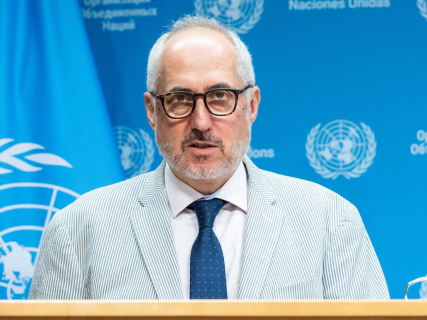

The United Nations confirmed this Wednesday that it will continue to support the Gang Suppression Force in Haiti following the recent renewal of its mandate by the Security Council. At the same time, the organization has emphasized the lack of resources for the humanitarian plan in the Caribbean country, as detailed in a press conference by the spokesperson for the Secretary-General, Stéphane Dujarric.
Despite this political and logistical support, António Guterres' representative has stressed that the UN has no authority to control or assess the results of the mission on the ground. "We have no role in the supervision and evaluation of the Gang Suppression Force," he specified to the media.
Nevertheless, he highlighted that, following the extension of the mandate, the organization will continue to provide support through the office specifically created to accompany that force in its deployment.
In this regard, Guterres' spokesperson insisted that the United Nations will maintain cooperation with the countries that make up the force to facilitate their compliance with the obligations assigned to them. "We are doing that and will continue to do so, working closely with them to help them implement their own mandate," he stated.
At the same time, Dujarric lamented that the humanitarian emergency in Haiti continues to be heavily conditioned by the lack of funds. He recalled that the Humanitarian Response and Needs Plan for the country "has not yet received half of the funding" expected, estimated at 880 million dollars (about 756 million euros) to assist 4.2 million people.
To date, the United Nations has only managed to raise 416 million dollars (about 358 million euros), according to the organization's own data. Furthermore, he criticized that this money is arriving when there are barely three months left until the end of the year, which maintains a significant financial gap and makes it difficult to cover the needs included in the humanitarian program.
These statements come after the UN Security Council approved on Tuesday the six-month extension of the mandate of the Gang Suppression Force (GSF) in Haiti, which will remain in effect until March 31, 2027. The decision is made in a context of the expansion of armed gangs and urgency to restore state authority in large areas of the territory.
The resolution 2829 (2026) was approved with twelve favorable votes, none against and three abstentions, corresponding to China, Pakistan, and Russia. The text also asks the Secretary-General to continue providing logistical and operational support to the mission through the United Nations Support Office in Haiti (UNSOAH), in compliance with what is established in resolution 2793 (2025).
At the beginning of 2024, a new wave of violence shook Haiti and led to the resignation of then-Prime Minister Ariel Henry. Henry had taken office in 2021, amid strong criticism and after several years of instability, following the assassination of President Jovenel Moise at his official residence by a group of armed men.
Five years after the assassination of Moise, the security situation continues to be disastrous in the Central American country. The escalation of violence has already caused nearly 1.5 million displaced persons, of which almost 80% are outside the capital, Port-au-Prince, as insecurity spreads to other regions of the State, according to figures from the International Organization for Migration (IOM).