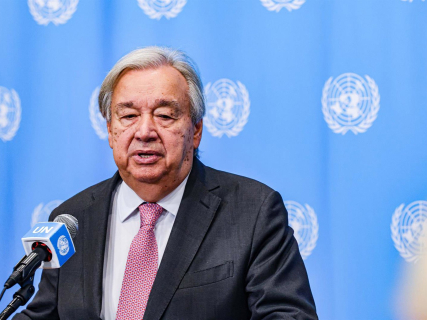

The Secretary-General of the United Nations, António Guterres, has taken advantage of the ninth anniversary of the forced displacement of the Rohingya population to demand "providing protection to those fleeing Myanmar" and "strengthening collective action" in the face of a crisis that began in 2017, when military repression triggered the flight of nearly a million people.
As explained by his spokesperson, Stéphane Dujarric, "almost a decade after the horrific events of 2017, the Secretary-General is calling for renewed global attention and action regarding the difficult situation of the Rohingya," warning of the "growing insecurity, a reduction in their protection space, and increasingly diminished prospects for durable solutions" for this minority.
The statement details that in Myanmar "the Rohingya and other communities remain trapped in conflict and displacement, suffering severe human rights violations and other abuses, even by the Myanmar army, the Arakan Army, and others." Dujarric emphasizes that "hundreds of civilians continue to be killed each year, while circulation and humanitarian access remain restricted," to which are added risks of "forced recruitment, arbitrary detentions, and sexual violence."
In this scenario, the text emphasizes that "the Secretary-General reiterates his call for the protection of civilians in accordance with applicable obligations under International Law" and "thanks the continued hospitality of Bangladesh and other countries hosting refugees, and urges all States to provide protection to those fleeing Myanmar." The spokesperson also stressed that Guterres "is concerned about the growing number of Rohingyas perishing at sea and calls for regional cooperation on search and rescue, safe disembarkation, and combating human trafficking."
Furthermore, "he is deeply troubled by the rise of disinformation, misinformation, and hate speech directed against the Rohingya in Myanmar and other countries in the region." Therefore, the highest official of the UN calls on the international community to "strengthen collective action to support a comprehensive and inclusive political solution" and "continue providing humanitarian assistance, livelihood opportunities, and support for self-sufficiency" until "conditions allow for the voluntary, safe, dignified, and sustainable return of the Rohingya."
Currently, hundreds of thousands of Rohingyas continue living in the gigantic refugee settlement of Cox's Bazar, in Bangladesh, where they drag an existence marked by overcrowding, the spread of diseases, the impact of storms, and frequent fires, in addition to remaining in a situation of legal and institutional limbo since the mass exodus of 2017.
At the same time, Myanmar remains immersed in a civil war unleashed after the coup d'état of 2021 that brought the current president, Min Aung Hlaing, to power. According to the Assistance Association for Political Prisoners of Myanmar (AAPP), more than 8,300 people have lost their lives across the country in junta operations and nearly 22,600 remain imprisoned.
The National Unity Government, which groups the democratic authorities of Myanmar in exile, claims that the Myanmar Army has perpetrated dozens of massacres against the civilian population since it took control. In turn, the United Nations High Commissioner for Human Rights, Volker Türk, has repeatedly denounced the "impunity" with which the Burmese military leadership acts, which it holds responsible for generating a "perpetual" political and humanitarian crisis.