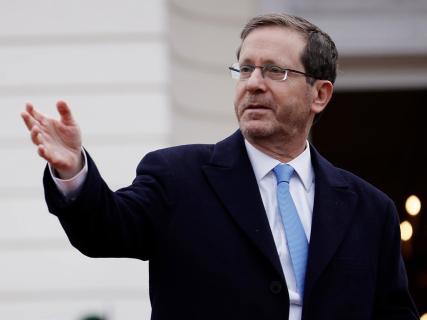

The president of Israel, Isaac Herzog, has called for “patience” this Wednesday as investigations continue into a alleged “foreign interference” in the legislative elections of October 27. At the same time, he has reiterated his confidence in the institutions in charge of the inquiries, after the Central Election Committee (CEC) dismissed irregularities and in a context of pressures from the coalition led by Prime Minister Benjamin Netanyahu to stop the official ratification of the results.
Herzog, who received the final results from the CEC, has underlined that the elections held last week were “a true celebration of democracy”. “The citizens of Israel turned out in large numbers at the polling stations across the country,” he said, referring to the high turnout recorded.
“I said it before and I repeat it here: I have full confidence in the work of Shin Bet, the Israel Police, and the authorities tasked with enforcing the law,” he said, adding that “any suspicion of subversive foreign interference in the election results must be investigated thoroughly”.
The head of state has insisted on the need to let the investigators work: “Patience is required. The investigation will be carried out in a professional manner, with cooperation among all the agencies that make up the special investigation team, and I trust these processes, as has always been the case.” He also expressed his support for the work of the attorney general, Gali Baharav-Miara, amid a heightening of political tensions over these accusations.
Following the suspicions about alleged external funding, which include allegations of attempts to mobilize the vote among Arab-Israelis, Herzog has asked “not to defame an entire community.” “Be careful with generalizations. I have great respect for Arab society in Israel,” he pointed out, according to a statement released by his office.
The president went further by denouncing the tone of part of the public debate: “I condemn the crudeness and the racist statements that we have heard recently. They have no place, directed toward any community in Israel,” he said, linking these words to a reminder of the assassination, 31 years ago today, of the then prime minister, Isaac Rabin.
"This date will remain forever as a painful reminder. A reminder that warns us about what can happen when disagreement turns into hatred, when political rivalry turns into violence," he has said. "There is no place for violence among us. Neither physical nor verbal. Neither against an individual, nor against any community, sector, or segment of society," he added.
In this context, Herzog has stressed that "the elections are over" and that "now is the time to face reality." He has urged political formations to "avoid a new round of elections" and to "assemble a stable Government that is good for the people of Israel," ahead of the imminent start of his consultations with the parties to decide whom he will task with forming the next Executive.
"For me it is important to emphasize that I am not asking anyone to renounce their values, but given the current reality, in which there is no clear winner after the elections, I ask for originality and creativity, courage and good will, so that the State of Israel emerges as the winner," the head of state has said.
ASKS TO ADDRESS "TRANSCENDENTAL" MATTERS
Herzog has stressed that the country faces issues "transcendental" that "require urgent business." "All it takes is for any reasonable person to observe the security and diplomacy challenges we face, the changing region surrounding us, and to remember the issues that tear us apart internally, to understand that an immense responsibility rests on us," he has explained.
"After three years of war, the eyes of the citizenry are on you, our leaders," the president said, who has recalled that he has a "very broad" power when designating the parliamentarian to whom he will entrust the task of forming the Government. "The only criterion that I ask the factions and their representatives to have in mind when appearing here is the following: what is it that, at this moment, is truly better for the country," he concluded.
His statements come after the Shin Bet informed the CEC that its inquiries point to a possible case of foreign funding and interference that would affect "thousands of people," although it has clarified that it needs to continue with the investigations. As a result, the National Security minister, Itamar Ben Gvir, has demanded the arrest of "all the leaders of Arab parties" for questioning.
For its part, the CEC reiterated early in the day that it has not detected "irregularities" that call into question the cleanliness of the legislative elections of October 27. The presidium of the body has already ratified the results, which will be sent to the president, Isaac Herzog, so that he can open the round of consultations and determine which candidate he grants the mandate.
The procedure thus enters its final phase, in parallel with the attempts by Likud, the formation of Benjamin Netanyahu, and its coalition allies—among them Otzma Yehudit—to postpone the validation of the results, citing alleged irregularities and fraud in the voting.
The elections gave the Likud as the most-voted list, which would have obtained 27 seats, compared with the 21 of the opposition party Yashar, headed by Gadi Eisenkot. However, neither of the blocs reaches the majority of 61 seats by itself, so the alternatives involve a pact with the Arab parties—which add up to 19 deputies—or a right-wing coalition that leaves out the ultra-Orthodox parties.