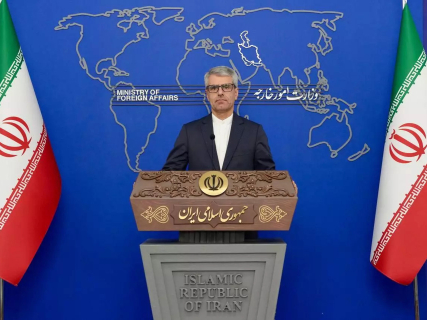

The authorities of Iran have acknowledged that they maintain an exchange of messages with the United States, although they have emphasized that their "priority" in the current context is to "defend" their "sovereignty" and "territorial integrity" and to ensure the protection of their population "from the war crimes that the American country is committing."
"They --the Americans-- are exchanging messages, but for Iran the priority in the current situation is to defend our sovereignty and territorial integrity and to protect our people from these war crimes that the United States is committing," stated the spokesman for the Iranian Foreign Ministry, Esmail Baqaei, in an interview for the Austrian channel ORF, reported by the Iranian agency ISNA.
Subsequently, the spokesman clarified his words, emphasizing that, although "the mediators are busy doing their work," for the ruling leadership of the Islamic Republic, which has denounced that it "is being bombed and attacked," the "main priority" remains "to defend Iran."
"The mediators, among them Pakistan and Qatar, are active and exchanging messages between the parties," indicated the high official, stressing that, despite the fact that Iran "has never shied away from the negotiating table," it will also not accept a dialogue "whose purpose is to dictate or impose demands."
On the other hand, Baqaei described the most recent attacks by the American Army on Iranian territory as "a continuation of the illegal war" that began on February 28 after the joint offensive by Washington and Israel against Tehran.
"We witnessed a ceasefire. We entered the negotiation process in good faith, both for the good of our own people and to ensure the security of the region and the world. We negotiated in good faith and managed to reach a memorandum of understanding to end the war on all fronts," asserted the Iranian, adding that the United States, "from the first days evaded compliance with its obligations by alleging various excuses."
In this sense, after emphasizing that Tehran "fulfilled all its commitments to facilitate the safe passage of vessels through the Strait of Hormuz," the spokesperson criticized that, shortly after the signing of the aforementioned memorandum, the United States launched "a large-scale military aggression against Iran using the incidents against merchant navigation" in that strategic enclave, where traffic is now at historic lows due to the double blockade imposed by the U.S. and Iranian authorities.
"This memorandum of understanding is not a long and complicated document; it is a brief memorandum of understanding with 14 clauses, and the whole world expected that, at least this time, the United States would fulfill its obligations," he indicated, emphasizing that the text is "unequivocal," "does not admit interpretations," and that, for this reason, "what the United States did constitutes a clear and flagrant violation of various provisions of this agreement" in what he maintained represents a "betrayal of diplomacy for the third time."
When asked about the latest episodes recorded in Hormuz, including the explosion this very Sunday of a mine in the path of a tanker that, according to Iranian authorities, "deviated from the route specified by Iran," Baqaei claimed the role of his citizens as "guardians of the security" of the strait and the Persian Gulf "for many years."
"We have guaranteed the safety of the ships and vessels that traverse this strategic waterway despite being subjected to the most severe sanctions of the last decades," he defended, insisting that, in his opinion, "the incidents that occurred in the Strait of Hormuz were not provoked by Iran's actions" but rather "are a direct consequence of the aggression of the United States and Israel" against the country.