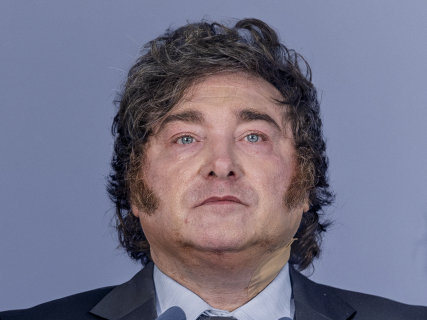

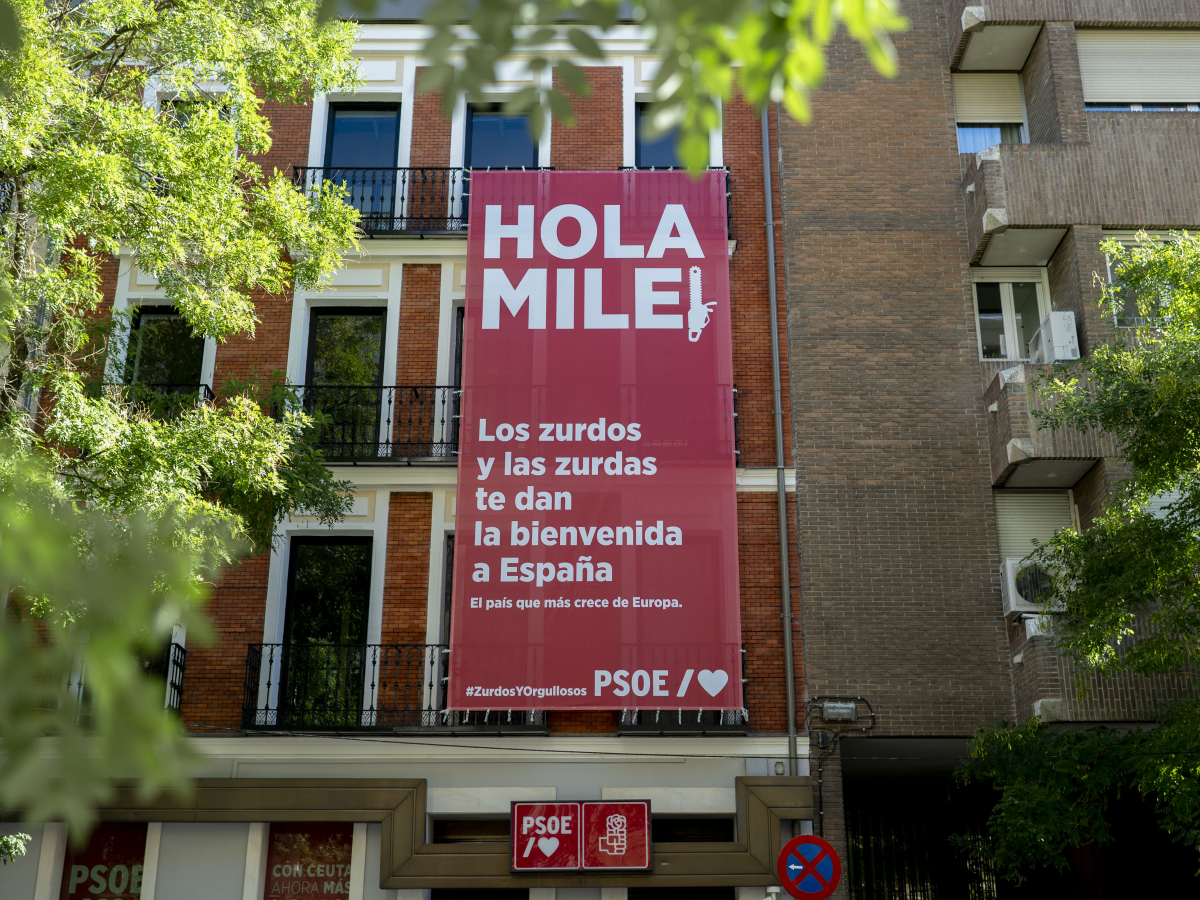
Up to 25 sponsors disappeared yesterday from the front panel of the event that welcomed Javier Gerardo Milei, president of the Argentine Republic, while the PSOE headquarters in Ferraz displayed a banner on its facade reproaching his visit and defending being 'leftists'.
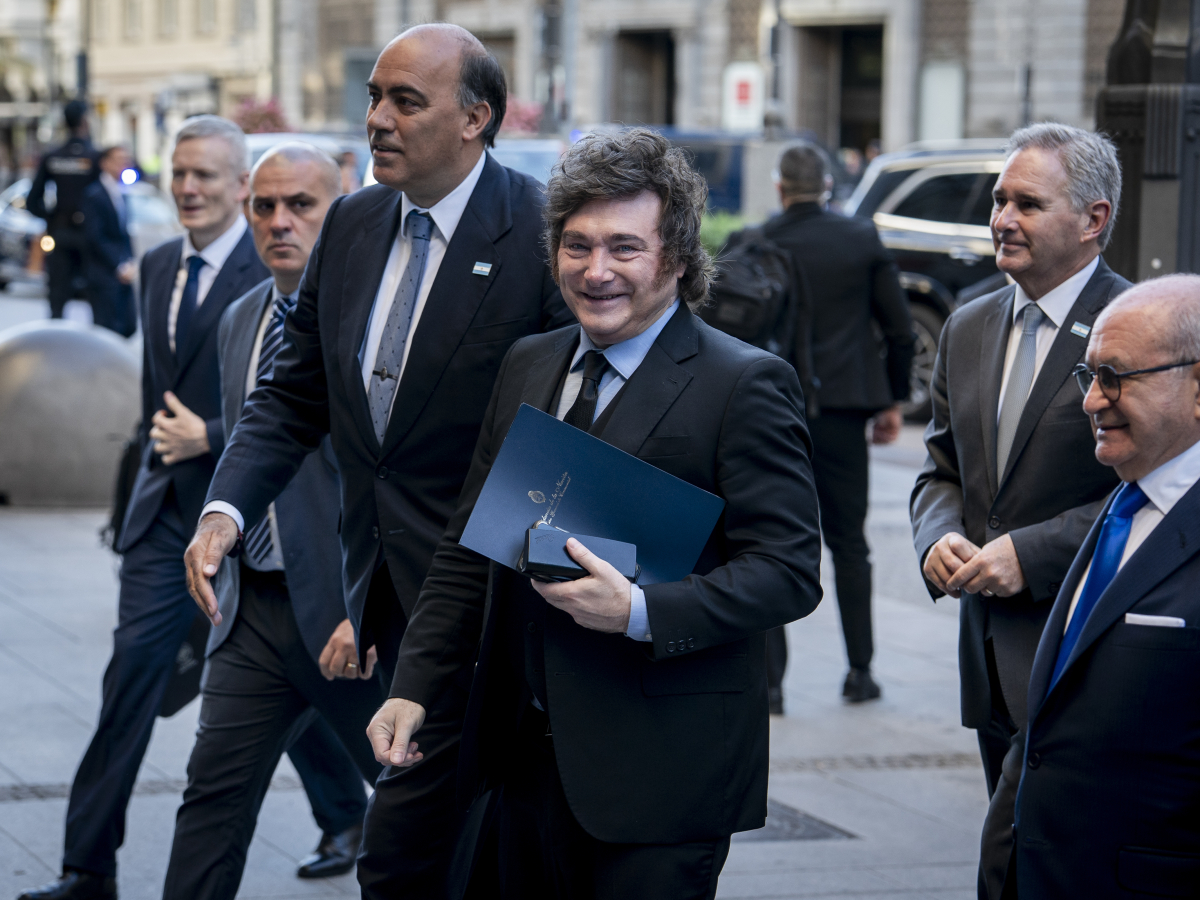
At ten fifteen in the morning, exactly half an hour late, the president ascended the staircase of this historic building, located a few steps from the Puerta del Sol, to deliver a speech full of liberal notions and against the "liberticidal" policies of Pedro Sánchez, as he referred to the president of the Government, along with other critical comments.
The speech by Javier Milei at the Casino sparked a mix of enormous curiosity, displays of support, and some caution among the attendees. At some moments, the audience responded favorably to his words, while at others the theatricality of the Argentine president, the forcefulness of his interventions, and the harshness of some of his political messages seemed to generate some apprehension.
The advertising of the event also caught attention. In contrast to the usual presence of a larger number of sponsoring companies in the announcements of these meetings, on this occasion only the logos of two unique patrons could be identified: Solaria and Asisa.
Nevertheless, the expectation of the packed auditorium did not disappoint, at least in terms of the number of attendees and personalities. Among them were numerous businessmen, diplomatic representatives from the United States and Israel, media directors, politicians from the Community of Madrid, and the president of the Senate, among others.
The defense of liberalism and the attacks on socialism
Milei took advantage of his speech to advocate for economic and political liberalism, with references to the School of Salamanca, and to attack socialism and the management of Sánchez's Government. The Argentine president defended the reduction of the weight of the State, tax cuts, and the elimination of regulatory barriers as ways to boost economic activity.
In his speech, he presented the decisions adopted by his Government as a break with the previous model. He stated that Argentina started from a consolidated deficit equivalent to 15 points of GDP and claimed that he had reduced taxes by four points of the gross domestic product. He also asserted that, in 30 months, his Executive had returned to Argentines "close to 20 points of GDP".
The Argentine president also defended his Administration's elimination of 18,000 regulations and cited Decree 70/2023 as one of the main tools of his deregulation program.
His intervention was marked by a combative tone, with criticisms of the left and those who, in his opinion, use institutions to sustain policies contrary to economic freedom.
In this context, he demanded to remove socialists from political action, a statement that placed his speech in the realm of confrontation, also highlighting the economic differences in management.
Los sponsors pidieron NO APARECER en el discurso de Milei en España JAJA
— Arrepentidos de Milei (@ArrepentidosLLA) October 21, 2026
FENÓMENO BARRIAL pic.twitter.com/Gkwa1QUb5k
Housing, one of the examples of his program
With the presence among the audience of the director of Tressis, economist Daniel Lacalle, housing occupied a relevant part of his argument. Milei stated that, after the elimination of rental controls and the repeal of the Rental Law, the supply of rental housing had quadrupled in Argentina in 30 months and prices had fallen by 40%.
Milei's argument emphasizes that the removal of restrictions has allowed for an increase in supply and facilitated access to rental housing. The Argentine experience has become one of the examples he uses to defend the liberalization of the market.
Energy and mining to boost growth
The Argentine president also emphasized the country's natural resources, with references to lithium, copper, gold, and energy potential. He presented the exploitation of these resources and the development of infrastructure as opportunities to attract investments and increase exports.
In the energy sector, he pointed to the growth possibilities of liquefied natural gas exports and stated that they could reach 100 billion dollars starting in 2027 and 200 billion in the following four years.
To attract foreign capital, he defended the Regime of Incentives for Large Investments (RIGI), approved by his Government to offer specific conditions for large projects.
Political and business corruption
"And this is why the private sector is starting to invest again," Milei emphasized before an audience plunged in enormous silence, before stating that, for the first time in a century, Argentina is beginning to show its true potential.
The Argentine president also questioned those who consider the level of investment in relation to GDP to be insufficient and raised the need to analyze that figure taking into account the structure of the economy and the protected sectors. In his view, protectionist measures shelter particular interests and harm the general public. Milei stated that this protection often responds to exchanges of favors and linked these practices to corruption: "It is a business between corrupt politicians and corrupt businessmen", he stated.
In his opinion, the liberalization of the economy allows for a reassignment of resources that puts an end to those privileges and opens space for other productive activities.
No response to the PSOE's action in Ferraz
The visit of Milei coincides with the proximity of the general elections on November 29 and with a new episode of confrontation between the Argentine president and the Spanish Government.
Yesterday, the PSOE installed a banner in Ferraz with critical messages towards Milei and claims linked to the policies of Pedro Sánchez.
The president of the Government also published a video on TikTok in which he appropriated the term "leftist," commonly used derogatorily by his political opponents.
"If raising pensions is being leftist, I am leftist. If raising the minimum wage is being leftist, I am leftist. If expanding the permits for parents to enjoy their children is being leftist, I am leftist. If defending women's right to decide about their bodies is being leftist, I am leftist. And if saying no to war is being leftist, I am leftist and very proud of it," he stated.
Asked by journalists about the PSOE's initiative, Milei passed by without making comments. Thus, he did not directly enter into the controversy driven from Ferraz during his public intervention in Madrid.
Ayuso and Abascal, on his Spanish agenda
After the speech, the Argentine president confirmed that he planned to meet with Isabel Díaz Ayuso -as he did in the afternoon at the headquarters of the Canal de Isabel II- and that he would also speak with Santiago Abascal -he did so via a video call-. He referred to both as friends with "healthy and positive ideas" to get Spain out of the decay that, in his opinion, the country is going through.
Milei, on the other hand, ruled out a meeting with Pedro Sánchez and again directed personal criticisms against the president of the Government, whom he called a "criminal" and "thief." He also stated that to visit Sánchez in Moncloa, he would have to "sew his pockets" to prevent being robbed or plundered.
The agenda of the Argentine president included yesterday events in the university sphere, in addition to a meeting with Ayuso at the Canal de Isabel II.
According to political sources consulted by this newspaper, his trip was scheduled in advance, although its coincidence with the pre-election campaign for the Spanish general elections has added a political dimension.
Featured story
Óscar López responds to Milei: In Spain the chainsaws will continue cutting firewood
3 minutes
"The decline is not a destiny"
In the final part of his speech, Milei again presented the Argentine experience as a model that, in his opinion, can serve as a reference for other Western countries. "We want the reconstruction of Argentina to be the roadmap for the next West," he stated, before insisting that "the decline is not a destiny."
The Argentine president closed his intervention with his usual "Long live freedom, damn it!". The audience responded with loud applause, on a morning where curiosity about the leader coexisted with support for a good part of his ideas and with some reservation towards his confrontational style.
The meeting thus left two images: the defense of a program of economic liberalization, which Milei presents as the path for Argentine recovery, and a political speech marked by criticisms of Sánchez and socialism.