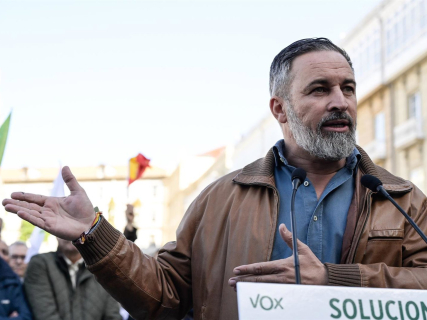
Consult here the heads of the list for the 29N of Vox: Abascal for Madrid, Figaredo for Asturias and De Meer for Almería

The formation confirms its candidates for Congress in the 52 constituencies, with Montse Lluís as number two for Madrid and Pepa Millán in the fourth position.

fotonoticia 20261021131540 1920

fotonoticia 20261021131540 1920

Add DEMÓCRATA to Google

Ask FREN

Published

Last updated

2 minutes

Most read

Elecciones 29N · Encuestas

La media de las encuestas

Media a 21 de octubre de 2026 · 15 institutos

  • PP31,6 %
  • PSOE26,9 %
  • Vox18,7 %
  • Sumar6,3 %
  • Podemos3,1 %
  • ERC2,2 %
010203040ene 2024jul 2024ene 2025jul 2025ene 2026jul 2026

Media del último estudio de cada instituto en 30 días y su evolución semanal desde el 23J. Partidos con al menos un 2 %.

Todas las encuestas

Elecciones generales del 29 de noviembre · Demócrata

Vox announced this Wednesday the names of the candidates who will head their lists for the Congress of Deputies in the general elections on November 29. Santiago Abascal will run again for Madrid, while other prominent leaders of the party, such as José María Figaredo, Rocío de Meer, and Carlos Hernández Quero, will lead the candidacies for Asturias, Almería, and Málaga, respectively.

The party leadership, which approved the lists in its National Executive Committee last Monday, bets on leaders from its organic and parliamentary structure to head a good part of the candidacies.

In Madrid, Abascal will be accompanied by Montse Lluís as number two, followed by the Vox spokesperson in Ceuta, Juan Sergio Redondo, in third position. The parliamentary spokesperson, Pepa Millán, will occupy the fourth place, while the councilor and national spokesperson for Sports, Cristian Toro, will close the top five positions.

Among the main names, Samuel Vázquez, spokesperson for Security and Immigration, who will head the candidacy for Ávila, and Ignacio Hoces, deputy secretary for Institutional Affairs, who will run for Badajoz, stand out. The national spokesperson for Education, Joaquín Robles, will be the head of the list for Murcia, while Alberto Rodríguez Almeida, responsible for Industry, will do so for Las Palmas.

The heads of the list of Vox by autonomous communities

Andalusia. Rocío de Meer (Almería), Blanca Armario (Cádiz), José Ramírez del Río (Córdoba), Jacobo González-Robatto (Granada), Tomás Fernández (Huelva), Francisco José Alcaraz (Jaén), Carlos Hernández Quero (Málaga), and María de los Reyes Romero (Sevilla).

Aragon. Esther Blanco (Huesca), Daniel Alda (Teruel), and Carmen Rouco (Zaragoza).

Asturias. José María Figaredo.

Balearic Islands. María Isabel Cerezo.

Canary Islands. Alberto Rodríguez Almeida (Las Palmas) and Alejandro Gómez (Santa Cruz de Tenerife).

Cantabria. Emilio Jesús del Valle.

Castilla-La Mancha. Rubén Herrero (Albacete), Ricardo Chamorro (Ciudad Real), Iván Vélez (Cuenca), Ángel López Maraver (Guadalajara), and Manuel Mariscal (Toledo).

Castilla y León. Samuel Vázquez (Ávila), Eugenia Landaluce (Burgos), Pablo Juan Calvo Liste (León), Matías Recio (Palencia), Laura Magdalena Miquel (Salamanca), Gonzalo Babé (Segovia), Andrea Martínez Ruiz (Soria), Pablo Sáez Alonso-Muñumer (Valladolid), and Miguel Suárez Arca (Zamora).

Catalonia. Juan José Aizcorbe (Barcelona), Ignasi Mulleras (Girona), Rafael Villafranca (Lleida), and Jordi de la Fuente (Tarragona).

Valencian Community. David García Gomis (Alicante), Alberto Asarta (Castellón) and Ignacio Gil Lázaro (Valencia).

Extremadura. Ignacio Hoces (Badajoz) and Marcela Reija (Cáceres).

Galicia. Manuel Fuentes Lamas (A Coruña), Jesús Primitivo Rodríguez (Lugo), María Jesús Morenza (Ourense) and Álvaro Díaz-Mella (Pontevedra).

La Rioja. Ángel Alda.

Madrid. Santiago Abascal.

Murcia. Joaquín Robles.

Navarre. María del Perpetuo Socorro Sada Ballesteros.

Basque Country. Marco Antonio Moreno Asla (Bizkaia).

Ceuta. Ana Belén Cifuentes.

Melilla. José Miguel Tasende.

With the presentation of their heads of list, Vox advances in the preparation of its candidacies for the general elections on November 29, in the midst of the deadline for submitting lists to the electoral boards.

More key points, information and questions with FREN

AI-GENERATED CONTENT

What is the status of the processing of the electoral lists submitted by Vox for November 29th, and what are the next steps according to Spanish electoral legislation?

As of October 21, 2026, Vox's candidacies for the general elections on November 29 have not yet been proclaimed: today marks the start of the period to submit them to the provincial electoral boards. The information consulted confirms candidate announcements but does not allow us to affirm that all lists have been formally submitted. The next milestone will be their provisional publication, followed by review, correction, and proclamation.

Current status: announcement does not equal proclamation

Vox has announced candidates, including Santiago Abascal as the lead candidate for Madrid, and its intention to run for Congress in all 52 constituencies. However, these announcements do not replace the formal submission nor the verification of legal requirements by the electoral administration. This distinction is made by the Demócrata search tool, updated on October 19.

Therefore, the situation should be described as the candidate submission phase, not as final approval. Nor is there any record in the sources consulted of a formal specific challenge against these lists or an electoral protection appeal admitted by the Constitutional Court. An internal disagreement about candidates should not be confused with an appeal against their proclamation.

Next steps and schedule

The procedure is mainly articulated in Articles 44 to 49 of the Organic Law of the General Electoral Regime, known as LOREG. According to the schedule published by Demócrata, the milestones are:

  • From October 21 to 26: submission to the corresponding Provincial Electoral Board. The deadline ends at midnight on the 26th. Each candidacy must provide candidate identification, acceptance, and the required documentation; Vox does not submit a single nationwide list for Congress.
  • October 28: publication in the Official State Gazette (BOE) of the submitted candidacies. This first publication allows knowing their composition but does not yet mean that all have been admitted to run.
  • Review and correction: during the following two days, the boards will communicate any detected or reported irregularities. Representatives will have 48 hours from the communication to correct fixable defects.
  • November 2: proclamation of candidacies that meet legal requirements, once possible corrections have been examined.
  • November 3: publication in the BOE of the proclaimed candidacies. This is the official act to consult which Vox lists are admitted and with which members.
What is reviewed and how to appeal

The boards verify documentation, candidate acceptance, eligibility, and compliance with composition rules. For this call, the published information includes the requirement of alternation between women and men on Congress lists, introduced by Organic Law 2/2024. A correctable documentary omission does not necessarily have the same consequences as a legal cause of ineligibility.

After the proclamation publication, the schedule sets the possibility to appeal before the competent Contentious-Administrative Court between November 4 and 5. This court has two days to resolve. The dispute may concern either exclusion or admission of a candidacy considered contrary to the law.

Subsequently, when applicable due to violation of fundamental rights, one may appeal to the Constitutional Court through electoral protection, which must resolve within three days. This is not an automatic review of all lists. Consequently, to verify the status of a specific Vox candidacy, three moments must be distinguished: submission, proclamation, and possible resolution of appeals.

What are the competencies and functions of candidate Santiago Abascal as president of Vox and deputy in Congress?

Santiago Abascal holds two different responsibilities: as president of Vox, he directs and represents the party; as a deputy, he participates in Congress decisions and government oversight. The first is an internal function of a political organization; the second, a public representative responsibility. His status as a candidate does not by itself add institutional competencies.

As president of Vox

Abascal has presided over Vox since 2014 and was re-elected in January 2024. His organic powers are set out in the party statutes. The main ones are:

  • Represent Vox before authorities, institutions, entities, courts, and individuals. This is representation of the party, not of the State.
  • Direct and coordinate general political action, promoting its priorities and strategy within the organization.
  • Preside over the National Executive Committee and other party bodies of which he is a member.
  • Execute internal agreements of the National Executive Committee, the Political Action Committee, the Management Committee, and other relevant bodies.
  • Issue internal instructions for the functioning of the party, within his statutory powers.
  • Represent the party internationally, unless delegated, and direct its relationship with the Disenso Foundation.
  • Appoint the general electoral representative, who represents the party in submitting candidacies.

In practice, these powers allow him to lead Vox's public representation, coordinate its political orientation, and intervene in electoral strategy according to internal procedures. However, presiding over the party does not allow him to approve laws or give orders to the Administration. Nor does it automatically convert all collective body decisions into personal decisions of the president.

As a deputy in Congress

He has been a deputy for Madrid since 2019. His official Congress profile records his membership in the XV Legislature and the Permanent Deputation. Parliamentary powers must be distinguished between those he can exercise individually and those requiring acting through the group or gathering regulatory support.

  • Debate and vote: participate in the Plenary and committees he belongs to, intervening according to the rules for speaking turns.
  • Participate in legislation: submit amendments and promote or co-sign initiatives. Bills presented by deputies require the supports provided in the Regulations; an individual signature is not necessarily sufficient.
  • Control the Government: submit written or oral questions and participate in other control instruments, according to applicable requirements.
  • Request information: ask for data, reports, and documents from public administrations, with knowledge of his parliamentary group.
  • Promote political decisions: participate, through the corresponding channels, in motions and non-legislative proposals, which express positions or requests to the Government but are not laws.

He also participates by voting on budgets, investiture, and other matters attributed to Congress. These are collective competencies of the Chamber, not powers he can exercise alone. Congress explains these powers on its page about deputies' functions.

His responsibility in the Permanent Deputation

Abascal has been a member since November 21, 2023. This body guarantees parliamentary continuity outside ordinary periods and when the Chamber is dissolved. His membership means participating in its deliberations and votes, not individually substituting Congress.

In short, his leadership over Vox is political and organizational; his parliamentary powers are those recognized to deputies and must be exercised according to the Chamber's procedures.

What results did Vox obtain in the last general elections compared to the major parties in each province?

In the last general elections, held on July 23, 2023, Vox obtained 33 deputies and approximately 12.4% of the votes. It ranked behind the PP, with 137 deputies in the final result, and the PSOE, with 121. However, the provincial information consulted contains contradictions that prevent offering a complete and reliable breakdown of the 50 provinces, Ceuta, and Melilla.

The national comparison

Electoral summaries published during the count placed the PP at 33.1% of the votes, PSOE at 31.7%, Vox at 12.4%, and Sumar at 12.3%. These percentages allow appreciating the distance between candidacies but must be distinguished from the final distribution of deputies and the particular results of each constituency.

  • Compared to PP: Vox was approximately 20.7 percentage points behind nationwide.
  • Compared to PSOE: the difference was about 19.3 points.
  • Compared to Sumar: both had similar national percentages; Vox obtained 33 deputies and Sumar 31.

These general data appear in the coverage of the count. Figures released during election night should not be confused with final ones.

Why I did not provide an incorrect provincial list

The territorial summary consulted does not offer a sufficiently consistent basis to answer your question province by province. For example, it attributes Vox 33 constituencies with representation but only lists thirteen with deputies. Also, the seats assigned to those thirteen add up to 17, not the 33 national ones. Some provincial distributions also do not match the totals presented by the summary itself.

Therefore, it would not be correct to transfer those percentages and seats to a provincial comparison, even if their presentation might seem precise. The discrepancy does not affect only a tenth of a vote: it compromises identifying where Vox obtained representation and how many deputies corresponded to its competitors.

What the comparison you request should include

To respond usefully, each province needs the same magnitudes and comparison criteria:

  • Vox: votes, provincial percentage, and deputies obtained.
  • PP and PSOE: their percentages and seats in that same province, without substituting them with their national results.
  • Provincial leading force: the most voted candidacy, also when it is not PP or PSOE.
  • Electoral difference: distance of Vox relative to the winning candidacy, expressed in percentage points.
  • Representation: distinction between electoral support and deputies, as they are different measures.

It is also advisable to clarify that “major parties” can mean the two main national parties or the most voted in each province. For your question, the most complete comparison would always include PP and PSOE and add any other candidacy that led the provincial result.

Territorial overviews by Europa Press and El País serve as contextual references. The national conclusion is clear: Vox ranked below PP and PSOE. The complete provincial breakdown is not reliably evidenced in the sources consulted; therefore, I do not provide you with concrete results that could mislead you.

Play

Test your knowledge with FREN!

How much do you know about this topic? Answer the following 3 questions.

Which Vox leader will head the list for Madrid in the general elections on November 29?

Question 1 of 3

Who will lead the Vox candidacy for Asturias?

Question 2 of 3

In which province will Rocío de Meer be the head of the Vox list?

Question 3 of 3