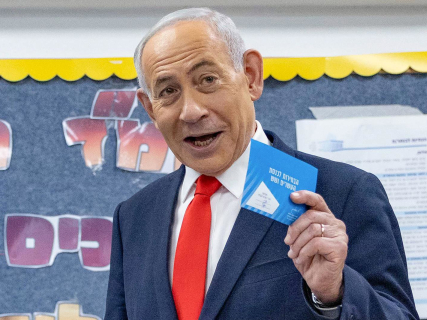

The outgoing prime minister and Likud leader, Benjamin Netanyahu, has demanded this Saturday the creation of a national unity government together with the parties that until now made up his government coalition, despite the fact that, following the latest elections, this bloc does not have the necessary majority in the Knesset, the Israeli Parliament.
"There are those who want a government to take office quickly, next week, with those who support terrorism," Netanyahu said, in a veiled reference to Eisenkot. "Forming a government in the State of Israel with those who want to eliminate the State of Israel," he added.
In his view, an executive of that kind, "dependent on Hamas supporters will not fight Hamas" nor will it guarantee the protection of the Israeli soldiers deployed in Gaza and in Lebanon, as he criticized.
For this reason, he calls for "a national unity government that includes all the parties of the national camp and all the Zionist parties that want to protect our country." "A national unity government will permanently eliminate Iran's nuclear threat, will protect Isarel as a Jewish state, and will bring us unity," he promised.
With this initiative, Netanyahu is correcting his proposal from last Monday, when he defended "a broad national government" that he himself would lead, with the difference that the coalition he now seeks to replicate would not have a clearly designated candidate at the front.
At the same time, Netanyahu has reiterated his warning about the danger that, in his view, a government supported by Arab formations would entail, which he refers to in a generic way as "terrorism sympathizers" and which, as he has claimed, "would destroy the country."
Earlier this same Saturday, Israel's president, Isaac Herzog, has advanced that this Sunday he will officially task the leader of the Yashar party and Netanyahu's main political adversary, Gadi Eisenkot, with forming a government.
In the elections held on October 28, Netanyahu's coalition won 53 of the 120 seats in the Knesset, while the four parties of the so-called change bloc, led by Eisenkot, totaled 48 lawmakers. The Arab parties Raam and the Joint List won 19 seats and back the investiture of an executive led by Eisenkot.
In response to Netanyahu, the Yashar party has accused the Likud leader of "hypocrisy" and has invited "Likud and its friends" to join a coalition led by Eisenkot, "without extremists."
"If Likud and its friends are truly interested in unity and in a broad government, they are more than welcome to publicly announce that they dissolve the alliance with the extremists, that they accept the four principles of Gadi Eisenkot, and that they want to enter a government with Prime Minister Eisenkot," Yashar has explained.
The four conditions set by Eisenkot are recognizing Hamas as a terrorist organization with the intention of destroying its military and government power in the Gaza Strip, recognition of Israel as a Jewish and democratic state, support for the values of the Declaration of Independence, and mandatory military service for the entire population.