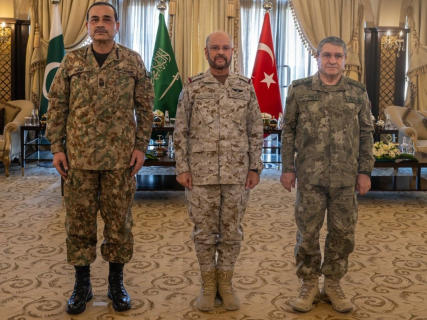

The military chiefs of Saudi Arabia, Pakistan, and Turkey have gathered this Friday in Riyadh to address shared security and explore new ways to intensify their defense cooperation, a month after the signing of an agreement considered historic to strengthen joint deterrence amid escalating tensions in the Middle East.
The three commanders have met in the Saudi capital with the aim of reviewing the regional landscape following the recent attacks carried out by the Houthis. According to the official statement, the delegations have assessed the security context and the main threats facing the kingdom.
"The leaders expressed their strong condemnation of the attacks directed against Mecca and the civil and economic infrastructure of the Kingdom. They also praised the vigilance and professionalism of the Saudi Armed Forces to ensure the safety of citizens and residents, as well as the security of the Kingdom," the statement reads.
Throughout the meeting, the representatives studied different ways to deepen coordination between their Armed Forces, focusing on the exchange of intelligence information, operational cooperation, and the integration of military capabilities in order to strengthen deterrence and collective defense.
The attendees also emphasized the strength of their bilateral ties and mutual trust between their armies, highlighting that the meeting in Riyadh symbolizes their willingness to immediately implement the commitments outlined in the Mecca Agreement for Joint Defense.
In this regard, the three states have reiterated their determination to fully guarantee the sovereignty, security, and territorial integrity of Saudi Arabia.
The pact --signed by the Saudi crown prince, Mohammed bin Salman; the Turkish president, Recep Tayyip Erdogan, and the Prime Minister of Pakistan, Shehbaz Sharif-- reflects "the shared commitment" to "further strengthen" collective security, as well as to "promote peace, security, and stability in the region and beyond, in pursuit of a safe and prosperous future."
The three countries emphasized in August that the agreement is based on "historical ties" centered on "Islamic brotherhood and solidarity," while also having "shared strategic interests" and already counting on "close cooperation in defense" that, thanks to this pact, can be strengthened in "all its aspects."
The pact comes after Riyadh and Islamabad signed a defense agreement last year that raised the issue of joint deterrence. Even then, the Pakistani Defense Minister, Jawaja Asif, did not rule out including a third country in the formula.
With this historic agreement, the three countries seek to strengthen their defense cooperation in the context of the war between the United States and Iran, which has affected Saudi territory and disrupted maritime traffic through the Strait of Hormuz, key for oil transport in the region.