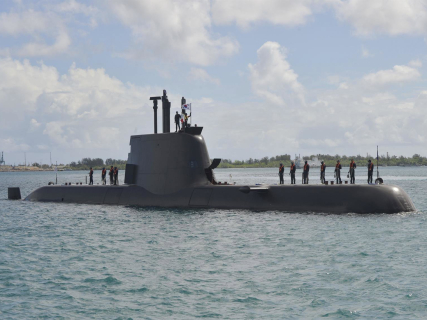

South Korea has given a “green light” to the basic plan of the “Jang Bogo N” program, with which it intends to boost the domestic design and manufacture of nuclear propulsion attack submarines equipped with conventional armament. As the Defense Acquisition Program Administration (DAPA) has detailed, the official launch of the project is set for 2027.
The decision was made this Friday at the armaments review committee of the Ministry of Defense, convened in an ordinary session. The plan, initially presented in May, provides that the first submarine will be launched in the middle of the 2030s and will enter operational service after 2039.
The initiative, agreed upon with the United States, will use small modular reactors (SMR) purchased directly by the South Korean executive branch and low-enriched uranium fuel, with a concentration below 20%. In addition, in August it was exempted from the preliminary feasibility study that is usually required in military acquisitions, an exception reserved for high-classification programs.
Reinforcement of deterrence against North Korea
The DAPA plans to select, through public tender, the shipyard responsible during the first half of 2027 and to close the contract before that same year ends. Although the final investment figure is still pending definitive approval, the first estimates cited by the Yonhap agency contemplate the construction of at least three submarines of 8,000 tons, at an approximate cost of 28.9 trillion won (about 19.3 billion euros).
According to the Defense body, the goal of the program is to strengthen South Korea’s deterrence capability against North Korea’s nuclear and ballistic threats and to increase the submarine assets integrated into the preemptive attack system “Kill Chain,” one of the three pillars of the national defensive strategy.
The committee has also given its approval to the development of the second block of the surface-to-surface tactical missile KTSSM-I, known as the “artillery killer,” which will have a range 30% greater than that of Block I or Ure. Its mission will be to quickly neutralize North Korea’s long-range artillery positions that put the metropolitan area of Seoul at risk.
This program will run between 2028 and 2035 and will involve an estimated investment of 537 billion won (about 355 billion euros).
Likewise, the plan to modify the serial production of the military communications system TMMR, a multiband tactical radio, has been approved, and to replace the veteran presidential helicopter with an S-92A Plus model from the U.S. manufacturer Lockheed Martin. The package of decisions also includes the renovation of the port patrol boats and the modernization of the unmanned surface vehicle used in detection and mine-clearing missions, according to DAPA.
The green light for this plan comes after South Korean authorities brought forward at the end of May their forecast to have the first domestically made nuclear-propelled submarine, fueled with enriched uranium, by the middle of the 2030s. The Minister of Defense, Ahn Gyu Back, then framed this initiative in the Government’s “roadmap,” which includes an extensive program for this type of submarines, backed by the United States following a leaders’ summit held in October 2025.