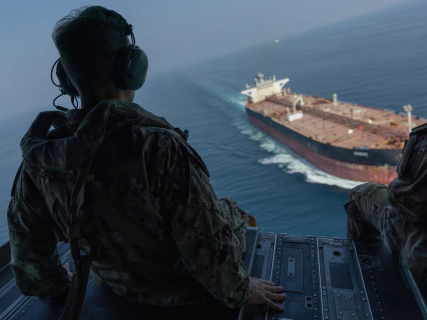

The South Korean Executive has agreed to expand the operating area of the Cheonghae Unit, currently deployed in the Gulf of Aden to counter piracy, so that it extends south of Oman and brings its patrols closer to the Strait of Hormuz. The plan includes the dispatch of new military resources, among them a P-8A Poseidon maritime patrol aircraft and specialized mine-clearing equipment.
The initiative, which provides for increasing the contingent from 320 to 395 military personnel, will allow the unit’s operational range to be doubled, placing it about 650 kilometers from the Strait of Hormuz, as the South Korean news agency Yonhap detailed this Thursday.
The Ministry of Defense of South Korea has said that the proposal will be submitted next week to the National Assembly for approval. With this expanded deployment, Seoul intends to respond to the upturn in acts of piracy in the region and, at the same time, prepare for possible mine-clearing tasks once the conflict between the United States and Iran concludes.
Authorities have stressed that the mission will preserve its principle of not becoming directly involved in armed clashes nor conducting incursions into Iranian territorial waters, while also maintaining an autonomous chain of command. The new assets, based in Djibouti, will be aimed at ensuring freedom of navigation and protecting merchant vessels on a key maritime route through which more than 70% of the oil South Korea imports flows.
Context of tensions with the United States and Iran
Seoul’s decision comes after pressures coming from Washington and remarks by U.S. President Donald Trump, who in August publicly criticized the South Korean government for not supporting the joint offensive with Israel against Iran.
In this context, South Korea confirmed that it was considering different formulas for military support for freedom of navigation in the strait, underscoring that the contribution of its Armed Forces is not limited exclusively to sending combat units and rejecting the existence of frictions with the United States.
On the other hand, Iran warned South Korea of "serious consequences" if it carries out a military deployment in the area, assuring that it would be interpreted as "direct support for those responsible for the U.S. aggression."
The spokesman of the Iranian Ministry of Foreign Affairs, Esmaeil Baqaei, urged Seoul not to give in to the “intimidation” of Washington and accused the U.S. Administration of trying to make the international community “pay the bill” for the chaos and disruptions to maritime trade caused by a “illegal and brutal” war launched by the very North American country on February 28 of last year.