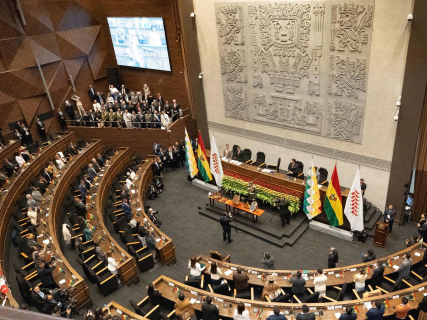

The Plurinational Legislative Assembly of Bolivia has given the green light this Thursday to the extension of the state of emergency, in effect since June 20 due to the wave of protests and blockades against President Rodrigo Paz, which was set to expire this Friday.
Following the formal presentation of the request sent on Monday by the Executive, the ministers of Government, Marco Antonio Oviedo, and Defense, Ernesto Justiniano, have explained to the 25 senators and 90 deputies present the reasons of the Government to maintain the measure for another 90 days. Finally, they obtained the support of 100 parliamentarians, enough to endorse the extension, according to the portal urgente.bo.
In his intervention, the Minister of Government warned of "a possible reactivation and articulation of blockades, marches, strikes, concentrations, with possible impact on strategic sectors, fuels, food, medicines, oxygen, and critical infrastructure" in case the state of emergency is not renewed, according to what was published by the Bolivian newspaper 'La Razón'.
For his part, the Minister of Defense emphasized that the national outlook is today less tense than it was three months ago, when more than 50 days of blockades disrupted transit and supply in various cities. "Bolivia today is calmer than it was three months ago," he emphasized, although he insisted that latent risks persist that justify the continuation of the measure.
During the debate, both Oviedo and Justiniano encountered legislators who harshly questioned their arguments and who, in their opinion, used offensive expressions. This led Oviedo to address the president of the Assembly and vice president of the country, Edmand Lara: "President, first of all, I think you need to order this. You cannot allow interventions where there is offense before questions are asked," he stated.
Lara replied by reminding him of his role at the head of the session and demanding respect. "You have to respect" and "Your dictator complex, keep it to yourself," the vice president responded, highlighting the strong political rift with Rodrigo Paz that has persisted since shortly after the elections.
In any case, and despite the verbal clashes, the Legislative Assembly of Bolivia —which includes the Chamber of Deputies and the Chamber of Senators— has ratified the continuity of the state of emergency. This measure was established at the end of June after weeks of roadblocks across much of the territory, organized by organizations linked to former president Evo Morales, who demanded Paz's resignation shortly after half a year in office.
In moments of greatest tension, more than a hundred blockade points were counted in seven of the nine departments of the country. After several failed negotiation attempts, when the 50 days of protests were reached, the Bolivian Workers' Central (COB) and the Government sealed an agreement. Subsequently, Paz decreed the state of emergency to resort to the Armed Forces in lifting the blockades that still maintained peasant sectors and Morales' allies.