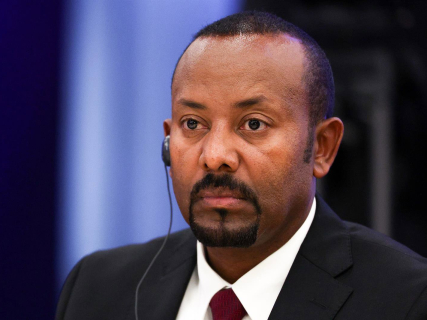

The resurgence of fighting in the Ethiopian region of Tigray between the federal army and the Tigray People's Liberation Front (TPLF), along with the advances made by government forces, has reignited fears of an open confrontation between Ethiopia and Eritrea. Addis Ababa's demands for its own access to the Red Sea and the impact of other nearby conflicts paint an increasingly fragile regional scenario.
On September 23, the TPLF proclaimed a "defensive war" and launched an offensive that took control of the three airports in Tigray, after months of tensions and low-intensity clashes. These incidents have occurred in parallel to the collapse of the peace agreement signed in November 2022 in South Africa, which ended two years of war in the north of the country and left behind massive devastation.
The TPLF, founded in the 1970s, dominated Ethiopian politics for years, especially after the fall in 1991 of the socialist regime established after the overthrow in 1974 of Emperor Haile Selassie. Its political weight, despite representing a community that makes up less than 10% of the population, fueled suspicions and tensions with other ethnic groups and with the central government.
The current hostilities are framed within the struggle for control of the regionally appointed authorities that were designated temporarily after the Pretoria pact. This dispute ended with the return of the TPLF to the government of Tigray in early May, amid mutual accusations of failing to comply with what was agreed in South Africa.
The main differences after the ceasefire revolve around the control of the western strip of Tigray —in conflict with Amhara over the boundaries set by the Marxist government overthrown in 1991—, the disarmament process of the TPLF, and the configuration of regional institutions after the last war, which is said to have left around 600,000 dead, according to the African Union (AU).
That conflict erupted after a long political and administrative escalation, partly marked by the TPLF's refusal to accept the postponement of elections and its attempt to retain power shares. The Tigray front had led the Ethiopian People's Revolutionary Democratic Front (EPRDF), a coalition based on ethnic lines that governed Ethiopia from 1991 until Abiy Ahmed took over the government in 2018.
The relationship with Eritrea
The arrival of Abiy marked a profound turn on the regional board. In a matter of months, the new prime minister sealed a peace agreement with Eritrea that earned him the Nobel Peace Prize in 2019, temporarily closing the war fought between 1998 and 2000 over the demarcation of the border following Eritrea's independence in 1993.
The thaw translated into an improvement in bilateral ties and Eritrea's participation in the war on Ethiopia's side against the TPLF, a historical enemy of Asmara. However, the relationship began to cool, largely due to Abiy's demands for access to the port of Assab to ensure Ethiopia a direct outlet to the Red Sea, an issue that has also generated friction with Somalia.
Eritrea, which was left out of the 2022 agreements, has denounced what it qualifies as expansionist ambitions on the part of Ethiopia —the most populous landlocked country on the planet— and accuses Abiy of seeking an armed clash. Addis Ababa, for its part, maintains that Eritrean President Isaias Afewerki has now aligned himself with the TPLF and would have sent troops to its territory, a claim that Asmara denies.
The danger of an escalation has intensified due to the advance of the Tigray Peace Forces, allies of the Ethiopian Government, towards the border with Eritrea, where they have occupied areas just a few kilometers from Eritrean territory. Abiy has warned of "extremely severe consequences" if dialogue is not chosen, while Asmara replies that its "sovereignty, independence, and territorial integrity are non-negotiable."
The Eritrean Ministry of Information has reiterated this week that "there is no legitimate or good faith dispute" between the two countries and has emphasized that "it has no irredentist claims" over Ethiopian soil, which it accuses of "continuous provocations" and "subversion campaigns." Additionally, it has asserted its right to "defend its sovereignty against any act of aggression or threat of invasion."
Ethiopian claims to regain access to the Red Sea date back to Eritrea's secession, which left Ethiopia without a coast. Since then, Addis Ababa has depended almost entirely on the roads and the railway line that connects the capital to a port in Djibouti, one of the five coastal states in the area alongside Somalia, Eritrea, Sudan, and Kenya.
The regional context
The pressures on Assab are also reflected in the Ethiopian movements in Somalia. Among them stands out the memorandum of understanding signed in 2024 with the semi-autonomous region of Somaliland, which unilaterally proclaimed its independence in 1991, recognized so far only by Israel.
The agreement stipulated that Ethiopia would obtain naval and commercial access for 50 years in this Somali territory, in exchange for Addis Ababa recognizing its independence and sharing part of the profits of Ethiopian Airlines, the state airline. The pact sparked a strong backlash from the federal government of Somalia in Mogadishu.
The dispute prompted a closer relationship between Somalia and Egypt, which in October 2024 signed a cooperation agreement on security matters. Both countries share concerns about the Ethiopian plans to access the sea and the impact of the large dam built by Addis Ababa on the Blue Nile, which has heightened tensions with Sudan and Egypt, very worried about the consequences on the flow of the Nile, their main source of fresh water.
In January 2020, the three countries reached a principle of consensus on the most contentious points, but Ethiopia withdrew from the talks before signing it. This decision fueled the clash with Cairo and Khartoum, aggravated by the war in Sudan, which began in April 2023 between the Sudanese Army and the Rapid Support Forces (RSF).
The Sudanese conflict has become another key piece of the web of regional alliances and an additional focus of instability. Khartoum accuses Addis Ababa of supporting the RSF and even allowing the use of Ethiopian soil for drone attacks, accusations that Ethiopia has labeled as "unfounded."
Addis Ababa, for its part, denounces the alleged support of Egypt, Sudan, and Eritrea for the rebel Coalition of Ethiopian Peoples' Forces for Survival, known as Tsimdo. This alliance includes the TPLF, the Oromo Liberation Army (OLA), active in Oromia, and the Fano militias, present in Amhara and formed by special units from this region that fought alongside the Ethiopian government in Tigray and are now also facing federal troops.
The prolongation of violence in Tigray not only threatens to trigger a new large-scale conflict within Ethiopia, but it could also ignite a regional war that drags in more actors and connects with the crisis in Sudan. The deep historical rivalries and territorial and resource disputes among the countries of the Horn of Africa raise the risk of even greater destabilization.