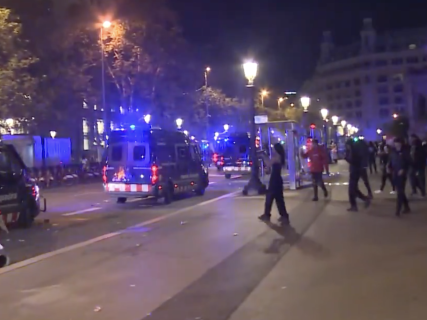
Looting and barricades in the center of Barcelona: businesses are lowering their shutters and the Mossos are asking to avoid the area.

The disturbances of a youth protest called by social networks are spreading around plaza Catalunya. Illa condemns the damage and supports the police to protect citizens and commerce.

Screenshot 2026 10 24 at 21.37.27

Screenshot 2026 10 24 at 21.37.27

Add DEMÓCRATA to Google

Ask FREN

Published

Last updated

3 minutes

Most read

Elecciones 29N · Encuestas

La media de las encuestas

Media a 24 de octubre de 2026 · 15 institutos

  • PP31,4 %
  • PSOE26,9 %
  • Vox18,8 %
  • Sumar6,4 %
  • Podemos3,1 %
  • ERC2,2 %
010203040ene 2024jul 2024ene 2025jul 2025ene 2026jul 2026

Media del último estudio de cada instituto en 30 días y su evolución semanal desde el 23J. Partidos con al menos un 2 %.

Todas las encuestas

Elecciones generales del 29 de noviembre · Demócrata

The center of Barcelona has recorded this Saturday, October 24, looting, fires of urban furniture, and police charges during a youth protest called through social networks. The incidents, which began in Plaza Catalunya, have reached nearby commercial streets and have forced establishments, including El Corte Inglés, to lower their shutters. The Mossos d'Esquadra have recommended not approaching the area.

The evolution of the altercations has added looting to the initial confrontations with the police and the assault on a store on Ronda Universitat. There have also been reports of broken shop windows, overturned motorcycles, and stone throwing against the agents.

The police device and the traffic cuts have altered a Saturday afternoon with numerous neighbors and tourists in the center. The Guàrdia Urbana has restricted circulation in the surroundings of the plazas de Catalunya and Universitat while the Mossos intervened to disperse the involved groups.

Shops close in the face of looting and destruction

Commercial activity has been interrupted by the confrontations and the movement of groups through the streets near plaza Catalunya. The closing of shutters has been a protective measure against the risk of damage, although some establishments have suffered attacks on their windows.

In addition to the documented looting in Ronda Universitat, the incidents have affected an environment that connects with the Rambla and Portal de l'Àngel. There have been preventive closures of shops and restaurants and the intervention of firefighters to extinguish the fires.

The Catalan police have warned of the presence of hooded groups that were burning containers, damaging urban furniture, and throwing stones. Their recommendation to avoid the area seeks to keep passersby away from the hotspots of violence and facilitate police intervention.

A barricade with containers and motorcycles next to Vergara street

One of the points of the first altercations has been located at the confluence of Vergara street with Catalunya square. There, participants in the disturbances have erected and set fire to a barricade made of small containers, trash cans, and motorcycles.

They have also broken the glass of two bus shelters and caused damage to a traffic light. The vans of the Mossos have patrolled the perimeter of the square while the riot police on foot intervened to disperse the hooded individuals.

A youth call inspired by the protests in France

The mobilization had spread through social networks as a protest "against the system." The slogan "Institut Indignats" refers to the French student movement that has led mobilizations in recent weeks.

Among the attendees were young people dressed in black and high school students, some underage. The call had not been communicated to the Department of Interior, according to police sources cited by elDiario.es.

The incidents have occurred just a few meters from the encampment for the right to housing set up in Catalunya square. The physical proximity does not confirm a link between both calls. El País reports that members of the camp have distanced themselves from the violent acts.

Illa: "Protesting is a democratic right"

The president of the Generalitat, Salvador Illa, has condemned the altercations and thanked the work of the Mossos to protect citizens and commercial establishments.

"Protesting is a democratic right. Aggressing, intimidating, or causing damage is not," he has pointed out on the social network X. His message distinguishes the exercise of the right to protest from attacks against people, businesses, and urban furniture.

More key points, information and questions with FREN

AI-GENERATED CONTENT

What is the legal process to authorize a demonstration in Barcelona and what procedures are necessary before the Department of Interior?

To hold a demonstration in Barcelona no prior authorization is required: a communication must be submitted to the competent authority of the Generalitat, within the scope of the Department of Interior. The difference is important: a fundamental right is exercised, not a discretionary permit requested. The Administration can limit or prohibit it only with sufficient justification and respecting proportionality.

1. Legal framework and competent authority

Article 21 of the Constitution recognizes the right to peaceful and unarmed assembly. For demonstrations and gatherings in public transit areas, prior communication is required. The procedure is mainly developed in the Organic Law 9/1983, of July 15, regulating the right of assembly, especially its articles 8 to 11.

In Barcelona, the communication must be addressed to the competent governmental authority of Interior of the Generalitat. Constitutional jurisprudence documents this autonomous competence in STC 170/2008. This procedure should not be confused with municipal procedures regarding accessory elements, traffic, or installations.

2. Deadlines to submit the communication
  • Ordinary procedure: written submission with a minimum advance of ten calendar days and a maximum of thirty days before the event.
  • Urgent call: can be communicated at least twenty-four hours in advance when there are extraordinary and serious causes justifying the urgency. These must be expressly explained; it is not enough to submit an ordinary call late.

The communication corresponds to the organizers or promoters. If a legal entity calls it, its representative must act. It is advisable to keep the submission receipt and provide an operational contact to attend clarifications and coordinate the development.

3. Information that must be prepared

The document must clearly identify who organizes the demonstration and how it will develop. It is advisable to structure it with the following contents:

  • Identification of the organizers and, when appropriate, their representative, with address and contact details.
  • Purpose or reason for the call.
  • Date, start time, expected duration, and places of gathering and ending.
  • Specific itinerary through the streets of Barcelona, described unambiguously.
  • Security measures planned by the organization and those whose adoption is requested from the authority.
  • Justification of extraordinary and serious circumstances, if the urgent deadline is used.

The organizers are responsible for good order and must adopt measures to promote peaceful development. The STC 61/2023 recalls this obligation and that of communicating security measures.

4. Action of Interior and municipal coordination

Interior may examine the communicated conditions and assess security needs. If it perceives founded reasons of public order disturbance with danger to persons or property, it may prohibit the call or propose changes of date, place, duration, or itinerary. The decision must be motivated and proportionate.

Ordinary inconveniences or traffic impact alone do not justify a prohibition: this is explained by STC 24/2015. If scenarios, installations, or other accessory occupations are foreseen, applicable municipal procedures must be separately verified; these do not replace the communication to Interior.

5. Reaction against a prohibition

If the organizers disagree with a prohibition or modification, they may resort to the special judicial procedure for the protection of the right of assembly, regulated in article 122 of the Law of the Contentious-Administrative Jurisdiction. The deadline to appeal is forty-eight hours from notification. In the Barcelona cases examined by the Constitutional Court, the Contentious-Administrative Chamber of the Superior Court of Justice of Catalonia intervened.

What are the powers and functions of the President of the Generalitat of Catalonia according to the Statute of Autonomy?

The President of the Generalitat of Catalonia has three central functions according to article 67.1 of the Statute of Autonomy: to hold the highest representation of the Generalitat, to direct the action of the Government, and to exercise the ordinary representation of the State in Catalonia. These functions are complemented with powers over the promulgation of norms, relations with the Parliament, electoral calls, and institutional appointments.

1. Institutional and State representation

As the highest representation of the Generalitat, he occupies a preeminent position in precedence and protocol in Catalonia, according to article 67.5. His condition as ordinary representative of the State entails the following functions, listed in article 67.6:

  • Promulgate, in the name of the King, the laws, decree-laws, and legislative decrees of Catalonia, and order their publication.
  • Order the publication of the appointments of institutional State positions in Catalonia.
  • Request collaboration from State authorities exercising public functions in Catalonia.
  • Exercise other functions determined by laws.
2. Direction of the Government

The President directs the action of the Government and is part of it. It is advisable to distinguish his direction function from the powers of the Executive as a collegiate body: article 68 attributes to the Government the direction of political action and Administration, the executive function, and regulatory power.

Article 67.8 recognizes as presidential powers the appointment and dismissal of counselors and the raising of a vote of confidence, by which he submits to the Parliament the continuity of his political support. If he has not appointed a first counselor, he may temporarily delegate executive functions to one of the counselors, according to article 67.9.

3. Promulgation of laws

Article 65 specifies that the President promulgates Catalan laws in the name of the King and orders their publication in the Official Gazette of the Generalitat of Catalonia within fifteen days following their approval, as well as in the Official State Bulletin. For their entry into force, the publication date in the Catalan official gazette applies. This intervention does not equate to approving laws: the legislative function corresponds to the Parliament.

4. Dissolution of the Parliament and elections

According to article 75, he may dissolve the Parliament early, after Government deliberation and under his exclusive responsibility. He cannot do so while a motion of censure is being processed nor before one year has passed since the previous dissolution by this procedure. The decree must call elections, which will be held between forty and sixty days after its publication.

Also, if no candidate obtains investiture within two months after the first vote, the Parliament is automatically dissolved. The acting President must immediately call elections, also to be held between forty and sixty days after the call (article 67.3).

5. Appointments, control, and substitution

Article 77.1 attributes to him the appointment of members of the Council of Statutory Guarantees: two-thirds proposed by the Parliament and one-third proposed by the Government. Therefore, it is not a free presidential selection.

The President is elected by the Parliament among its members and appointed by the King (article 67). He is politically accountable before the Chamber, along with the counselors, and delegating functions does not eliminate that responsibility (article 74). Whoever substitutes him cannot raise a vote of confidence, appoint or dismiss counselors, nor dissolve the Parliament early (article 67.8).

Source: Statute of Autonomy of Catalonia, approved by Organic Law 6/2006, of July 19.

What political background and professional trajectory does Salvador Illa have before becoming President of the Generalitat?

Before becoming President of the Generalitat in August 2024, Salvador Illa accumulated a trajectory of more than three decades combining municipal politics, administrative management, business leadership, and responsibilities in the PSC. His greatest public projection came as Minister of Health during the pandemic, but previously he had held positions in La Roca del Vallès, the Generalitat, and the Barcelona City Council.

Education and professional experience

Born in La Roca del Vallès on May 5, 1966, he graduated in Philosophy from the University of Barcelona and completed a master's degree in Economics and Business Management at IESE, University of Navarra. That combination of humanities and business training preceded his management responsibilities. His education is listed in the Moncloa biography.

Outside the Administration, he worked in the commercial area of a plastics company in Cardedeu, linked to construction products. He was also an associate professor at Blanquerna, Ramon Llull University, and had a brief stint as general director of the audiovisual producer Cromosoma, between his stages in the Generalitat and Barcelona. These experiences are recorded in profiles from Infobae, La Vanguardia, and El Español.

Municipal beginnings and public management

His institutional career began in 1987, as a councilor of La Roca del Vallès. In 1995 he joined the PSC and assumed the mayoralty after the death of Romà Planas. His term as mayor took place between 1995 and 2005, in two periods, so it should not be understood as an uninterrupted mandate. It was his first experience leading an Administration, according to profiles from El Periódico and Crónica Global.

Between 2005 and 2009 he was Director General of Infrastructure Management of the Department of Justice of the Generalitat. Subsequently, he developed these responsibilities in Barcelona, recorded in his parliamentary biography:

  • 2010-2011: director of the Economic Management area of the City Council.
  • 2011-2016: coordinator of the Socialist Municipal Group.
  • 2014-2016: chief of staff of Jaume Collboni.
  • 2016-2017: manager of the Business, Culture, and Innovation area.
Rise in the PSC and Ministry of Health

In 2016 he assumed the Organization Secretary of the PSC, working alongside Miquel Iceta in the internal direction of the party. His trajectory until then was more linked to organization and management than parliamentary exposure. El País describes that stage as a fundamental antecedent of his leap to state politics.

In January 2020 he was appointed Minister of Health of Pedro Sánchez's Government. He remained until January 2021 and his mandate was dominated by COVID-19: coordination with autonomous communities, response to the health emergency, and preparation for the start of vaccination. He did not come from a medical career, but from public management. He left the ministry to lead the socialist candidacy in Catalonia, as recorded by ConSalud.

The stage immediately before the presidency

After the February 2021 elections, he was a deputy, president of the Socialistes i Units per Avançar group, and leader of the opposition. On December 18, 2021, he became first secretary of the PSC. In May 2024 he again led his candidacy, which obtained 42 seats. Thus, he reached the presidency with local, autonomous, and state experience, as well as party leadership and private activity, according to the Generalitat biography.

Play

Test your knowledge with FREN!

How much do you know about this topic? Answer the following 3 questions.

What was one of the immediate consequences of the riots in downtown Barcelona?

Question 1 of 3

What action did the Mossos d'Esquadra take to manage the situation during the disturbances?

Question 2 of 3

To which international movement did the youth protest slogan refer?

Question 3 of 3