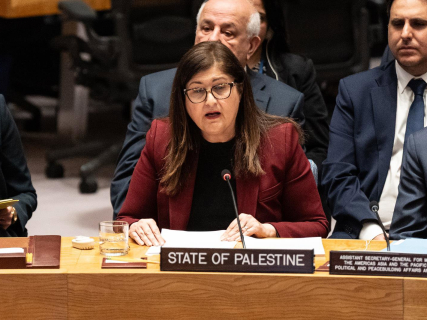

The Palestinian Authority’s Minister of Foreign Affairs, Varsen Aghabekian, has this Friday called for the European Union to step forward and use its economic weight to pressure Israel through commercial sanctions that, in the particular case of the West Bank, help to curb the escalation of “colonist terrorism” that, according to what is denounced, has intensified under the cover of the war in Gaza.
Aghabekian, accompanied by the former High Representative of the European Union Josep Borrell and by legal officials from several international NGOs, took part in a colloquium in which the tools available to the EU were analyzed—recalling that it is Israel’s main trading partner—to put an end to the “impunity” with which, in the words of the Palestinian minister, the Israeli authorities are currently acting.
“Israel only understands the language of sanctions,” Aghabekian said, insisting that it is not enough for Europe to limit itself to written support for a two-State solution and that the time has come to apply concrete measures on the ground.
“You have to bite,” the minister demanded, before underlining that the European Union would have full capacity to do so, since Israel is currently violating the second clause of the bilateral trade association agreement, which states that the relationship between both parties “is based on respect for Human Rights and democratic principles.”
Aghabekian highlighted the role of Spain and Ireland, which she described as “pioneers” for their restrictions on the importation and advertising of products originating from Israeli settlements in occupied Palestinian territories. However, she warned that these decisions, although valuable, are insufficient if they are not accompanied by a joint and firm stance by the whole of the EU.
Limitations of the unilateral measures of Spain and Ireland
The decisions adopted by Spain and Ireland have a limited scope due to their strictly bilateral nature and because Israel, as another of the speakers denounced, the legal director of the Global Echo Litigation Center, Jessica Stober, has multiple mechanisms to get around them.
In its report "Importing Occupation", prepared based on data on nearly 6,000 Israeli agricultural exports to Europe over the past eight years, Stober and the Global Echo Center describe a "complex and widespread" web through which "agricultural products produced in illegal settlements are regularly imported to Europe as if they were Israeli". They speak of a genuine "culture of obfuscation", which includes the mixing of product origins or the modification of exporters' tax addresses.
"A pattern", denounces the Global Echo Center, "that violates laws, trade agreements and European policies" and which, in its view, provides sufficient grounds to openly call for sanctions on trade with Israel.
The principles of International Law that regulate agricultural production in settlements located in occupied territories and its export to third States, they recall, are based on the prohibition on acquiring territory by force and on the inalienable right of peoples to self-determination. Despite this, the European Union, as an institution, has not adopted specific measures in this area so far.
Borrell attributes the European blockade to the weight of German historical guilt
The former High Representative of the European Union for Foreign Affairs and Security Policy between 2019 and 2024, Josep Borrell, has stated that the lack of progress in Brussels is, to a large extent, due to the tendency of Community institutions to "pass the buck" in a context of ongoing disagreements.
"The President of the Commission has not wanted to move a millimeter from her position of blind and irredentist support for Israel to the Government of Netanyahu. She has done nothing and she will do nothing", he said about the President of the European Commission, Ursula von der Leyen, whom he accused of referring this matter to an institutional web dominated by a major power like Germany, shaped by its "historical guilt" stemming from the Holocaust.
"I find it difficult for the European Union to change its position because it is dominated by Germany and the countries that resulted from the outbreak of the Austro-Hungarian Empire and the bad conscience of the genocide against the Jews. I state clearly who they are", Borrell added.
In his opinion, "the European Council will never display unanimity when it comes to taking measures to sanction the Government of the prime minister Benjamin Netanyahu," and the European Parliament will also not be able to activate mechanisms to bring the Commission before the Court of Justice of the European Union for its inaction.
In addition, Borrell has pointed out the paradox that commercial matters fall exclusively within the remit of the European Commission, which would indeed have legal capacity to suspend the association agreement with Israel if it found that it was violated by any of the parties, beyond a mere review of the treaty, despite the fact that Von der Leyen argues that her position does not allow her to impose sanctions.
In any case, the courses of action are limited. Senior legal adviser to the NGO Open Society Justice Initiative, Esti Tambay, considers it possible that a member state could sue the European Council and the European Commission "for inaction" before the Court of Justice of the European Union (CJEU), understanding that this passivity has a direct impact on respect for International Law. All that would be needed is a "brave" person willing to take that step, she noted.
"It is true that the challenges are numerous," the Foreign Affairs minister has claimed to conclude, "but there is a responsibility to International Law and International Humanitarian Law, because the Israeli settlements in the West Bank are illegal, and we need political commitment: we need that push that will take us to the point of activating measures, because we cannot wait much longer or await the next crime."