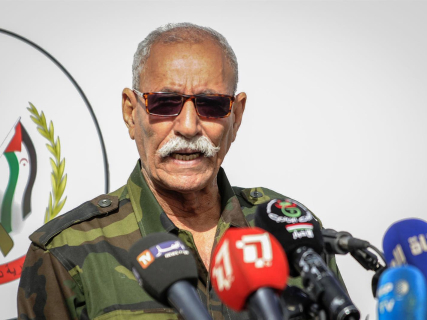

The Polisario Front has urged the European Union this Wednesday to take advantage of the end of the mandate of the United Nations mission in Western Sahara (MINURSO) to “play an important and positive role” in the area. In its view, Brussels can no longer keep “turning a blind eye” or “supporting the Moroccan thesis” about the future of the territory, and it has pointed both to the Community institutions and to Spain as responsible for the UN mission not being renewed.
From the European Parliament, Oubi Bucharaya, legal affairs adviser to the leader of the Polisario Front, Brahim Ghali, set out in a press briefing the political and legal implications of the non-renewal of MINURSO. The United Nations Security Council failed to reach consensus on a resolution to extend the mandate of this mission, created in 1991 with the objective of organizing a referendum on self-determination for the Sahrawi people.
“The non-renewal of MINURSO has to serve to challenge the European Union as a whole,” the Sahrawi representative said, calling on Brussels to abandon its policy of “turning a blind eye” and “supporting the Moroccan thesis.” He believes that the European bloc is in a position to “play an important and positive role” in the new context opened up after the departure of the United Nations mission.
Bucharaya also stressed that the EU cannot prolong the “legal limbo” arising from not applying “the various decisions” of the Court of Justice of the European Union (CJEU) against the trade agreement between Morocco and the European Union, in which products originating from Western Sahara under Moroccan control are included explicitly.
Along these lines, he underlined that the disappearance of MINURSO does not imply that the UN Security Council can evade its “responsibilities” regarding the territory, nor that the right to self-determination of the Sahrawi people expires, noting that this same idea has been reiterated by the UN secretary-general, António Guterres.
Criticism of Spain for its support for the Moroccan plan
The representative of the Polisario Front questioned the change in the posture of the Government of Pedro Sánchez in 2022, when Spain began to consider the Moroccan autonomy plan as the “most serious, credible and realistic” basis for resolving the conflict. In his view, this decision fueled the dynamic that has ended in the current deadlock in the Security Council.
"Spain, which is the administering power of the territory, the power that has a historical responsibility toward the people of Western Sahara, has to be questioned as well," Bucharaya has indicated, who believes that the line adopted by the Spanish Executive in 2022 "served for little."
As he added, that diplomatic shift was the one that "engendered all this negative dynamic" that has culminated in the veto at the United Nations, and he has warned that both Spain and the EU share "a great responsibility in the non-renewal of MINURSO" and in the current situation, in which "the stability of the whole region is at risk."
The interruption of the MINURSO mandate occurred after Russia vetoed last October 30 a draft resolution promoted by the United States that backed Morocco's autonomy plan for Western Sahara, by estimating that the text moved away from the principle of self-determination of the Sahrawi people. Moscow, in turn, submitted an alternative resolution to extend the mission without mentioning Rabat's proposal, but it was also blocked by Washington.
After this diplomatic clash, the representative of the Polisario Front before the United Nations, Sido Mohamed Omar, hailed the Russian veto as "a historic day for the Sahrawi people" and expressed his thanks to Moscow for stopping an initiative that, in his view, sought to legitimize Morocco's "illegal occupation" of the territory and to drain the conflict of its nature as a process of decolonization.