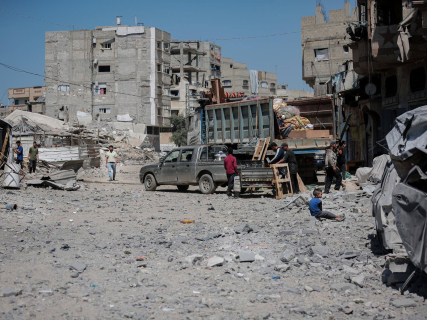

The UN High Commissioner for Human Rights, Volker Turk, has warned this Wednesday of a growing “risk” that Israeli forces will commit new “atrocities” against the Palestinian population, in a context of ongoing attacks and rights violations in the Occupied Palestinian Territories.
“I am extremely concerned about the systematic nature of the violations that are being carried out both in the Gaza Strip and in the West Bank. In Gaza, my office has repeatedly warned about the danger that these Israeli actions pose to the existence of Palestinians as a group,” he pointed out.
He noted that events in recent months “have exacerbated the fear that this danger will spread across the entire territory.” “Our alerts are not being heeded and the atrocities are continuing to take place,” he indicated in a statement in which he emphasized that “civilians are still being killed.”
“Thousands of Palestinians are being forced to move and some senior Israeli officials do not deny that these actions are being carried out with the intention that they be permanent. Civil infrastructure is being destroyed in Gaza and illegal settlements are advancing in the West Bank,” he lamented.
Turk also stressed that Palestinians “are being detained arbitrarily and are subjected to torture and ill-treatment.” “The list goes on,” he denounced, expressing his “concern” about the continuation of these abuses despite the ceasefire announced last year, which has not prevented new attacks in Gaza, where some 1,680 Palestinians have died since then.
Blockades, closures and deterioration of the situation in Gaza
The UN Human Rights chief has harshly criticized the blockade and prolonged closures imposed by Israel on the Gaza Strip, which “deprive Palestinians of the basic needs for their survival, including food, medicines and shelter.”
At the same time, he recalled that both Hamas and other Palestinian armed groups are responsible for “protecting civilians, respecting prohibitions against summary executions, arbitrary detentions, torture and other ill-treatment, as well as safeguarding the safety and independence of humanitarian personnel and operations.”
He has also denounced that in the West Bank systematic and violent campaigns are carried out to "replace Palestinian communities with Israeli settlers throughout the territory, fragmenting it in such a way that any possibility of establishing a contiguous Palestinian state in the future is undermined".
"Representatives of the Israeli Government, at the highest level, have repeatedly set out annexation policies, ethnic cleansing, and collective punishment in the West Bank. Across society, incitement to hatred and the commission of violations that constitute atrocious crimes, war crimes, crimes against humanity and even genocide has been appalling," he added.
He has also emphasized that "all States have an obligation to act, right now, to prevent the commission of new atrocious crimes against Palestinians. Independent investigations must be carried out and those responsible held accountable. The work of international tribunals in this regard must receive the support of all States," he concluded.
Basic items for families in Gaza are out of reach
The Norwegian Refugee Council (NRC) has warned that essential products have been left out of the reach of many families in Gaza as winter arrives, due to Israeli restrictions and "insufficient humanitarian funding".
According to the organization, this situation has caused a sharp rise in the prices of goods in the local market, which seriously makes access difficult. Entities present on the ground point out that the total cost of blankets, winter clothing, and other basic accommodation items needed for an average family of six members to face the winter in Gaza could exceed 6,000 dollars (about 5,400 euros).
The same products would have an approximate price of 700 dollars (around 639 euros) if they were bought in the international market and introduced by humanitarian aid agencies.
The NGO details that the shortage has driven the price of essential shelter and home items up by as much as 1,500%. "Almost the entire population of Gaza depends on humanitarian aid; however, prices have risen so much that even aid agencies cannot afford the basic shelter and home items that families need to survive the winter," Jehan Salim, national coordinator of the Shelter Sector Working Group, lamented.
"Israel must immediately lift restrictions and allow the entry of essential aid, much of which is already ready to be delivered and is just a few kilometers away, in El Arish (Egypt). It is also necessary to increase the supply of commercial goods in order to bring prices down," he added.
The NRC says that the limitations imposed by Israel are the source of the shortage. In October, only 9% of the aid trucks that entered Gaza transported shelter materials, it emphasizes. "Although Israeli authorities have allowed the entry of some basic supplies, both the quantity and the pace of entry are completely insufficient given the scale of the crisis," it has said.
"All possible efforts are being made to support the displaced Palestinians this winter, but the time window is closing quickly*," Mauricio Tautiva, deputy coordinator of the Shelter Sector Group in Palestine, emphasized.
"Flexible funding and immediate donations of basic items are required, such as tents, tarpaulins, mattresses and blankets, but it is also necessary to fund more solid and durable housing solutions and allow them to enter Gaza to protect families beyond the winter," he clarified.