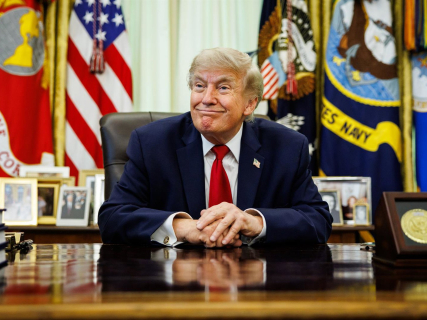

The president of United States, Donald Trump, has launched a harsh message against the Government of Spain on the eve of the NATO summit to be held in Ankara next Monday and Tuesday. The US leader has questioned Spanish commitment to the Atlantic Alliance and has directly pointed to Madrid for its refusal to increase military spending on the terms demanded by Washington.
“The Spanish belong to NATO, but they are not very good members,” Trump said in a series of statements in which he accused Spain of not responding as the White House expects. The president went further, stating that Spain “is not behaving well” and issued an ambiguous warning: “They will learn soon.”
The accusation places Spain in an uncomfortable position before a key meeting for the future of the Alliance, marked by Washington's pressure for European partners to increase their military contribution and assume a greater share of the cost of common defense.
Military spending, at the center of the clash
Trump's criticism is part of a broader offensive against European allies who, in the White House's view, are not making sufficient budgetary effort. The US president believes that countries like Spain, Italy, or even the United Kingdom have not responded adequately to the demands for support made by Washington after the start of the war in Iran on February 28.
Trump has described the difference between the military spending of the United States and that of other NATO partners as “ridiculous.” According to figures cited by the leader, Washington allocates $999 billion to defense, compared to $66.5 billion for France,$48.8 billion for Italy, or $44.3 billion for Poland. In that context, he has placed Spain among the allies who, according to his interpretation, are not living up to the commitment required by the international situation.
The underlying message is not new, but the direct tone against Spain is. Trump reiterates that the United States protects its allies without receiving a proportional contribution in return and has even described NATO as a “paper tiger” if its members do not genuinely increase their defensive capabilities.
An appeal to Spanish history
The US president also resorted to a historical reference to reinforce his warning. Trump mentioned the "disaster of '98" and the loss of Cuba, Puerto Rico, and the Philippines as an example of the consequences of weak defense and a vulnerable international position.
The allusion introduces an especially delicate element into the bilateral relationship. It is not just a budgetary criticism, but a direct appeal to Spain's past to question Spain's ability to act as a reliable ally within an increasingly tense security architecture.
That historical reference, combined with the phrase "they will soon learn", has raised the tone of the controversy and anticipates a complicated summit for the Spanish government, which will have to defend its position in a context of strong US pressure.
The threat over US troops in Europe
Trump has once again raised the possibility of reducing the US military presence on European soil. He has also hinted on several occasions at the option of rethinking the United States' role within NATO, although a formal withdrawal from the Alliance could not be adopted unilaterally without facing political, legal, and institutional limits.
The threat has a clear function: to force allies to commit more resources and to accelerate defense contracts. For Washington, the war in Iran and the deterioration of the international scenario demand a much more forceful response from European partners.
For Europe, on the other hand, the debate combines security, public spending, military dependence on the United States, and strategic autonomy. Trump's pressure once again places these tensions at the center of the Atlantic agenda.
Rutte tries to contain the crisis
The Secretary General of NATO, Mark Rutte, has intensified his role as mediator in the face of Trump's rhetorical escalation. After recently meeting with the US president, Rutte is confident that the summit in Ankara will allow for the announcement of new defense commitments and contracts worth billions of dollars.
These agreements could benefit US companies and serve to reduce the White House's pressure on European allies. However, the direct attack on Spain complicates the climate before the meeting and forces Madrid to attend the summit with its focus on its level of military spending.
The question will not be only how much each country invests, but what commitments it is willing to assume at a time when Washington demands more involvement and less dependence on American protection.
Spain, in the spotlight
Trump's pointing marks a turning point in the relationship between Spain and the United States within NATO. The White House has decided to make military spending a test of loyalty and to place Spain among the countries that, in its opinion, are not complying sufficiently.
For the Spanish Government, the Ankara summit arrives at a moment of high diplomatic tension. Madrid will have to defend its role within the Alliance, explain its budgetary roadmap, and prevent the clash with Trump from escalating into a deeper bilateral crisis.
NATO arrives at the meeting with an evident paradox: it needs to show unity in the face of a more unstable international scenario, but internal differences over spending, leadership, and burden-sharing threaten to dominate the summit. And, this time, Spain arrives singled out directly by the President of the United States.