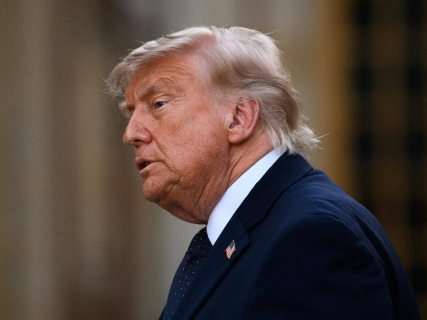

The President of the United States, Donald Trump, stated this Thursday that the new and "historic" nuclear cooperation agreement reached with the authorities of Saudi Arabia is "subject" to the Abraham Accords, the framework promoted by Washington for the normalization of ties between Israel and several Arab states, including the United Arab Emirates and Bahrain.
"The civil nuclear agreement between the U.S. Department of Energy and Saudi Arabia, which will only affect the non-military use of this energy (...) will be approved, but it will be fully subject to Saudi Arabia adhering to the respected and successful Abraham Accords," Trump indicated in a message disseminated on social media in which he clarified that this pact "does not contemplate the enrichment" of any material by Riyadh.
In this way, the occupant of the White House emphasized that the United States "does not oppose civil nuclear facilities (that are not aimed at the enrichment of material)," making clear the limit that Washington wants to set on the development of the Saudi atomic program.
The administration of former U.S. President Joe Biden had previously linked nuclear cooperation with Saudi Arabia to the kingdom formally recognizing Israel, although critics of the current president now argue that this requirement has been removed in recent negotiations.
The Abraham Accords encompass the understandings for the normalization of relations between Israel, the United Arab Emirates, Bahrain, Morocco, and Sudan — the latter still pending ratification. These countries joined during Trump's first term the peace agreements that Israel already had with other Arab states, such as Jordan and Egypt.
The nuclear pact was signed the day before by the U.S. Secretary of Energy, Chris Wright, and the Saudi Minister of Energy, Abdulaziz bin Salman. The text opens the door to a greater presence of U.S. companies in Saudi Arabia's civil nuclear energy program, which, according to Washington, "will benefit the industry, workers, and supply chains in the United States, while helping to meet Saudi energy needs."
According to the details provided by the Department of Energy, the agreement —which must now be examined by the U.S. Congress— "lays the legal groundwork for a multimillion-dollar partnership that will last for decades and will promote several priority economic and strategic objectives, including nuclear non-proliferation."