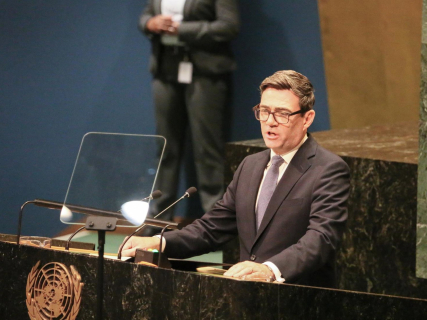

The Prime Minister of the United Kingdom, Andy Burnham, claimed this Tuesday before the United Nations General Assembly a role of global leadership for London, based on translating into action his support for the two-state solution between Israel and Palestine, and in supporting Ukraine against a foreseeable new Russian military offensive during the upcoming winter. Burnham urged Moscow to negotiate peace, but made it clear that, as long as there is no ceasefire, the United Kingdom will continue to support Kiev.
"The terrorist attack against Israel on October 7, 2023, was utterly horrific; I have condemned it in the strongest possible terms. We continue to condemn (the Islamic Resistance Movement) Hamas, and we stand with Israel in the face of ongoing threats," Burnham noted before emphasizing that, nonetheless, "this does not justify the actions of the Israeli government in Gaza or the West Bank."
In this context, he lamented that "many people have died, including many girls; much aid is not getting through, and too much time has passed." "We will not stand by while this horrible suffering continues to grow and the prospects for a two-state solution, the best hope for peace and stability for both nations, are in jeopardy," he stated, referring to Israel's plans to establish new settlements that would divide the West Bank into two blocks, north and south.
For this reason, he recalled the decisions already made by the United Kingdom against the Israeli settlements considered illegal and urged other countries to take action, warning that "we live in a space of little trust in politics": "If we continue to talk about the two-state solution, but fail to support those words with actions, that trust will fail, and our enemies will seek to exploit the alienation that comes from that."
Commitment to support Ukraine during the winter
Burnham reserved another central part of his speech for the war in Ukraine, recalling the harsh conditions suffered by the population last winter, with Russian attacks on cities and energy infrastructure during a cold wave.
"We cannot let them do that again this winter, so we are working to help Ukraine protect its skies and civilians," he emphasized, noting that London is "leading" efforts to "increase the cost for Russia of continuing" the war, although he acknowledged that the new sanctions law against Iran and Russia passed last week in the United States "will be differential."
Additionally, he has promised to "support Ukraine in repairing and protecting the heating and energy plants that Kiev will depend on this winter" and has called on other governments to expressly condemn the Russian attacks on these facilities.
"Everyone present in this room knows that attacks on civilian infrastructure are expressly prohibited by international law. However, we are here, at the UN, announcing funds to mitigate the effects of these war crimes, which, according to our forecasts, will be perpetrated again by a permanent member of the Security Council," he pointed out.
Consequently, he insisted that "this must end" and urged Russia to "choose a different course tomorrow, whether it be a ceasefire or sitting at the negotiating table." "Until then, we will support Ukraine more strongly than ever for as long as necessary," he assured.
Defense of British sovereignty over the Falklands
The Labour leader took advantage of his speech to outline the image of a new British leadership on the international stage, reiterating his adherence to the UN Charter and respect for international law.
"We will stand firm against any threat and challenge to the law, not only from Russia but from other countries as well," he indicated, before explicitly referring to Argentina, which questions British sovereignty over one of its overseas territories.
His promises to defend the international legal order, he emphasized, "includes where the rights of British territories to remain British are threatened, such as the Falkland Islands," referring to the archipelago of the Malvinas, claimed by the government of Javier Milei, especially since the President of the United States, Donald Trump, suggested a few weeks ago that he could review Washington's support for London in this dispute.
Alliance with the United States on artificial intelligence
Burnham has preferred to focus the rest of his mentions of the Trump Administration on areas of cooperation, such as sanctions against Russia or artificial intelligence (AI), the other major axis of his speech before the General Assembly.
After highlighting the potential of this technology in fields such as healthcare, the economy, or education, the prime minister has taken advantage of his visit to the UN to announce "a new alliance with the United States in terms of AI defense to protect our critical national infrastructures," without offering further details for now.
Next, he admitted that artificial intelligence "will also pose a source of disruptions in our way of living and working, a multiplier of risks." "I know how worried people are, so we have to rise to the occasion."
In this line, he argued that "fundamental decisions about this technology are too important to leave to chance" and that, therefore, "they must be made by elected governments that are at the service of workers." "We must provide people with the support they need during this change, ensuring that it also becomes a driver of reindustrialization and opportunities," he emphasized.
To illustrate his approach, he looked to the past and the first Industrial Revolution, "a time of incredible technological progress" that, however, for the working class meant "enormous suffering and exploitation." "This time we have to get it right," he stated.
In line with this approach, Burnham has announced that he will "place AI at the center of the British presidency of the G-20 next year."
Strategy against cyberattacks and disinformation
The prime minister has again linked AI with the growing risks of cyberattacks and disinformation campaigns, warning that this technology can amplify their impact. He has denounced operations aimed at "provoking tension and discord" and has pointed directly at Russia.
In fact, he has claimed that "the Kremlin spends around 1.3 billion pounds (more than 1.5 billion euros) each year manipulating information."
"We are talking about an insidious campaign that reaches people's homes and fades what is happening. People do not know what they think of their own country and their community, creating a narrative of decline, division, and hopelessness," he has warned, also cautioning that "When inequalities are accentuated too much, our societies run a greater risk" in the face of these interferences.
"Well, it's over; we are going to face the new decade differently," he has stated, announcing that he has instructed the UK Security authorities "to begin working on a new National Information Defense Center, in order to detect, attribute, and neutralize this type of hostile cyberattacks by States, to support and defend our democracy."
At the same time, he has reiterated that his Executive is "willing to share" their experience on "how these actors operate and how to respond," because "it is a vital task for our collective security" and "we are stronger when we unite with others, when we build bridges beyond borders to solve common problems."