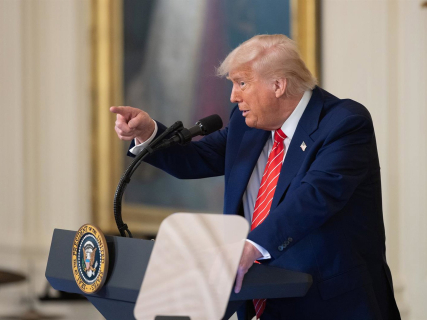

The president of the United States, Donald Trump, has once again resorted this Tuesday to a triumphalist tone by assuring that the United States maintains "total control" over the Strait of Hormuz, one of the most sensitive maritime routes in the world. According to the president, Iran would be urgently seeking an agreement to stop the war once and for all.
Until now, Washington does not interpret the latest attacks registered in the area as a violation of the ceasefire. Trump has avoided specifying which actions by Iran would be considered a formal breach of the truce in the region, although he has warned journalists that, if the truce is broken, he will make it known.
"Iran knows perfectly well what it has to do and, more importantly, what it must not do", he pointed out. He also downplayed Iran's military capability at sea, stating that its vessels are "fast, but not as fast as a missile", and assuring that "they cannot compete with our Navy".
However, the situation on the ground continues to deteriorate. In the last few hours, the air defense systems of the United Arab Emirates have intercepted new attacks attributed to Iran, in the form of drones and missiles.
The UAE Air Defences are currently dealing with missile and drone attacks coming from Iran, and the Ministry of Defense confirms that the sounds heard in various areas of the country are the result of the UAE Air Defences systems dealing with ballistic missiles, drones, and unmanned aircraft.
— وزارة الدفاع |MOD UAE (@modgovae) May 5, 2026
UAE Air Defences system… pic.twitter.com/CVJeI7MMcA
Iran denies attacks against Arab Emirates
Tehran, for its part, accuses the United States of feeding the escalation and putting at risk the stability of the ceasefire in an increasingly volatile region. Iran has denied having carried out attacks against United Arab Emirates in recent days, despite the fact that the Gulf country has denounced the alleged offensive between this Monday and Tuesday.
The joint command of the Iranian Armed Forces has rejected these accusations, although it has simultaneously warned of a "devastating response" if the Emirates takes actions against Iranian ports, coasts, or islands. In parallel, the Iranian president, Masoud Pezeshkian, has accused the United States of maintaining a policy of "maximum pressure", with the aim of forcing Tehran to negotiate on terms it considers unacceptable.
Pezeshkian also pointed out that, despite the dialogue remaining open, he perceives an increase in the US military deployment and threats in the region.
Likewise, the Minister of Foreign Affairs of Iran, Abbas Araqchi, has traveled this Tuesday to Beijing, to hold a meeting with his Chinese counterpart within the framework of diplomatic consultations between both countries. According to the Iranian Ministry through its official channel on Telegram, the meeting has addressed both bilateral relations and the regional and international situation.
US warns of its "devastating power"
The situation in the strait remains uncertain and the threats are mutual. The United States has announced that it has reinforced its surveillance of ship traffic in Hormuz and has warned Iran that, in the event of an attack, it will face the "devastating American power".
The Secretary of Defense, Pete Hegseth, explained at a press conference this Tuesday that Washington has deployed a large military contingent in the area —destroyers, aircraft carriers, helicopters, fighters, and drones— within the framework of the so-called "Project Liberty", promoted by the Trump Administration to guarantee navigation in the region.
According to Hegseth, this protection system acts as a security "dome" over the strait, although it explicitly excludes Iranian forces. He has also stated that six ships allegedly tried to divert to Iranian ports and were forced to return.
The head of the Pentagon has underlined that the mission is strictly defensive and temporary, focused on protecting international commercial traffic. He has insisted that the United States is not seeking a confrontation, but has warned that it will not allow the blocking of this key maritime passage for the transit of global crude oil.
Humanitarian crisis in Lebanon
Meanwhile, the humanitarian crisis in Lebanon continues to worsen. At least 380 people have died in the country since the ceasefire came into effect on April 17, according to the United Nations Refugee Agency (UNHCR), which warns that attacks have not ceased despite the truce.
In its statement, the agency warns that the destruction continues to spread throughout much of Lebanon, affecting both homes and basic infrastructure, which has also caused the displacement of thousands of people.
According to data from the National Council for Scientific Research of Lebanon (CNRS), cited by UNHCR, in the first days of the ceasefire 428 homes were reportedly destroyed, while another 50 suffered damage of varying severity.
On a broader level, the Lebanese Ministry of Public Health raises the toll since the start of the conflict to more than 2,700 dead and 8,300 injured, while more than a million people have been forced to leave their homes.
Only in the last 24 hours, and despite the truce, new fatal victims have been registered in the country, which maintains the tension and the complaints about the real compliance with the ceasefire.