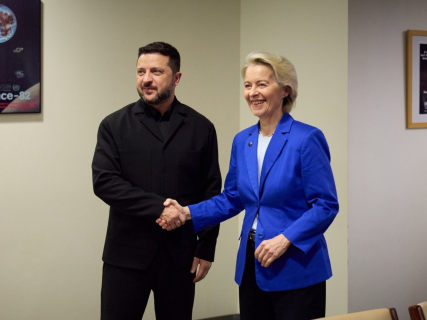

The president of Ukraine, Volodymyr Zelensky, and the president of the European Commission, Ursula von der Leyen, held a meeting this Tuesday in New York, on the sidelines of the first session of the United Nations General Assembly, in which they analyzed the financial situation of the country after four years of war with Russia and studied new formulas for economic support for Kiev both for this year and for the next.
"I had a detailed conversation with Ursula von der Leyen about how to ensure the financial resilience of our country this year and next," Zelensky announced in a post on social media in which he reiterated his gratitude for "the decision on the EU loan of 90 billion."
In this context, the head of the Ukrainian state emphasized that the country "is fulfilling the related obligations to close (its) budget deficit as much as possible" and has indicated that the teams from both sides have agreed to work "on other paths of financial support" with the aim of ensuring Ukraine's economic stability.
From the community side, the president of the Commission has stressed that Brussels "is working more than ever to strengthen Ukraine's defense" and has assured that "there will be more support in (this) area."
"Our new anti-ballistic program can help quickly increase production," illustrated Von der Leyen, who added that, "as reforms progress in the Rada (the Ukrainian Parliament), there will also be more budgetary support."
"We still have 37 billion euros available for this year," she noted, calling on "all leaders" to likewise double their support for Ukrainian defense.
EU sanctions against Russia at the center of the debate
Another key point of the conversation, Zelensky indicated, was regarding the European Union's sanctions regime against Russia.
The Ukrainian leader has insisted on the relevance of punitive measures against the Kremlin and has described any lifting of sanctions on Russian oligarchs as "counterproductive," arguing that "According to the president of Ukraine, 'it is precisely these types of measures that bring closer a just peace and guaranteed security'."
"At a time when Russia is inflicting brutal blows on our people (...), the signals about lifting sanctions on certain Russian oligarchs seem suicidal and unproductive. Wars end with determination and strength, not with indulgences for the associates of the aggressor," he has stated, while thanking Von der Leyen "for her willingness to work on the inclusion of additional Russian surnames in the European Union's sanctions lists."
The meeting coincides with the decision of the Twenty-Seven to unblock the agreement to extend for three years the sanctions against nearly 3,000 people and entities for the Russian invasion of Ukraine, after Latvia withdrew the objections that had stalled the pact on Monday night and agreed to abstain regarding the lifting of restrictive measures against the oligarchs Alisher Usmanov and Mikhail Fridman, as France had demanded.