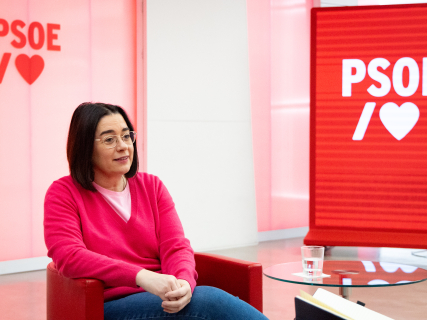

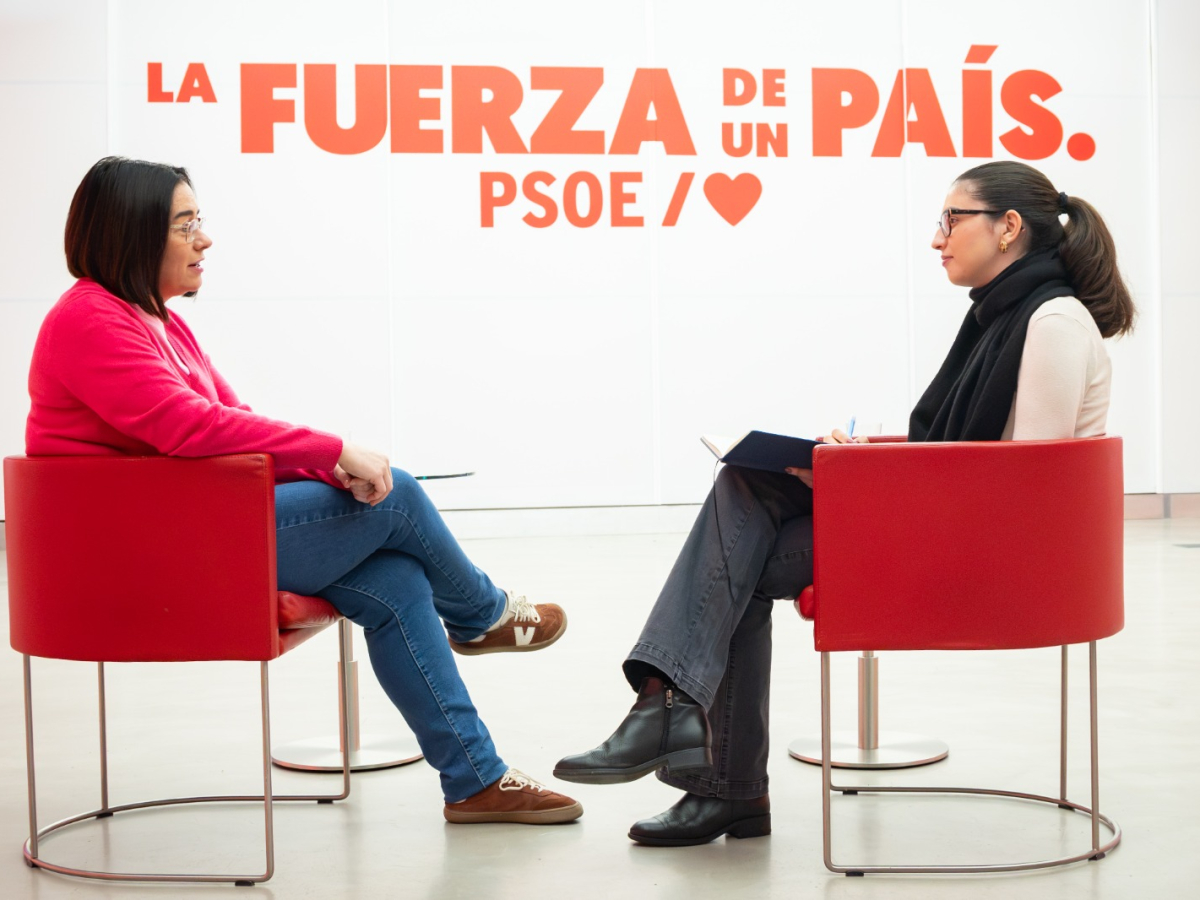
24 hours after the general strike of 11N, and 48 hours from the start of the 29N campaign, Elisa Garrido (PSOE) received DEMÓCRATA in the Ramón Rubial room at the Ferraz headquarters. Garrido is Deputy Secretary for Organization and Territorial Coordination, and also number one to the Congress for La Rioja. The candidate who made her debut in the San Jerónimo race in the last legislature, faces the electoral call convinced that the party can improve its results if they manage to mobilize the progressive electorate.
During the conversation with this outlet, she defended the management of the latest internal crises, described Óscar Puente’s actions after the train accident in Urda as “exemplary,” and ruled out that the PSOE will again make it easier for a PP Government through an abstention like the one in 2016: “I don’t think the PSOE rank-and-file would have understood a situation like that.”
QUESTION - The legislature ended with major pending initiatives; which laws “hurt” them especially that they were left hanging?
ANSWER - Above all, those that were left almost at the doors of being approved. For example, the one on domestic violence by proxy, conversion therapies, or the possibility of improving labor market insertion for people with disabilities. All those kinds of initiatives that had been worked on and that were at the doors are the ones that cause the most anger.
But I trust that we will have another legislature with a larger left majority in the Congress of Deputies and that we will be able to get those laws and many more out, which perhaps we were finding it harder to advance with the current composition.
P - The PSOE arrives at these elections after a complicated legislature, with judicial investigations, parliamentary difficulties… What responsibility does the party take for the accumulated wear?
R- Well, speaking about judicial issues, I believe this is a key moment in which we can see that a large part of all that noise and that harassment and takedown of the PSOE and our leaders had more to do with work by the Partido Popular trying to accuse us of whatever it was, even by buying witnesses and promising them millions of euros to do it, than with what there is truly.
It’s true that there have been specific cases. We believe that the main difference is that in the PSOE corruption is not systemic, but it is undeniable that within our own party we have also had people with conduct that is not exemplary.
We would always have liked to have chosen some people better
But in these cases the PSOE always acts. We don’t smash computers with sledgehammers or tell them that they should be strong. What we do is demand accountability, expel them from the party, and request the act, if they are deputies, or remove them from the positions they hold.
In the specific cases that have occurred, we have acted in the most exemplary way possible and, of course, we would always have liked to have chosen some people better.
P- Holds a position of responsibility in the Organization Secretariat of the PSOE. What atmosphere is felt within the party ahead of the elections of 29N?
R- Well, to tell the truth, if I have to define it in a single word, I would say illusion. Illusion and strength, probably. It’s true that this pre-campaign is being atypical because it has been marked by the Urda train accident, that’s undeniable. But it is also true that in the events we are developing, in the work with the comrades in the territory... what we see is that party members and socialist voters are very eager to go out and vote; they are very eager for the elections to be held so as to have a progressive government again.
P- In the last few weeks, two relevant figures from the PSOE have resigned, Montse Mínguez and Óscar Puente; how has that affected the mood of the party?
R - Well, that is a sign that the PSOE has another way of acting in the face of crises, in the case of the accident or of calling into question the exemplary nature in some situations. Of course, it is not something that leaves us indifferent, but above all we demonstrate that we are different when it comes to doing things.
For example, Óscar Puente didn’t just submit his resignation. The first thing he did was confront the situation, go to Atocha, face the citizens, and explain the information he had at that moment with clarity and transparency. He held a press conference that lasted practically two hours. Afterwards, he took measures, the following Council of Ministers was already approving measures for people affected by the accident.
P- Three weeks before the ballot boxes open, what reasons does a socialist voter have today to place trust again in Pedro Sánchez? What does the PSOE offer that it has not been able to offer during these years of government?
R- Well, I think these are crucial elections; we cannot simply measure them by what we can offer after eight years in Government, because we are betting on something much more important. We are not talking about elections in which there is a possibility of ordinary alternation within a democratic country such as Spain. We are in some crucial elections in which the far right is knocking at the door of our Government, in which we are betting on regression and on losing rights that we thought were already consolidated and that nobody was going to take away from us: labor rights, women’s rights, the rights of LGTBI people...
We are talking about elections in which we can continue advancing in rights and protection, with a stronger State that can face crises, accidents, and the devastating consequences of the climate change that Spain is suffering, or having a Government that what it wants is to destroy any public system, our welfare state and Europe, selling itself to the far-right wave, which, fortunately in some places, is being stopped.
We are talking about something more important than a simple alternation. And what can we offer? Well, continuing to bet on a strong State, continuing to bet on improving the quality of life of citizens, above all.
P - In the last campaigns, they have frequently resorted to mobilization against the right and the far right. Do you think that message is still enough to convince the electorate, or do they need to offer something more?
R - Especially, I think any left-wing voter in our country, who doesn’t want to be involved in a reactionary wave in Spain, has learned that they have to make a strategic vote. Especially in those provinces where few members of parliament are allocated, as we have demonstrated with the joint Senate list.
And I think those left-wing voters understand that, and understand that if they want a progressive government, in each place they have to vote for the progressive option that has the most chances of contributing members of parliament to the Congress so that later they can elect president.
P - The PSOE is competing again in elections with several formations to its left that compete for a similar electorate. To what extent does that fragmentation worry them?
R - Well, I think each of us has our roadmap clear. The PSOE works to offer a strong project, to try to have the best people at the heads of the candidate lists so that they can represent our ideas with force. And we know that the rest of the political forces on our left are doing exactly the same, understanding that what interests all of us is a common goal, a progressive government in Spain.
P - They are using "With the strength of the people" as a slogan in their pre-campaign rallies. Is it an attempt to recover the mobilization that Pedro Sánchez achieved in the 2023 elections, when the socialist result exceeded the expectations of the polls? Do they think it is possible to repeat that comeback on 29N?
There are two things. Of course, mobilization is crucial for us and we need all progressive people to go out and vote in a strategic way. That is extremely important.
But it is also a way of making it clear that each person's vote has power and is worth the same, whether it is a person from a working-class neighborhood with their basic salary or a multimillionaire who puts millions at the service of platforms to try to change the vote for their own benefit. The strength of the people is in that.
P - And regarding the possibility of a comeback like the one that happened on 23J?
R - I think what the polls establish is that there is a race. It wouldn’t be so much a comeback, but a situation in which the blocs are very close to each other and we depend above all on mobilization.
It is true that on 23J we came back against the polls, which, unfortunately in many cases in our country are not polls, but that they have been transformed into an attempt to prescribe the vote. But what we are going to achieve on this 29N is to increase the number of socialist voters, because we need more seats for a stronger majority.
I am sure that Pedro Sánchez is going to be president of the Government of Spain again
P - What scenario does the PSOE consider for November 30? Are they prepared to negotiate a new investiture or also to assume a role in the opposition?
R - The PSOE has always respected the election results. We are not like the right, which only cares about democracy when it wins. Of course, we will respect what comes out of the ballot boxes and we will do our part as best as possible where the citizens decide to place us. With absolute respect for the result, with loyalty to the State, and above all with loyalty to the Spanish people.
P- If Sánchez were unable to continue at the head of the Government, do you believe that in the PSOE a period of renewal should be opened to rethink both the political project and leadership?
R- I am sure that Pedro Sánchez is going to be president of the Government of Spain again, and that is the scenario we are working on and in which we put all our effort, our brainpower, and our heart.
P - Ten years have passed since the PSOE’s abstention that prevented the third repeat election and that invested Mariano Rajoy, do you believe we will see pacting of the style between the two-party system again?
R- I don’t think the current situation has anything to do with what it was 10 years ago. I don’t think the PSOE’s membership would have understood a situation like the one that occurred back then. What we learned is that handing the key to the PP brought a Government that celebrated workers’ cuts, social benefits cuts, shouting ‘to hell with them’. 10 years from that will also be reached, and there are many people who suffered it firsthand. We remember it too much to start considering a question like that again.
In detail:
Before starting the interview Elisa Garrido decides to leave the mobile phone out of the ‘set’ of the interview taking place at the historic Socialist headquarters located on Ferraz Street. The volume of messages she is receiving in this pre-campaign is overwhelming, and she doesn’t want anything to distract her during the conversation.
The road to the ballot boxes is going slowly among politicians, advisors, and journalists. “Let’s see if this ends already”, is the most repeated message in the huddles these days. Tomorrow the official campaign begins and we enter the countdown period.