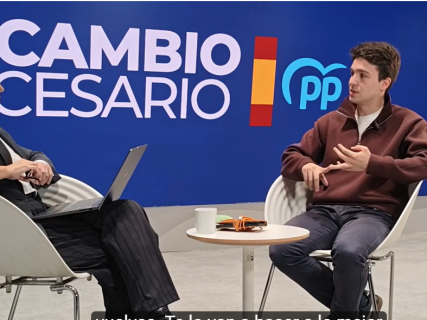


PP in the Basque Country
P: Mr. Dancausa, thank you very much for receiving us in your home
R: Thank you very much to you. At last, the interview.
P: Well, yes, at last we carry out the interview. I take the opportunity to congratulate you on your presidency in Nuevas Generaciones. I think you’re giving this institution a new air
R: Yes, well, we’re trying to give it an impetus. In Spain, there is a youth with a lot of desire to get mobilized, to be an active part and to take part in everything that’s happening in our country. Spain needs a change and we try to channel it, to capitalize on it in the best possible way with hundreds of young people in every province of Spain, with activism that is very detached, very relaxed, very mobilizing, very inspiring, with young people of every kind, from every corner of Spain.
And, well, for the moment we’re very happy with the result, with the impact on social networks, with the university presence.
Well, with the organization in general and with the renewal of the organization. But, of course, there’s still a lot to do. We’ll continue once the elections are over, because now the only priority is to get rid of Sánchez.
P: Well, you talk about young people all over Spain and also in the Basque Country, where they have a candidate who seems very strong, doesn’t he? It’s Ion Echeverría who is suffering the pressure of a campaign in the Basque Country by uncompromising and hostile people. You’ve lived through one of these episodes the first weekend of the campaign in Hernani
R: The first thing I would have to say is that, if I had to bet on whether Ion is going to win the seat in Guipúzcoa, I would put my money on it, because I’m 100% convinced that he’s going to win it, fundamentally because of the great campaign he’s running and because of his courage.
Indeed, I was with him the first weekend. We held an event in San Sebastián and then we went to some towns. We went to Zumaia and to Getaria. And we hadn’t announced that we were going to these towns; there was nothing called, nothing organized.
We got out of the car, and we started walking around. We saw some of them making gestures, a some bildutarra who identified us. He was making gestures with a couple of WhatsApps, and within 10 minutes, in each town there were already 15 people to throw us out of the town.
Without being organized, without having been called in advance, they would, well, I don’t know, from Sunday in their homes or doing whatever, and they organized themselves immediately. And there I realized the situation that continues to be lived in the Basque Country. There is a lot of people who are afraid. If you think like us, you can’t express it. There is social apartheid in the towns, so that nobody votes or thinks the way we can think it, how the Partido Popular can think it.
And there is still so much to do and above all this, I think the campaign that Ion is doing, regardless of the seat, which I think he will get, the truth is that Ion’s campaign is very important on a moral level. Because there are many people in many towns in the Basque Country who are afraid and need a bit of leadership, they need that initiative, they need the PP to go to the towns, with their faces uncovered, without fear and, so that they can also feel better, feel freer, feel more comfortable, with their situation—no, I’m not saying with their political situation, I’m saying with their social situation. This is fundamental.
What I saw that week in the Basque Country has impressed me. I knew it, but not as deeply as we have seen it. And, well, they no longer put bombs and no longer shoot in the nape of the neck. And it seems we have to thank them because they only throw stones and because they only carry out social apartheid against those who don’t think like them.
P: Okay, but throwing stones is violence
R: Yes, throwing stones is violence. It is political violence. I saw an interview in the press with Oskar Matute.
P: Yes, I was going to mention it. An interview in which he says that he would never leave to go for drinks (poteo) or with anyone from the PP or with anyone from Vox
R: Well, it’s that political violence begins there. It begins with those speeches and then the people in the towns replicate it. Just like he wouldn’t take part in a poteo, some people in the Basque Country listen to him and say, well then, with this people you don’t talk, you don’t socialize, you have to bully them, you have to carry out social apartheid on them.
And to me it seems deplorable. And, well, just like physical violence has consequences, political violence also has to have criminal and legal consequences. I think it also has to have political consequences. In this case the people responsible are Bildu, which is the PNV and the PSOE, for everything that is happening in the Basque Country. That has to have consequences.
The seat of Ion is also very important because in the province of Guipúzcoa six seats are shared out. It is the only province in which all the seats, over these last 4 years, have gone in favor of Pedro Sánchez.
I think it is time for some seat, and for the people who have not been in favor of everything that has happened these years in the Basque Country and in Guipúzcoa, to have a voice. And I think that with Ion Echeverría we are going to get that, we are going to have it.
And another of the things about the Basque Country in particular is that I had been told that the PNV is a right-wing party. A center-right party,
P: That was what used to be said
R: Yes, that was what used to be said. But the reality is that the PNV has voted in favor of the yes-is-yes law, has voted in favor of the trans law, has voted in favor of the communist decrees of Maricarmen, in favor of the regularization of half a million illegal migrants.
Therefore, I don’t know whether it is a right-wing party, a center-right party, or what. I don’t think so.
That is, people who are right-wing, regardless of their views about the Basque Country, I think are left without support by this PNV, and the only option left for them is the PP.
P: What security are they counting on during this campaign? Do they have security from the Ministry of the Interior; it seems the minister doesn’t pick up their phone? Do they have security from the Ertzaintza?
R: Well, look, I have an opinion about the Ertzaintza, about what is happening in particular with Ion’s situation, because it’s a double-edged sword. On the one hand, there are occasions in which they do not guarantee security, they cannot guarantee security, and they refuse to do it, and that is directly the responsibility of Marlaska. And then when they say, come on, we’re going to guarantee your security.
So instead of putting him some bodyguards, as could happen in a normal situation, what happens is that there are 15 ertzainas accompanying him, with helmets, with shields, with batons, with a milk carrier, with three cars.
And, of course, if you are going to campaign somewhere and you have 15 agents with shields and helmets and batons, accompanying you, it is very difficult for someone to come close to you and for someone to want to talk to you. It’s very hard for someone to be able to listen to you, right?
I don’t know to what extent this is intentional, and it is a way to sabotage the campaign.
I think, in effect, that his security has to be guaranteed with the necessary number of bodyguards, but, also because it is a political situation, that it be handled with the greatest discretion possible.
P: In all these days of the campaign, have you had any message of solidarity from the Socialist Party?
R: I’ve seen a couple of tweets. I’ve seen one from the youth wing of the PSOE in the Basque Country and I’ve seen another from the PSOE’s own account, and, well, those tweets are very good. But the reality is that it’s them who have to guarantee security. They’re the ones who don’t have to encourage those hordes of animals, of acorn-fed animals and uncivilized ones, who are the young people of Bildu and all that lot that fosters that violence.
P: Can it be said that since Sánchez has been governing in Spain and also partly in the Basque Country, this land has been borrokized?
R: I don’t know in detail how this evolution of recent years will have been. What is certain, though, is that political violence has been normalized, whitewashed, and naturalized. And this is something that cannot happen.
They are happy that, in many towns in the Basque Country, there are many people who don’t dare to express their ideas freely. And that seems terrible to me. That’s why it’s so important that there be a brave PP in the Basque Country that goes to the towns, with their face uncovered, that goes to the towns with absolute naturalness.
Also, I don’t know this riffraff. I know them from the Complutense University. At the Complutense University it’s the same, but they don’t have that culture of violence. In the Basque Country it’s the same apartheid, the same cancellation, but taken to a higher level by the culture of violence they have. Because many of them are children, they’re grandchildren, they’re nephews of people who, 20 years ago, were doing much more serious things. That’s why it’s very important that there be a strong, brave PP in the Basque Country, without fear, and that it be willing to go to all the towns with absolute naturalness.
These areas of harassment and intimidation, the images we’ve seen in Hernani, the images of the stones… they’re going to do this to you once, so that you don’t come back. Maybe they’ll do it to you twice or, maybe, three times. But the fourth time you go with your face uncovered, saying that you’re here and that you’re not going to leave, they’ll get tired. They won’t throw more stones at you.
That’s why it’s so important that Ion Echeverría, that everyone, that the Partido Popular go to the towns every week and without fear, with absolute normality and with absolute naturalness.
P: In addition to having a presence in the Basque Country in this campaign, we see that they have also submitted the Law of Basque Grandchildren. Can this idea be put into practice?
R: Yes. It can be. This law seems fine to those who have stayed in the Basque Country and held on, and who are a minority. And of course, to those who have left. But it is clear that the Partido Popular or the parties that are proponents of unity, of coexistence are in the minority; they are objectively getting bad results, because 250,000 people have left—most of them would be our voters—with their respective children and their respective grandchildren, some of them, because we are talking about the last 60 or 70 years, approximately.
In this way, it is normal for the PP to have a seat in the Basque Country. If it’s that 250,000 people, who for the most part would be our voters, have abandoned the Basque Country and scattered throughout the rest of Spain.
I think that the election results we see in the Basque Country are strongly conditioned by that exile of so many people.
The Basque Country is a large region, but it isn’t that large. That is, 250,000 people, plus their respective children—so we’re already talking about around 400,000 people. That’s 400,000 votes in the Basque Country. It’s a very important percentage and those are many seats.
Right now, representativeness in the Basque Country is rigged, with all the people who have left. That’s why this law of Basque grandchildren seems just to me, and it seems reasonable to me that any person who defends unity, who defends coexistence, and who defends the memory regarding what has happened until very recently and, to a lesser extent, is still happening, can vote here.
P: Do you think it will cost the Basque Nationalist Party for having intermittently supported, since 2018, the policies of Pedro Sánchez? And I’m not saying this in case this vote goes to the PP, but it could go to Bildu
R: Yes, it will cost them. A lot of votes are going to go to Bildu. The PNV is, I’m not going to say in a process of disappearing, but it is starting to become residual because of its support for Pedro Sánchez. When Pedro Sánchez falls, I don’t know what will remain of them as a party. And, well, in the end, I also don’t know what their values were, what their ideals will be. But it’s clear that they sold themselves to Pedro Sánchez, and Basque society has realized this, and it is punishing them.
The thing that saddens me is that it will be in favor of Bildu, on many occasions, but it’s clear that the PNV is on its way to becoming residual in Spain.
And well, I hope that all that people who are dissatisfied with the PNV for whatever reasons, because they are a left-wing party, because it is a party sold to Pedro Sánchez, because they are a party that has mimicked Bildu, well, that they can find in us that party and that option it offers opportunities, it offers stability, it offers industry, it offers security, it offers work, it offers that houses be built in the Basque Country, because in the end that is what we present ourselves for.
Housing
Q: Let’s talk about housing, if you please. Housing has been the leitmotiv of the general strike and the reason why the left has brought to the Permanent Deputation measures that had previously been rejected by Parliament.
The housing problem is not only for young people; it is also for people between 35 and 45 years old, in reality. And on this issue, Mr. Feijóo has already advanced since the start of the pre-campaign, that his party is committed to building 1,000,000 homes in a few years.
But we have also heard the vice president, Cuerpo, criticize this measure and question whether this figure is something that can be achieved. Can a million homes be built in Spain?
A: When we talk about building a million homes, we are not talking about a million public homes. We are talking about putting the conditions in place for a million homes of public initiative, private initiative, and public-private collaboration to be built, with a rental regime, a purchase regime, a protected housing regime, and a free housing regime, so that young people and people of all kinds, of every condition, of every social group, have opportunities to access a home, liberalizing land in abundance.
Land must be liberalized in industrial quantities, training workers so that they want to work in the construction sector, removing countless bureaucratic obstacles that exist in the autonomous communities and in town halls, but that depend on state laws, and those are many, and it doesn’t know what slows down the construction process, and that is the only way.
It is clear that talking about a million public homes is not reasonable, but rather that, when we talk about a million homes, we are talking about homes in a regime of all types.
The Government, what is clear, is that from the outset it has no political will to build them because they are content with scarcity; in fact, they have deliberately caused it, so that prices rise and to create that poverty, that dependence on the State, on countless occasions.
And I, what I don’t know is where the public housing is. I am now traveling all over Spain, through many provinces, through many autonomous communities, and before going to these places I inform myself to find out how many of the homes that Pedro Sánchez is talking about have fallen in that province.
P: Of the ones he announced from the beginning?
R: Yes, as a person from Madrid, none of them have come here. And I have to say that in all the provinces I have visited, in all of them, I have had to say that the PSOE has built zero housing, except in one where they told me they had built eight.
P: Can you tell us where?
R: I think it was Málaga.
P: And what do you think will be the effect of the Maricarmen decree? Will it encourage owners to put more housing on the market supply of housing? Or, on the contrary, will it cause there to be more vulnerable people who have even more problems accessing housing?
R: No, in the end it will considerably reduce supply. I hope that this decree lasts hardly two months or three months, so that when we have a sufficient parliamentary majority, it can be repealed as soon as possible, because in the end what we are seeing is that all this regulation that this people is implementing only brings scarcity and therefore supply decreases and prices rise.
Since Pedro Sánchez has been in government, the purchase price has risen by 75%, the rent by 45%. But until the beginning of 2024, it is true that the price of housing was rising moderately at a fairly slow pace, but it was rising.
And at the beginning of 2024, when Sánchez applies his housing law, this can be seen in all the charts; you can see in the statistics since the housing law comes into force at the beginning of 2024, which is when the price has exponentially surged during the last few years.
And it is directly because of a regulation, because of a throttling, because of a limitation in the market, so that many people do not put their home up for rent in the rental market and that is a reality.
But I mean, I think this has been something intentional. And I think they are comfortable with this situation.
P: The Government accuses you of not applying its housing law in the communities you govern, and they blame you for the pricing problem. But, let’s take the case of Catalonia as an example, where the law is indeed being put into practice. Is there more housing supply in Catalonia than in the rest of the communities?
R: No, there is less. There is an argument from the PSOE that says that, thanks to the fact that the housing law is applied in Catalonia, the price has gone down. That is a lie, because, objectively, there was a week in which the price dropped by 0.1 %, but then it rose again in a very exaggerated way. But it was enough for them to have a headline that during a week the price went down in Barcelona.
As I was telling you, it served them to have a headline, but objectively, since this law came into force, the price has risen considerably. I don’t have the data for Catalonia right now, but there is much less housing available for rent, housing also for purchase. And another very important thing is that that million public homes that we are talking about has to be for the Spanish middle class and has to be for young people, because people always talk about social housing for the lowest classes, for the most vulnerable, with State protection.
That also, of course, has to have an important part for it, but there has to be homes for the middle class of all time, for the people who want to start a family, for young people who get married and want to become independent, for young people who are just starting out and need a home.
Not long ago I read something on Twitter. A tweet that I found very clever and that said: Do you remember the concept of the bachelor’s little flat?
The concept of the ‘bachelor’s little flat’—that is something that has already disappeared from the vocabulary in Spain. But we also have to make it so that there are flats for singles, flats for couples, for people who want to go on their own or for people who want to start a family. But in the end, there has to be housing for the middle class and for middle-class young people, regular ones, who want to get ahead with their work.
*** According to the official data of the Generalitat de Cataluña **, new rental contracts have been reduced, while the rental price has started rising again after the initial drop, as the purchase-sale price continues to become more expensive. Specifically, according to data from **Incasòl and Idescat, updated on November 9, 2026, the evolution of new contracts since the first quarter of 2024 is of −23,3 %; that is, 8,046 fewer quarterly contracts.
**Q: I thought you were going to talk to us about the housing solution, which was a concept that was created, it seems to me that it was the first minister of Housing, which was Antonia Trujillo. By the way, speaking of ministers, there is also a minister in the socialist Government who has rented a protected housing unit **
A: Well, in the end it’s a fraud. Advice I give, that for me I don’t have. We saw it with Montse Mínguez and all the houses. In the end, those who boast the most about something are usually the ones who have the most to hide.
In the end those so demanding moral limits, that this lot puts on others, it seems they don’t apply to them. If someone from the Partido Popular had done that, right now we would have the streets burning asking for their resignation. Or, posters with their face saying that it is a speculator, that it is an evil one, that it is a fraud. But well, she is a PSOE minister, I imagine that her voter isn’t going to punish her for it, because consistency is not one of their great values that demand it from their politicians.
And, well, nothing. It’s one more case of absolute Government fraud, in this case, allegedly, because we still don’t know the details.
Wages
Q: Let’s talk about wages. About the minimum wage and about the recent increase by the Government at a Council of Ministers, also accompanied by an increase in the pay of civil servants. It happens that, in Spain, the minimum wage is already above the average wage of many places in Spain. What problems do we have with wages?
A: Spain has a very big wages problem and the reality is that since Pedro Sánchez has been governing, nobody has improved their economic situation. Nobody, absolutely no worker has improved their economic situation, because those to whom the minimum wage has been raised also don’t have more purchasing power, because inflation ate that, and the rise in the cost of living ate it.
Therefore, that group of people to whom they have raised the minimum wage also do not live any better than the way they lived eight years ago, and, the rest of us, we are much poorer. In the end, an average worker who earned 1,500 euros used to earn two minimum wages and, well, his paycheck allowed for much more. And now he earns slightly more than the minimum wage.
But it has to be said that productivity has not increased, and that is why another of the great pillars of our economy has to be national reindustrialization.
There has to be factories, there has to be data centers, there has to be industrial plants, there have to be nuclear power plants, there has to be industry, of all kinds, in every corner of Spain and, also for empty Spain, so that towns, so that provinces can again have opportunities for people, because this is the only way for wages to go up.
And another of the things that I think we have to talk about besides wages is the fraud they have committed with the Next Generation funds. We are talking about more than 140,000 million euros, which were supposed to be used to transform the economy, to make major investments with added value for the coming decades. And what did they spend it on?
Why did they spend those 140,000 million, and has the Spanish industry not improved, has the company not improved, has the infrastructure not improved, objectively?
We have learned how part of those funds has been allocated to current spending.
P: Something for which the funds were not intended
R: That’s right. But they used them to pay the salaries of civil servants and to pay pensions. That can’t be done, that is, soon we will know about that fraud—where the money went—and soon we will know about the fraud of tens of billions of those funds and where they ended up, because it is clear that they did not end up where they were supposed to end up. Possibly they have ended up in companies owned by some friend of all this group of people.
We still do not know it, but it is clear that between 30,000 and 40,000 million euros are missing from the Next Generation funds, that we do not know where they are, that we do not know where they went and that they have not served to make the Spanish economy grow.
And in the end, we are paying for that. Young people are paying for it, the middle class is paying for it, and workers are paying for it, because those investments were for our work, to increase productivity and, however, we continue the same or worse than ever.
Where are the Next Generation funds?
P: What you have commented is very serious because part of those funds were largely allocated, and among the first 100 beneficiaries, to Adif and to Renfe. Money that could have been used and, please, I’m not saying this with any kind of demagoguery, to improve the rail infrastructure such as that of Madrid-Seville
R: The other day I had a debate and the PSOE representative said that the Government of Sánchez invests more in safety and maintenance of the rail lines than what the Mariano Rajoy Government did. And I think, well, if that’s the case, you put it worse for me, because you’ve spent quite a lot more money and the infrastructure objectively works worse. That is to say, the fact that you have allocated a larger budget item does not mean that that spending has been better.
And what is clear is that there are thousands of millions of euros of corruption that we still have to find out about and that we don’t know where they ended up, but it has been translated into the situation we are living in with the trains and in the train accidents that we have seen. Because it is true that they have budgeted thousands of millions of euros for maintenance, and that is not reaching the maintenance of the rail lines.
Therefore, that money has been left along the way, somewhere. Soon we will find out where it is and, of course, we are going to pull up all the rugs and we will find out where every euro went, that they stole from us for this kind of issues.
And, in the end, cases of corruption have occurred in all parties—someone who acted badly and took money that did not belong to them—and that is extremely serious. Action must be taken with all possible force. But what we are seeing now is a structural issue, an issue of thousands of millions that we still do not know about, that are missing, that are the ones for infrastructure, for industry, for housing and for many other things.
It’s that we are talking about the fact that in Spain there has been a record in tax collection, and yet everything works worse.
This means that, along the way, many thousands of millions are going away that we still do not know where they are.
To go back to industrializing Spain so as not to let talent escape
P: Reindustrialization. You have spoken about it. But of course, how is that done and especially bearing in mind that in our country there are many young people with great talent who have to leave Spain because here they cannot find work; because here they cannot develop their professional profile and, at the same time, we have another major problem, which is absenteeism? How can all of this be coordinated and Spain be industrialized?
R: The truth is that from Spain more than 130,000 young people leave each year, mostly university students, mostly trained people, who have been trained here, and who have had to leave Spain because here they did not find an opportunity.
We want all those young people to return, all that talent to come back. And in fact, we are going to make a return plan so that all that people have an opportunity and can come back. It seems fundamental to us. And we want whoever wants to leave Spain to do so because they want to, but not because they cannot stay.
And I say this because the great majority of these young people do not leave because they want to; because they would love to live in Spain, they would love to build their life, their family in Spain. And if they leave, it is because they cannot stay.
And national reindustrialization, in the end, involves investing in infrastructure; you have to invest in the electrical system, so that there is industry, because we saw the total blackout in Spain, but there have been many blackouts of heavy industry during the last two years. And it seems that people have not noticed that, but industry in Spain has stopped for hours.
P: Well, this is important to explain, and to say that those industry blackouts happen so that the rest of the Spanish people do not face another blackout
R: It is something, in my opinion, banana-like, and, of course, it is typical of an electrical system of a developing country or of a third-world country, where, with such frequency, there are blackouts—either the total blackout we have seen, or the blackout of La Palma, or the blackout of Ceuta, or the blackouts of industry.
And that is how it is: as you well say, it has been necessary to disconnect so that the light does not go out across the entire Spanish electrical system.
And here, for example, in Madrid we have suffered it. Díaz Ayuso, the president, has denounced that, on numerous occasions, there are many companies, there are data centers, there is a lot of industry that wants to come to Madrid and that, from the Community of Madrid, relationships are made, paperwork is handled to attract investment and attract that industry, and then the Government of Spain arrives and says that it cannot provide it with the energy capacity to open that data center, or to open that factory, or to open that innovation center.
It has even affected housing. It’s that there isn’t decent infrastructure, and in this case, related to the electrical system. As I’ve already told you, in my opinion it’s bananas.
I didn’t imagine that in Spain it wouldn’t be possible to build a house because it can’t be provided with electricity.
This is something that, maybe in some poor countries in Africa or in Latin America, I could imagine. Maybe I could imagine it in Spain 90 years ago, in a very poor Spain, that was being rebuilt. Maybe I could understand it in those moments.
But in the Spain of 2026, that a house isn’t built, or that data centers aren’t opened or that businesses aren’t opened, because there’s no electricity, is something that seems bananas to me.
Industrialization has to go through that too. That is, because there has to be infrastructure that gives investors confidence so they come here and invest.
Well, that’s all because it’s down there. Jobs at the end of the day are what Spain also needs. We’re talking about Ceuta; the migration crisis continues.
The invasion of Ceuta and its effects
P: Let’s get into the topic of Ceuta. The migration problem, the effects of the invasion are there. We know that it hasn’t taken major measures or asked for the necessary help from the European Union, and to the problem of the invasion is added pressure on public services, including, the security and the healthcare of the people of Ceuta. What is the PP going to do if it wins the elections this Sunday?
R: Well, Ceuta in particular is not a migration crisis; it is an invasion. It’s not a migration crisis of the usual kind, in which a group of people come looking for a better life, to a country that wants to integrate, to settle, to work.
We’re talking about 100,000 people sent by the Government of Morocco, to invade Spanish territory. We are not talking about that usual and traditional situation that we see in other migration crises.
By getting into the subject of Ceuta, then yes, we go on to the more general migration issue; the first thing that has to be done with Ceuta is to stand firm with Morocco. Morocco does not decide who enters and who leaves Spain. And any person who collaborates with that hostile situation that Morocco is putting us in, I believe that they have to be sanctioned.
Any politician, any journalist, any lobbyist, who is in favor of what Morocco is doing— to me, that seems like a traitor to Spain and I think that we have to stand firm in the face of that situation and, first of all, tell Morocco that Spain is a firm country and that we defend our borders and that they do not get to choose.
Then the migration policy, already in general, it has to be an orderly migration policy again. It has to be a policy in which we decide who enters and who leaves.
We also have to decide how many people can enter Spain.
In the last four years, more than four and a half million people have entered Spain, which is approximately 10% of the population. More than 50% of the foreigners who are in Spain have entered since 2020, so that people have a little sense of the magnitude of what the migration policy has entailed.
In six years, 50% of the foreigners who are in Spain have arrived, so that people have a little awareness of what has happened over these last years, which has been at an exponential pace and impossible to integrate.
And at this point, I think we have to be clear about what migration model we want to have and with how many people. For this reason, it is necessary to analyze each year what the situation is with wages, employment, infrastructure, services, and housing, in order to determine how many people can continue entering Spain.
In the end, when we talk about immigration and what it is going to contribute, not only the good will of those people, of course, that is the first thing; but also how much we can handle, integrate into our market, into our work, into our housing, etcetera.
And then there are the migration models that we are seeing in the European Union. We have to see what model each one wants.
We bet on a model more like Italy or a model more like the social-democratic Denmark model. In which there is sovereignty and you choose who enters and who leaves. And I believe that the current Government of Spain is betting more on the France model, in which there are millions of people who are not integrated and, who enter with impunity.
In France we see the disturbances from time to time and whenever they feel like it and for whatever reason they feel like it, as we have been able to verify with a football match, like the one involving PSG, which turns the streets of Paris into an inferno, into war.
But well, I think they’re in favor, because we have seen how they have called for burning the streets of Madrid. I mean, they must be in favor.
Q: One of the debates that arises with immigration, starting from the premise that Spain needs labor that it cannot find in the country for certain types of jobs, is that it has to be matched with the supply of services, and among them housing, which today is the main problem for Spaniards.
That is why my question is: can you regularize half a million people, for whom it is an objective that there has been a pull effect? Or, in other words, does Spain have so much money to manage this main problem, which is housing, and that in the end can make those people who come to our country more vulnerable?
A: Of course not. And the best example is Ceuta. Because in Ceuta, practically, more than 100% of the population of Ceuta entered in a day. At these moments, and four months have passed, what is left is 20% of the Ceutí population. which is something absolutely unmanageable.
And, well, in Spain we are seeing it: more than a million people enter each year. Which entails net growth of approximately half a million people per year, and the necessary investment is not being made in infrastructure, in services, in the labor market, in housing.
Immigration and housing
Q: Well, in doctors. You are talking about hiring 4,500 more doctors
A: Yes, but you will be with me in that it is very complicated to carry out an investment, because it is true that not all of them contribute enough and what is necessary to the common pot so that those investments can be carried out and, that this population growth comes with, let’s say, growth in taxes and in contributions so that those investments can be carried out.
Therefore, it is clear that migration policy must be orderly again and must be planned. We have to know exactly what our quotas are and how we can integrate them and, how we can make it so that they contribute.
It is very important that only workers can come to Spain. Only and exclusively workers can come. Because we are seeing how people are coming who are not coming to work. And even more so with the housing problem we have.
Because, in the end, everyone needs a roof.
And the décalage is the following. In Spain more than a million people are entering per year, and in our country approximately 80,000 homes are built every year.
Imagine the housing deficit and how that deficit is growing every year. That is why we aim to build a million homes in four years. And we say that figure because currently we already start from a deficit of more than 750,000 homes. But within four years, when we expect that million homes will be built, the deficit will already be one million.
That is why this figure of one million homes is not a figure pulled out of thin air, just to have a headline. It is a very well thought-out figure.
The PSOE’s criticism for involutionists
Q: Mr. Dancausa, the PSOE repeats a slogan in all its rallies, and it is that the PP, and of course Vox, are involution. What do you think when you hear that comment?
A: Well, involution is getting on a train and not knowing whether you will reach your destination. Involution is that when my parents were going to university and they were taking commuter trains, and the commuter train service worked better than it does now—this is about 30 years ago, roughly. Involution is that the average salary of a young person does not allow them to buy a house, to rent a house, or to buy a car. Something that, before, when the PP was governing, did happen and could be done.
Involution is a huge number of the things that we are seeing. Involution is that there is no safety in the streets.
That is what I say is involution.
In the end, they are running a campaign of fear and they try to put fear into people with things that make no sense at all, like trying to put fear into pensioners, trying to put fear into women, trying to put fear into homosexuals, and, trying to put fear into everyone with these absurd speeches about involution.
The PSOE has been scaring people all their lives. They said that if Aznar won, Spain was also going to regress, that if Rajoy won, well, we are going to regress and we are going to go back to black-and-white Spain, and so on.
They say that if the PP wins, or even if the PP wins and has to reach an agreement with Vox, there will be a rollback on rights. But the reality is that the PP and Vox govern in several autonomous communities; we have done so over the last eight years. And nothing has happened.
And everything works better in those communities. Services work better, the economy works better, there is more security, when you have jurisdiction in matters of security.
And that is a reality, so absolutely nothing of regression.
Right-wing youth
Q: If it seems to you that we are concluding this interview, as I have been interviewing all of your colleagues, I know that you have an inexhaustible agenda.
Mr. Dancausa, you belong to a generation that has not lived through the transition nor the first years of democracy. When young right-wing people are identified with fascism or racism, what is your opinion? What values and what way of doing politics does your generation want to contribute?
A: My generation has the commitment to bring Spain together again. For me, that is the most important thing. I don’t know if what I’m saying is a fascist statement, but what I think is that the one who thinks differently is not an enemy, but simply a person who thinks differently, and we have to treat them with respect, with plurality, and with normality and naturalness.
I think that is one of the great commitments that my generation has.
What I can say is that my generation is the most anti-socialist in democracy.
We are seeing it during these last eight years, in which Pedro Sánchez has been in government and we have seen how all the ruin and all the misery and the lack of opportunities that we have in Spain are the consequence of the policies that Pedro Sánchez has carried out.
When Pedro Sánchez comes into Government, I am 17 years old. That is to say, I am still at school. But I’m already at an age, let’s say, in the labor market, having gone through all that intermediate stage.
Throughout all that youth, which has been the one I had with Pedro Sánchez as head of the Government, I have seen that degradation.
I have seen how, when I started university, the issue of access to housing was not in the public debate. That wasn’t one of the big problems for young people, because young people started working, and their salary, well, it more or less allowed them to rent a house.
And if you managed to save something, then maybe you could buy one.
When I was in high school, there were no safety problems in the streets.
If we went out partying in Bachillerato, when we came back at night, we weren’t afraid that absolutely anything would happen to us.
And all those things have happened in these last eight years, with Pedro Sánchez. That’s why we are the most anti-socialist generation in history. And that’s why we are recovering some values that seemed to have been lost.
I’m very proud to belong to that generation and, also a bit of the part that concerns me politically, to have an active role.
P: Can it be said that young people have shifted to the right? Isn’t it a situational change?
R: No, it’s a reality. For *that is why it’s very important that all young people go to vote. Young people in 2023 were the age group that most abstained in the elections, therefore we need young people to go to vote on the 29N. *
In 2023, more or less 40% of young people didn’t go to vote. But it’s that now it’s very important that they go to vote now.
Because it’s a lie that they are all the same and, really now we need to bring about that big change, those big structural, courageous, generational reforms. This is what Spain needs.
And we’re going to do it and that’s why we ask for your trust. It’s very important that, for 10 or 15 minutes, which is how long it takes to go to vote on November 29, that they go, that it doesn’t make them feel lazy, that the country doesn’t change by complaining on Twitter.
The country doesn’t change by complaining on the couch in your house. The country changes by going to vote.
If on Saturday night you don’t have to go out partying, then on Sunday, at a decent hour and go to vote, do it, because if not you’re going to regret it over the next few decades.
Vote for Feijóo
P: And of course, in your case, vote for Feijóo
R: Vote for Feijóo. Vote for Feijóo, because he has a project for the next few decades. For me that is the most important thing.
We have those big reforms that involve building houses, that there be security again in the streets, that the borders be closed against illegal immigration, that there be work again, that wages go up.
That’s the product that Feijóo has.
Feijóo, in all the political responsibilities he has had during his life, he can say that he has left everything better than he found it.
This happened when he came to have those responsibilities, at Correos, at Insalud, in Galicia. Feijóo has left things better than he found them. And that is what he is going to do with Spain.
And, in the end, this national project that we have has been going on for years. It has been more than three years working on this electoral program. It hasn’t been done in a rush, and in a hurry. Alberto Núñez Feijóo has been more than three years thinking, comparing, studying all these measures, which are viable measures, that we are going to carry out and, that Feijóo knows the responsibility he has with our generation.
Q: He has said that 40% of young people did not go to vote in 2023. And now after three years, you are doing a campaign and, in fact, you will have traveled through many corners of Spain in this campaign that ends this Friday in Seville. Tell us, and already to finish, I promise you, what are you noticing?
A: I have noticed a lot of enthusiasm. Since the elections were called, the next day I was in Valencia, the next day in Alicante. And yes, as I told you, I have been able to visit countless provinces and countless autonomous communities. We have made thousands of kilometers since Sánchez called the elections.
And we have seen that enthusiasm, those desires for change. Because I will tell you, there is a general feeling of hopelessness among young people that the situation is very complicated and that it will be very difficult to get out of it. But in these last weeks I am seeing that hope.
I think people are looking at us with a lot of hope. And that hope, we treat it with a great deal of honor, and with a great deal of sense of responsibility above all, and, being aware of the immense responsibility we have, because it is true that many people need us not to fail them, and we are not going to fail them.
That is our commitment and that is Feijóo’s commitment. He has said it on numerous occasions.
And every time that I have been able to talk with him, I have seen that he is very aware of the responsibility of the very complicated situation that Spain is going through, especially for young people, and that it is going to be his turn to carry out bold reforms, structural reforms, very big reforms, and with a great deal of vision and a high level of foresight. But he will do it. We have given him our word and we will be there to accompany him and to help him.
P: It seems that Feijóo has taken young people into very great account in this program
R: That’s right. Feijóo has taken young people into very great account. I can tell you that, at the end of 2023, I took part in a meeting in which this program was already being drawn up. At that time, and to put things in context, all the demonstrations against amnesty were taking place; we had won the elections a few months earlier. But everything indicated that Pedro Sánchez was going to make a corrupt pact, as he ultimately did, to push through his investiture.
So, we began to work on our electoral program, to be prepared for when the elections would be. We didn’t know whether they would be held after two months of the legislature, after a year, after two years, or whether the legislature would run its course.
But it’s clear that we had to be prepared. And I tell you that that’s where the young people have been, civil society. There were also people, of course, from the party, and there have been countless people during three years developing and proposing.
In addition, they told us: you propose the ideas that you consider important, brave, the usual thing you imagine we would never put in an electoral program. Well, right away they told us: we’re going to study it and we’re going to include it if it’s feasible—and that’s how it turned out.
Well, Federico Jiménez de Losantos was saying that it is the best electoral program in the history of democracy. I’m glad he’s read it and I know that very few people read it. But it’s not an electoral program; I think it’s a national project. That’s what matters.
P: Mr. Dancausa, we’re sure to see you around here next November 29 on the night of the vote count. Good luck. And you know, your next appointment is at our house, at DEMÓCRATA
R: Thank you very much. And of course, I’ll go, because I’ve never been.