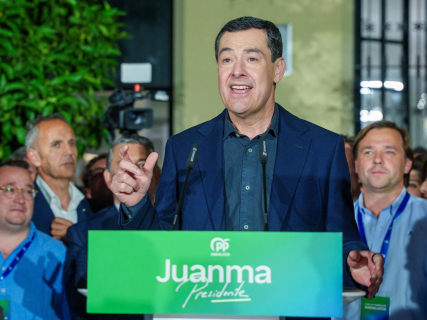
Moreno accuses Sánchez of leaving Andalusia without rail investments for eight years

The president of the Board claims the 363 million in investment planned in the 2027 regional budgets for Córdoba and contrasts the management of the Andalusian Government with that of the central Government. Moreno uses the example of Portugal to denounce the deficit in state infrastructure in the community.

fotonoticia 20260518165011 1920

fotonoticia 20260518165011 1920

Add DEMÓCRATA to Google

Ask FREN

Published

Last updated

3 minutes

Most read

Elecciones 29N · Encuestas

La media de las encuestas

Media a 7 de noviembre de 2026 · 11 institutos

  • PP31,0 %
  • PSOE26,2 %
  • Vox19,5 %
  • Frente Amplio6,6 %
  • ERC2,4 %
  • SALF2,2 %
  • Podemos2,1 %
01020304050ene 2024jul 2024ene 2025jul 2025ene 2026jul 2026

Media del último estudio de cada instituto en 30 días y su evolución semanal desde el 23J. Partidos con al menos un 2 %.

Todas las encuestas

Elecciones generales del 29 de noviembre · Demócrata

The president of the Junta of Andalusia, Juanma Moreno, has, this Saturday, lashed out against the Government of Pedro Sánchez for the lack of investment in infrastructure in the community and has accused the central executive of keeping Andalusia out of the main modernization projects for rail, road, and airports over the past eight years.

During a rally held in Córdoba, the Popular Party leader used the comparison with Portugal to illustrate what he considers a lack of investment commitment by the central Government toward Andalusia. "Imagine that the president of Portugal in eight years did not build even three and a half kilometers of expressways. We would say that is weak," he said to those attending.

Moreno extended the example to rail and airport transport to question Sánchez's executive's actions. Specifically, he reproached that during this period the commuter rail services have not been expanded, the airports have not been modernized, and the connections for medium-distance travel have not been improved, both for passengers and for goods. "Well, that is exactly what has happened in Andalusia, which has a similar size to Portugal," he said. The regional president has argued that the central Government has not built more than 3.5 kilometers of expressway in eight years and has denounced the lack of progress on other strategic infrastructure for the community.

The Popular Party leader has countered these criticisms with the economic development of Andalusia, which he has defined as Spain's third-largest economy and the community with the highest number of companies. He has also claimed the growth of industrial activity and has assured that the region is growing above the national average. "This land that has awakened, that is growing, that is developing, has not had either the affection, or the warmth, or the support," he reproached the central executive.

The rail corridor, another front against Sánchez

One of Moreno's main complaints has been aimed at the deterioration of rail infrastructure. The Andalusian president has focused on a corridor through which, according to his figures, 35,000 people travel daily, and has accused the central Government of allowing it to reach "the greatest of all possible forms of deterioration." "The worst of all is that the rail corridor, where 35,000 people move every day, he has abandoned it and has taken it to the greatest of all possible forms of deterioration," he said.

The criticism of the state of railway connections has thus been integrated into the discourse of the head of the regional council regarding the territorial distribution of state investments, with which he has sought to contrast Andalusian economic growth with the infrastructure shortfalls that he attributes to Sánchez’s Government.

Moreno asserts 363 million euros in investment in Córdoba

Against criticism of the central Government, Moreno has defended the investment policy of the regional council in the province of Córdoba and has highlighted that the regional budgets for 2027 include more than 363 million euros in investments for the territory.

Among the actions mentioned during the rally are projects linked to healthcare, housing, and water, as well as various strategic infrastructure for the province.

The Andalusian president has cited as an example the future logistics center of the Ejército de Tierra in Córdoba, a project for which he has claimed his involvement in light of financing needs. "Let me talk to the Treasury, let it fight it out with the Treasury, and let’s look for the money so that Córdoba has what it has and it will have it," he recalled regarding the efforts to push the initiative.

Moreno has also highlighted the development of the Ronda Norte of Córdoba, an infrastructure which, as he explained, had been left on hold since 2005, for more than two decades, until the Andalusian Government decided to reactivate its processing. The official has said that the regional council has allocated nearly 12 million euros in the budget for the first phase of the project, with the aim of making the works visible in the coming months.

"These are projects that have their deadlines, but more than nearly 12 million euros has already been allocated in the budget for next year for the first phase of the Ronda Norte," he pointed out. Moreno has defended that the inclusion of these items in the regional accounts will make it possible to carry out an infrastructure that, in his view, has been pending for too long. "We put it in the budgets because we have a budget and we also carry out the works," he said, before assuring that the Ronda Norte will be a reality during this term of office thanks to the action of his Government. The head of the regional council has used these projects to assert the implementation capacity of his Government and to contrast it with what he considers a lack of investment by the central Government in Andalusia.

More key points, information and questions with FREN

AI-GENERATED CONTENT

What is the status of the parliamentary processing of railway modernization projects in Andalusia?

As of November 7, 2026, the railway modernization of Andalusia is mainly in a phase of parliamentary promotion and oversight, through motions, non-legislative proposals, and requests for appearances. No comprehensive Andalusian railway modernization law has been found in processing. It is important to distinguish these initiatives from technical projects and works: approving a parliamentary request does not equate to authorizing or financing its execution.

Parliament of Andalusia: approved and ongoing initiatives
  • Corridors, Algeciras-Bobadilla and Almería. The non-legislative proposal 13-26/PNLP-000030, from the Popular Group, has already been approved; its approval was published on November 6. The submitted text demanded an annualized and budgeted schedule, completion of the modernization and electrification of Algeciras-Bobadilla, completion of Almería connections, and improvement of commuter trains and port accesses. It is a political promotion initiative, not a bill (BOPA, submitted text).
  • Railway infrastructures of Cádiz. The PNL 13-26/PNLC-000030, from Vox, is still under processing before the Commission of Development and Mobility. It was admitted on September 30 and on October 21 total amendments were published. It requests electrification, renewal, and sidings for freight on Algeciras-Bobadilla, high-performance studies, and adaptation of Sevilla-Cádiz. Its approval is not recorded in the consulted sources (BOPA, latest actions).
  • Appearances on railway improvements. Requests from the PP, 13-26/APP-000522, and PSOE, 13-26/APP-000749, to report before the Plenary, as well as from Vox, 13-26/APC-000429, before the commission, have been admitted. The admissions correspond, respectively, to October 14 and 21 and September 30; their holding is not recorded (PP request; PSOE request; Vox request).
  • Service control and planning. Ernesto Alba's question, from Por Andalucía, 13-26/PE-000113, about Almería-Madrid connections has already been answered: the response was published on November 5. Socialist questions about the execution of PITMA 2030, 13-26/POP-000066 and 000185, lapsed on September 25 and October 8 (Almería-Madrid; first PITMA question; second PITMA question).
Congress and Senate: promotion agreements already adopted

The Congress approved on April 15, 2026 eight points of a PP motion about connections with the south. They include revitalizing commuter and medium-distance trains, strengthening Cádiz-Sevilla-Córdoba-Jaén, improving Málaga and Sevilla offerings, and accelerating the Mediterranean and Central Atlantic corridors. It is an agreement already adopted, not a law pending approval (Congress, April 15).

In the Senate, the Transport Commission approved on June 9, 2025 a socialist motion to accelerate the Sevilla-Huelva high-speed line, by 26 votes and two abstentions. On September 22, 2026, it approved promoting the Cercanías-line 3 metro interchange in Sevilla at El Higuerón, by 27 votes and two abstentions, and improving Granada connections, by 18 votes and eleven abstentions (Senate, Sevilla-Huelva; Senate, September).

What this means for the projects

The practical conclusion is that there are parliamentary agreements, but not a joint legislative approval of the works. Sevilla-Huelva continues with projects in drafting; Antequera-Granada-Almería combines studies and differentiated actions; and Sevilla commuter trains have capacity studies. Their progress depends on planning, environmental assessment, financing, and contracting, not on turning each action into a law. The most concrete ongoing parliamentary processing identified is concentrated in Cádiz and in the cited regional appearances.

What are the competencies of the President of the Junta de Andalucía according to the Statute of Autonomy?

The President of the Junta de Andalucía exercises functions of government leadership, administrative coordination, and institutional representation. Its main regulation is in article 117 of the Statute of Autonomy, approved by Organic Law 2/2007, of March 19, although other articles add powers regarding laws, parliamentary relations, and elections.

1. Government leadership and administrative coordination

Article 117.1 establishes that the president "directs and coordinates the activity of the Council of Government" and "coordinates the Administration of the Autonomous Community." This places the Presidency at the head of governmental action but does not convert all Executive competencies into individual presidential faculties.

  • Designates and removes councilors, according to article 117.1.
  • Distributes executive functions among the members of the Council of Government once elected and appointed, according to article 118.4.
  • May temporarily delegate own executive functions to one of the vice presidents or councilors, in accordance with article 117.2.

The distinction matters: article 119 attributes to the Council of Government, as a collegiate body, the political leadership of the Community, the direction of the Administration, and executive and administrative functions.

2. Representation of Andalusia and the State

Article 117.1 attributes a dual representation: it holds the supreme representation of the Autonomous Community and the ordinary representation of the State in Andalusia. These are two distinct institutional positions that the Statute combines in the same person, along with their leadership and coordination functions of the Executive.

3. Promulgation and publication of laws

According to article 116, the president promulgates Andalusian laws in the name of the King and orders their publication in the Official Gazette of the Junta de Andalucía within fifteen days following their approval, as well as in the Official State Gazette. For their validity, the date of publication in the regional gazette applies.

This function should not be confused with approving laws: legislative power corresponds to the Parliament of Andalusia.

4. Relations with Parliament
  • Vote of confidence: article 125 allows the president, after deliberation of the Council of Government, to ask Parliament to confirm its support for his program or a general policy declaration. It is obtained by simple majority; if denied, he must resign.
  • Extraordinary sessions: article 103.3 allows him to request their holding. The convocation corresponds to the president of Parliament, after approval of the Permanent Deputation.

These faculties are accompanied by political responsibility before Parliament, expressly provided in article 117.3. Also, if a motion of censure succeeds, he must resign according to article 126.

5. Parliamentary dissolution and elections

Article 127 allows him to decree the dissolution of Parliament, after deliberation of the Council of Government and under his exclusive responsibility. The decree must set the election date. He cannot do so while a motion of censure is pending nor, as a general rule, before one year has passed since the previous dissolution.

There is an exception: if two months pass from the first investiture vote without any candidate obtaining the required majority, Parliament is automatically dissolved and the acting president calls new elections, according to article 118.3.

6. Popular consultations and jurisdictional conflicts

Article 117.4 allows him to propose popular consultations, on his own initiative or at citizens' request, on matters of general interest in regional or local matters, respecting article 78 and state legislation. Additionally, article 119.5 establishes that the Council of Government may raise jurisdictional conflicts to judges and courts through its president.

Source: Statute of Autonomy for Andalusia.

What legal requirements must be met for the Junta de Andalucía to execute investments in strategic infrastructures in the province of Córdoba?

The Junta de Andalucía can execute investments in strategic infrastructures in Córdoba when it has competence or legal authorization, budgetary financing, available land, and the required approvals, and respects public procurement rules. Considering an action strategic does not allow omitting these requirements. What matters is the type of infrastructure and its ownership, not only its location in the province.

1. Competence to act

First, it must be identified which Administration can approve, finance, and execute the work. The Statute of Autonomy regulates Andalusian competencies over public works, transport, energy, water, and territorial planning, within the constitutional distribution.

If the action corresponds to the State, the Junta cannot unilaterally replace it. Its participation must be articulated through the corresponding cooperation instrument or legal authorization, delimiting responsibilities and financing. Financing infrastructure does not equate to acquiring competence to execute it.

2. Credit and expenditure authorization

The investment requires adequate and sufficient credit, destined to the authorized purpose, and expenditure approval by the competent body. The Legislative Decree 1/2010, which approves the consolidated text of the Andalusian Public Finance Law, requires territorial classification of investment expenses and regulates multi-year commitments.

If the works span several fiscal years, their limits and authorizations must be respected: commitments are subordinated to the credit authorized in each budget. The Organic Law 2/2012 on budgetary stability and financial sustainability also applies. A political announcement or forecast of external financing does not replace these administrative decisions.

3. Project, territorial planning, and land

The public need, location, alternatives, and cost must be justified, and the technical project approved when applicable. The action must comply with applicable territorial and urban planning, using specific procedures provided for public infrastructures.

Additionally, legal availability of land must be accredited through acquisition, transfer, use of public assets, or expropriation. The latter requires processing guarantees for affected parties and compensation according to the legal procedure.

4. Environmental assessment and sectoral permits

The Law 21/2013 on environmental assessment distinguishes the evaluation of plans and programs from project evaluation. Its requirement and modality depend on the characteristics and effects of each action; not every investment requires the same procedure.

When mandatory, they must be completed before the corresponding approval or authorization and their conditions incorporated. Permits on water, historical and archaeological heritage, forests, livestock routes, or protected areas may also be needed, as well as public information and consultations with affected administrations.

5. Contracting and control

The Law 9/2017 on Public Sector Contracts requires justifying the need for the contract, preparing the file and specifications, and applying the corresponding award procedure with publicity, equality, transparency, and competition. During execution, modifications, quality of works, and payments must be controlled. Public-private collaboration does not eliminate these guarantees.

6. What the strategic consideration contributes

It is important to distinguish a priority public infrastructure from a business investment declared of strategic interest. The Decree-law 4/2019 regulates this second figure: it generally requires a minimum private investment of 25 million euros and 50 direct jobs, although justified exceptions are contemplated. These thresholds are not general requirements for all public works.

A Córdoba example of cooperation is the addendum on the Logistics Base, published on October 26, 2026: it foresees up to 100 million euros of regional contribution through a nominative subsidy to the State, specified by a specific agreement and subject to justification.

Play

Test your knowledge with FREN!

How much do you know about this topic? Answer the following 3 questions.

What investment figure has Juanma Moreno claimed for the province of Córdoba in the 2027 regional budgets?

Question 1 of 3

According to Juanma Moreno, how many kilometers of highway has the central government built in Andalusia in the last eight years?

Question 2 of 3

How many people travel daily through the railway corridor that, according to Moreno, is deteriorated?

Question 3 of 3