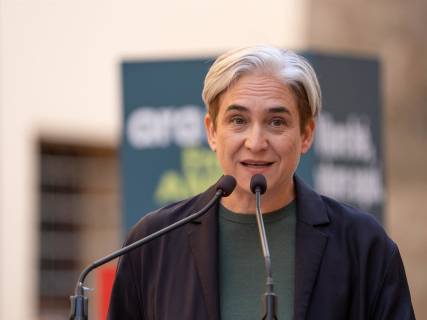

The candidate of Frente Amplio, Ada Colau, has said that she will be at the interview for the TVE program 'La Revuelta' without selecting the attending public, marking a distance with Vox leader Santiago Abascal, and defending a public radio-television that is "critical, uncensored and without fascism".
Colau has released this message in a brief post on her social networks, in which she referred to her participation this Tuesday in the space hosted by the comedian David Broncano, which will be broadcast one day after the interview with the Vox candidate.
"Unlike Abascal, you can imagine that I have not chosen my audience, either in this program or in any other. We are going to defend a public television that is critical, uncensored, without fascism—and that is with great doses of feminism and a sense of humor," she added.
For his part, the Minister of Culture and 'number two' of Frente Amplio for Barcelona, Ernest Urtasun, has described what happened during Abascal's interview as a "serious moment," considering that the right "was seen in all its splendor".
In his view, Abascal did away with "the humor" in the TVE space by going "to his own audience" in the format led by David Broncano. From then on, he has denounced "the censorship of the far right" such as, as he has pointed out, occurs in Castilla y León, where Vox governs with the PP and "has conditioned film aid on ideological criteria".