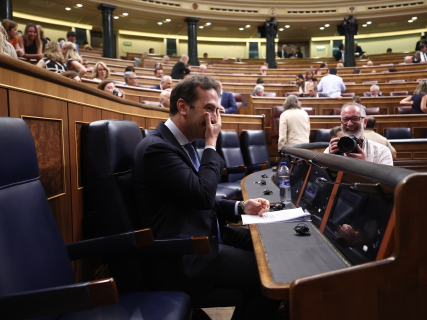

Amid reproaches of all kinds, from left and right, the Government found this Thursday in Congress sufficient support to move forward with the validation of the latest extension of the 'anti-crisis' decree-law.
The extension maintains discounts on fuels in a gradual withdrawal, and targeted aid to transportation professionals and the primary sector, the most affected by the rise in energy prices due to the war in Iran.
The star measure, however, is the disappearance of the so-called generation tax, the Tax on the Value of Electric Energy Production that electricity companies pay, and for which a progressive reduction is planned until its disappearance starting in 2028.
To the 1.825 billion euros of impact of this second decree-law, another 2.700 billion in lower revenue due to this withdrawal between 2027 and 2028 must be added, cited the economic vice president, Carlos Cuerpo, who pointed out that this measure was “a persistent request from the industry” and is “in line with the proposals of several groups.”
Particularly, from the PP, Junts, and PNV, but which was also supported by Esquerra Republicana this legislature. With a measure of such significance, and with such economic impact – Cuerpo cites that the reduction will impact a 6% decrease in the bills of companies and households --, the Government ensured the validation.
Despite not announcing it at the podium, neither PP nor Junts will block the decree-law. The 'popular' party points to abstention and the Catalan independence supporters, despite the criticisms in the debate, will support the validation by celebrating the incorporation of many of their proposals.
Josep Maria Cruset, a deputy from Junts, demanded in any case structural measures, particularly focused on industry, to ensure its viability. Idoia Sagastizabal, from PNV, celebrated that the measures of the decree-law were targeted and focused on the most affected professional sectors.
And ERC and Bildu pressed the Executive to redouble efforts in environmental policies, with the paradox, reported Mikel Otero (Bildu), that a large part of the fiscal effort of the decree-law is aimed at subsidizing fuels.
Podemos also criticized, through its deputy Javier Sánchez Serna, “the subsidy to the oil industry.” The ‘purple’ deputy criticized Vice President Cuerpo who, instead of limiting profit margins, tries to intimidate them with a list of non-compliant gas stations. “They are not going to lower prices for being on a list,” he assured.