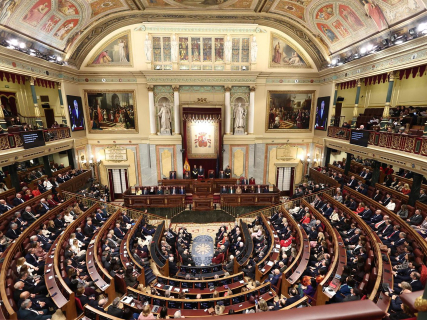

PP and Vox have denounced this Thursday that PSOE and Sumar support a reform of the Congress Regulations that eases the requirements to establish a parliamentary group in the Lower House, with the aim, according to them, of rewarding the minority parties that have supported the coalition government during this legislature and ensuring their backing in the next one if they need it again.
In the Plenary where this modification has been discussed, both the 'popular' and Vox have agreed that the change in parliamentary rules confirms that the legislature is exhausted and that the forces that have propped up the Executive fear a setback at the polls.
This has been expressed by the 'popular' Pedro Navarro, who has maintained that the Congress Regulations "cannot become a negotiation instrument for the imminent electoral process," although, in his view, it already is since the beginning of the legislature, when it was altered to allow the use of co-official languages in the Hemicycle.
In this line, he has rejected that the text be tweaked to "fabricate artificial groups." "We defend that whoever wants to have their own group earns it at the polls, with the support of the citizens, not in the hallway in exchange for a vote for some initiative," he has insisted.
The Vox parliamentarian Carlos Flores Juberías has criticized that the conditions to have a own group are lowered "to ridiculous limits" through a proposal that, in his opinion, demonstrates that, no matter what the president of the Government says, "the legislature has ended."
In this context, it has been questioned whether this reform is a "farewell gift for three years of faithful support" from the partners to the Executive or if it is rather "the advance payment for the support they expect to receive from them in the next legislature."
Criticism of Podemos and warnings to Junts
Additionally, he has urged Podemos to "give it a 'little thought'" to a text that, in light of their results in Aragón, Castilla y León, or Galicia, will be useful to them, since there they did not reach even 1% of the votes. A similar reproach has been directed at Junts, to whom he has suggested to lower it even to 0.1%.
"When the majorities change and other modifications of the Regulations are proposed, you will not be legitimized for any criticism, because your behaviors and your prior sectarianism will make you slaves to the same," has warned, for his part, the UPN deputy, Alberto Catalán.
Defense of pluralism and clear rules
In the face of these accusations, minority groups have argued that the reform of the Regulation allows "a better reflection or adaptation of the diversity and plurality of society that is manifested in the electoral results," as summarized by the representative of the PNV Mikel Legarda, and also reinforces the protection of political pluralism.
They have also emphasized that the new wording provides Congress with "clear" rules that will prevent majorities from making "twisted" use of the Regulation to veto or authorize the creation of parliamentary groups. This has been stated by both Jon Iñarritu, from Bildu, and Pilar Vallugera, from ERC, who has accused PP and Vox of continuing to observe Congress and the country "with the glasses of the last century."
"We are making a change in the internal life of this Parliament so that, if fascism governs in the next legislatures, we at least have the possibility of standing up to them, not only in the streets but also here," defended Alberto Ibáñez, from Sumar, claiming this type of compensatory measures.
The PSOE denies a rupture in the functioning of the Chamber
On the socialist side, María Adrio has emphasized that this regulatory reform "does not break the functioning of the Chamber" and that its purpose is "to correct a rigidity that today poses situations that are hardly compatible with the pluralism of the institution." Furthermore, she pointed out that it will prevent the Mixed Group from "being too large," something that, in her opinion, "would hinder its functioning and the organization of debates."