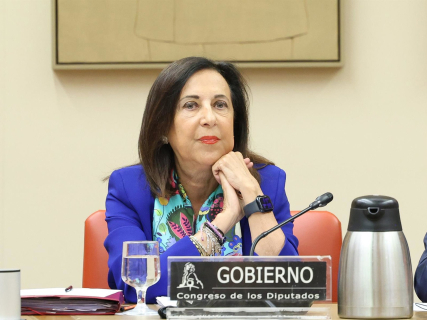

The Minister of Defense, Margarita Robles, reiterated this Tuesday in Congress that Ceuta and Melilla "are Spain and untouchable" and emphasized that any violation of national sovereignty will be responded to "firmly".
During her speech before the Defense Commission of Congress, convened to analyze the crisis generated by the massive entry of immigrants from Morocco into Ceuta at the end of July, the Defense official underscored that "it is essential that no one has the slightest doubt" about the Spanish identity of both autonomous cities. On several occasions, she has repeated "so that there is no doubt" that the two North African enclaves "are Spain" and "untouchable".
As she emphasized, "it's not that they are Spanish, they are very Spanish, and we are not going to allow their values of coexistence and tolerance to be put in danger or questioned." In this line, she warned that "any aggression or attempt of aggression" is interpreted as an attack against "all of Spain," insisting that the sovereignty and territorial integrity of the country "are untouchable".
Reaction to the statements from Morocco
Robles has stressed that territorial sovereignty and the protection of the security of Spanish citizens correspond to the State, and has assured that any attempt to violate them will be responded to "firmly," always within the framework of legality.
In this appearance, she avoided explicitly mentioning Morocco, unlike what she did after the massive entry into Ceuta, when she called on Rabat to "not touch" Ceuta and Melilla, while other members of the Government have maintained that the neighboring country is a "reliable" and "loyal" partner.
In her second turn to speak, the minister referred to the statements of the Moroccan Minister of Islamic Affairs, Ahmed Toufiq, who has reiterated Morocco's claims over Ceuta and Melilla and warned that he "will not accept" that the Spanish identity of the autonomous cities is "questioned" or "doubted".
Next, Robles pointed out that "it does not correspond to her" to comment "on the neighboring country." "He will know what he has done and what he has not done," she noted. She also recalled that her mobile phone was attacked with the spyware program Pegasus, a case that has been linked to Morocco, although she insisted that it should be waited for the courts to clarify who was responsible and reiterated that she has "never" felt "blackmailed" by Rabat.
"If the content of my phone were to be released, I wouldn't care either, but let the Spanish or Moroccan judicial authority determine if there have been responsibilities and whose," the minister has stated.
Migration crisis and political use
Regarding the crisis opened after the massive entry into Ceuta, Robles has warned that "let's not deceive ourselves: there are many issues that will take time to be known and others that we may never know." Immediately after, she referred to "interested actors who have probably favored this crisis or are using it with a clear political aim of destabilizing Spain and the EU."
The minister has also mentioned the "recognition of the proliferation of hybrid attacks and threats" that, in her opinion, "make it more necessary than ever to strengthen a joint action of democratic societies in defense of values and respect for the life and dignity of all human beings."
In this context, she has demanded that the EU maintain an "essential role" in responding to these challenges, along with security forces, intelligence services, and judicial authorities, with the aim of "fighting against organized crime and against the mafias that traffic in human beings." She has also advocated for strengthening economic and social aid to the countries of origin of immigration to address the causes that push people to emigrate.
Relationship with Morocco and message to the people of Ceuta
Regarding cooperation with the neighboring country, Robles has pointed out that "Europe and Morocco, as countries that share a border, must continue to work together and without sparing means or efforts to tackle irregular immigration," emphasizing that "what happened on July 30 cannot happen again."
On the other hand, the minister has wanted to address the citizens of Ceuta to apologize to those who may have felt "abandoned" or "not sufficiently accompanied" during the crisis, admitting that if that perception exists, it is because the Government "has arrived late" and "something must have been done wrong."
Robles has acknowledged the "anguish" that the neighbors may have experienced and has wanted to convey her "empathy" to them. "I want to tell you that you are not abandoned and you will not be, so do not feel that way," she concluded.