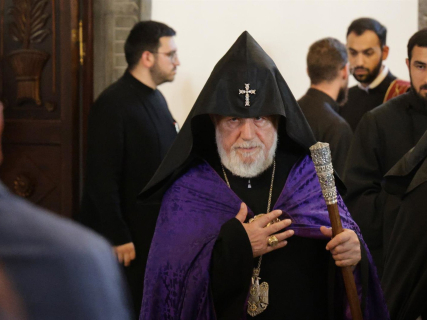

The Prime Minister of Armenia, Nikol Pashinián, has taken a new step in his confrontation with the Armenian Apostolic Church, led by Karekin II, by announcing the opening of an investigation into the ecclesiastical leadership. The head of the Government accuses the religious hierarchy of sedition following the harsh criticisms launched by the institution in the wake of the loss of the Nagorno Karabakh region and the territorial concessions made to Azerbaijan.
"Following my instructions, a report is being prepared on the deep systemic crisis that has arisen in the Holy Church of Armenia, which exposes dozens of facts that demonstrate that Ktrich Nersisyan (Karekin II) has excluded the Holy Apostolic Church of Armenia from the canonical circle, with all the consequences that this entails," the Armenian leader stated before Parliament.
Pashinián, who does not recognize Karekin II as the highest authority of the Church and reproaches him for acting outside the internal norms and violating canon law, has indicated that he will only agree to meet with him if he is willing to discuss the package of reforms proposed by the Executive.
The last major clash between both parties occurred when the Church removed Bishop Gevorg Saroyan, considered close to the Prime Minister, from his position for alleged misconduct and failure to fulfill his clerical duties. The prelate appealed the measure before a civil court, which ended up ordering the religious institution to reinstate him.
Nevertheless, the Church refused to reinstate Saroyan. Subsequently, the Prosecutor's Office filed charges against Karekin II and six other bishops for obstruction of justice and alleged abuse of power. The accused denied any wrongdoing and defended that civil judges do not have jurisdiction to intervene in these types of internal matters.
The rupture between Pashinián and the ecclesiastical leadership worsened after the outcome of the conflict over Nagorno Karabakh and the subsequent territorial concessions to Azerbaijan. Prominent religious figures, such as Archbishop Bagrat Galstanyan, led massive protests against the Government's peace strategy, which, for its part, accuses the high-ranking Church officials of acting as emissaries of Moscow.
Galstanyan, at the head of the Tavush Movement for the Homeland, is currently under house arrest after being charged with organizing mass disturbances and attempting to seize power during the mobilizations. Although the archbishop suspended his pastoral responsibilities to become a reference for the opposition, he continued to operate from the ecclesiastical structure protected by the Holy See of Etchmiadzin.
In the background of the clash lie radically opposed visions of the role of the Church. The ecclesiastical hierarchy defends that priests, like any other citizen, have the right and obligation to speak out on issues of national interest, while the prime minister maintains that the religious institution should limit itself to the spiritual sphere and not intervene in the political life of the country.