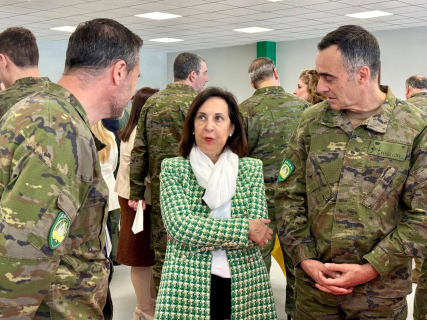

The Defense Commission of Congress meets this Wednesday to debate and vote on initiatives registered by PP, PSOE, Vox, Sumar, and UPN with the aim of reinforcing the conditions of members of the Armed Forces and making a military career more attractive, in an international context where the need to strengthen defense and security has gained momentum. Among the proposed measures are salary increases, facilities for geographical mobility, and the implementation of a military well-being index.
These proposals for resolutions have been presented based on the report of the Observatory of Military Life corresponding to 2024, submitted to the Courts and collected by Europa Press, which reflects concern over the "chronic" personnel deficit in the Armed Forces described in the document.
The Observatory of Military Life, a consultative body dependent on the General Courts, estimates a shortage of between 13,000 and 23,000 active duty personnel and warns of the "scant interest" in promotion within the institution, a situation it links to low salaries and the difficulties associated with continuous changes of assignment.
PP, PSOE, Vox, Sumar, and UPN focus their initiatives on improving remuneration and regulating geographical mobility. The 'popular' party adds the creation of a compensation system for uprooting that takes into account the personal and family impact of transfers.
Labor integration of spouses and compensation
The PP also proposes the signing of agreements between the Ministry and regional public employment services to favor the labor integration of the spouse of military personnel assigned to another locality, with measures for guidance, relocation, promotion of self-employment, and preferential access to training and entrepreneurship services. A line of action shared by Sumar, which demands a comprehensive plan to support geographical mobility.
Likewise, it is proposed to enable specific aid to compensate for expenses arising from double residency situations caused by military personnel transfers.
Vox, for its part, demands the incorporation into the remuneration system of a supplement to compensate for extraordinary services, such as guards, training, continuous services, and other tasks that exceed ordinary working hours and currently do not have financial compensation.
In the same direction, and coinciding with UPN, Santiago Abascal's party asks to increase the budgetary allocation for the construction of new logistics infrastructures, as well as for the maintenance and modernization of existing ones.
Recruitment and Teleworking Plan in the Armed Forces
PSOE and Sumar emphasize recruitment problems. The socialists advocate for increasing the personnel of the Armed Forces through "novel measures" that also contribute to retaining existing talent.
In the case of Sumar, the party wants the Observatory of Military Life to urge the Executive to present a Strategic Recruitment Plan that addresses the personnel deficit, with quantifiable annual goals, diversification of recruitment channels among young people under 30, and a quarterly monitoring system.
Furthermore, the group led by Yolanda Díaz proposes promoting the use of remote work formulas and remote nodes in those destinations and positions that, due to their characteristics, can be performed through teleworking.
PP and Sumar also agree on the creation of a military well-being index, with objective indicators on mental health, work-life balance, remuneration, stability, and mobility, the results of which would be published annually accompanied by an evolutionary and comparative analysis.