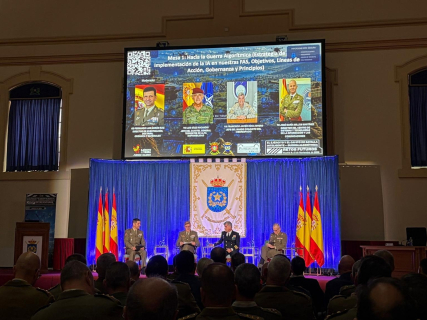

The head of the High Availability Ground Headquarters and institutional representative of the Armed Forces, Lieutenant General Luis Sáez Rocandio, has underscored Spain’s “key” role in NATO and has insisted on the need to drive digital transformation in the Armed Forces. “We have to be interoperable,” he stressed.
“Spain is an important country in the Alliance; it is present with determination and with a key resolve; this Wednesday it conveyed, during the ‘Future Challenges’ 2026 sessions organized by the Ejército de Tierra in Madrid; accompanied by Vice Admiral, Francisco Javier Roca Rivero, head of the Joint Command of Cyberspace (MCCE) and Lieutenant General, José María Millán Martínez, director of the Center for Information and Communications Systems and Technologies.
Lieutenant General Sáez called for “operating in the Alliance” in a geopolitical scenario in which the United States asks its partners to “do more”: “The United States is undeniably present in Europe, but the message is that ‘the Europeans, you have to do more and you have to ensure your own defense’.”
In this context, he explained that “the way to wage war” or “the face of conflict” has been transformed with the concept of ‘multidomain operation,’ which involves interoperating in a “convergent and simultaneous” manner between cyberspace, outer space, and the cognitive domain. These are “invisible” and “infinite” domains in which “state and non-state actors” must be “considered” and that “influence in a decisive way.”
Digital transformation and allied interoperability
As he detailed, superiority is based on operating “faster and better,” supported by digital transformation, “putting the data at the center of the system” and “accelerating it with Artificial Intelligence (AI).” “The key is to have an allied command-and-control system that includes the 32 multidimensional nations, the six domains of operations, and that is based on data and accelerated with artificial intelligence,” he said.
That command-and-control system integrates, among other elements, sovereign combat clouds, an integrated sensor network that “makes the battlefield transparent,” and a robotic zone with platforms and unmanned effectors (robots). “We have to be prepared for something fast and we have to be interoperable among allies,” he asserted, emphasizing that the Atlantic Alliance is working “very hard” on that digital interoperability.
On this line, Sáez has defended optimizing processes, investing in data, placing data at the core of the system, and undertaking digital transformation in both the Armed Forces and NATO. He has emphasized that artificial intelligence “has come to stay” because it is “essential” to “accelerate processes and be able to decide faster and better than our adversaries.”
“Artificial Intelligence is not one more tool, it is a strategic infrastructure, it is almost an actor that, in no case, replaces command but does require an ethical debate. Everything we learn in this allied environment must have a use within the national framework, because we also have the obligation to be able to defend Spain autonomously,” he has underscored.
An “urgent” change of mindset in cyberspace
Along the same lines, Vice Admiral Roca has said that “our problems have changed but not our solutions,” warning that “what works for you today, protects and defends you; tomorrow it could be your worst nightmare,” and that, for that reason, we must be ready for “the worst possible scenario.”
“We cannot combat the threats of the present and the future, with the weapons and capabilities of the past,” he has warned, pointing out that, in the field of cyberspace, an “urgent” change of mindset and culture is essential to master it. “We don’t like cyberspace because it is very complex, very demanding, and we don’t dominate it. The AI is there, but we don’t want to use it; we see the problems more than the solutions,” he criticized.
Leadership, talent, and a new military culture
For his part, Lieutenant General Millán has backed that shift toward a new culture, highlighting that “the combatant must be the centerpiece of transformation” because it is who “raises the processes, adopts the technology, and interprets the data,” and who “has to understand and lead the change.”
Likewise, he has placed emphasis on leadership, talent, and education, defending automated processes, data so that they “provide criteria for deciding,” technology as “a tool,” and resilience to “adapt with agility.”
With all that, he has called for assuming that information and communications technologies (ICT) “have unleashed a revolution in military affairs” and that, consequently, it is essential to “adopt a digital mindset, design digital training at all levels, and define who fights in cyberspace.”